

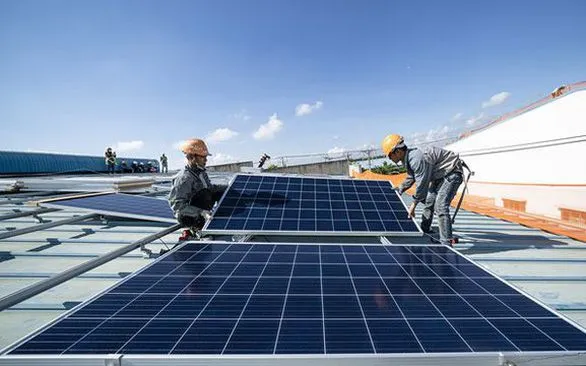
Rooftop solar power "shares the burden" with the national grid.
Extreme heat and "suffocating" pressure on the power grid.
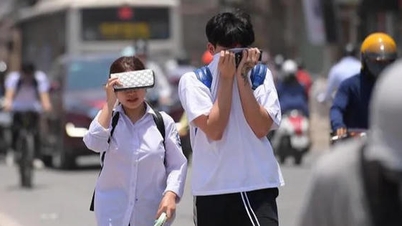
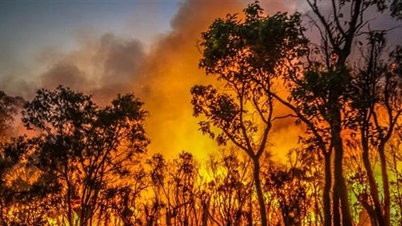
According to the National Center for Meteorological and Hydrological Forecasting, on May 25th, a severe and exceptionally intense heatwave will continue to cover a wide area. In areas from Thanh Hoa to Da Nang City and the eastern part of Quang Ngai province, the highest temperatures will generally range from 38-40 degrees Celsius, with some places exceeding 40 degrees Celsius. The heatwave will last from 9 AM to 6 PM.
The Northern region is also experiencing intense heat, with temperatures commonly ranging from 36-39 degrees Celsius. In Hanoi , the weather is dry and hot, with temperatures reaching 37-39 degrees Celsius, and some central areas approaching 40 degrees Celsius. Even at night, the air remains muggy at 29-32 degrees Celsius.
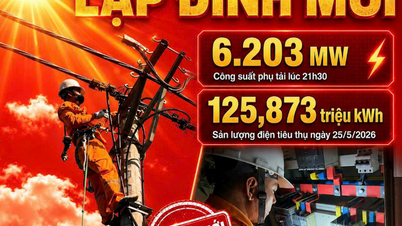
Extreme weather conditions are immediately reflected in energy consumption charts. The National Power System and Market Operator (NSMO) forecasts that the national power system's electricity consumption on May 25th will reach 1.136 billion kWh. Of this, the North will consume 581 million kWh, the Central region 106 million kWh, and the South 447 million kWh. Notably, the peak power demand of the national power system is expected to occur at 9:30 PM, reaching a massive 53,503 MW (with the North alone accounting for 27,960 MW).
To cope with this pressure and ensure there is no power shortage, NSMO had to issue orders to start up expensive oil-fired generating units. Specifically, the S1 and S2 O Mon I units (running on fuel oil) were connected to the grid before 7:00 AM on May 25th. Other backup oil-fired generating units such as S1-3, GT4-5 Thu Duc (DO), S4 Can Tho (FO), GT1-4 Can Tho (DO) are also in a state of readiness, continuously monitoring load developments to be mobilized at any time.
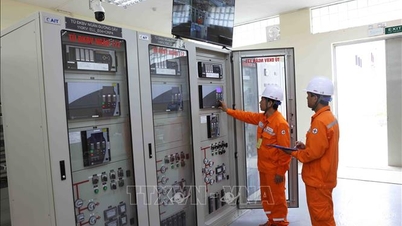
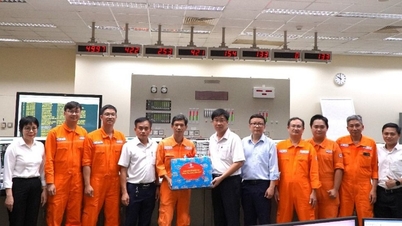
Alongside maximizing power generation, the Vietnam Electricity Group (EVN) has directed its power corporations to ensure safe and stable electricity supply. A principle EVN has set for the hot season is: Absolutely no power outages or reductions for repair or renovation work will be implemented on days with temperatures above 35 degrees Celsius (except in cases of force majeure). In addition, EVN encourages customers to use customer care applications to proactively monitor daily electricity consumption and promptly detect any unusual increases in output.
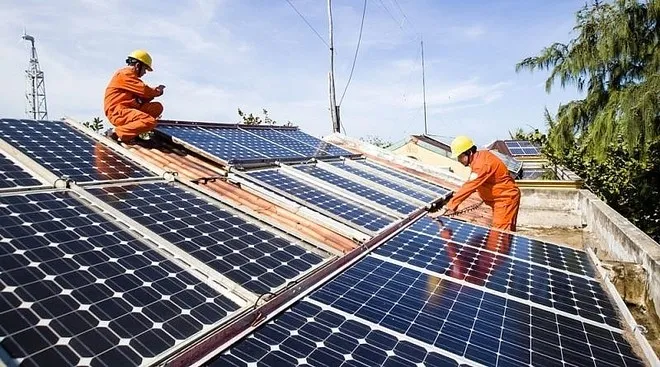
Renewable energy sources, especially rooftop solar power, are proving their immense value.
Rooftop solar power: A "green" and self-sufficient supply source.
According to forecasts, the heatwave in Northern and North Central Vietnam, lasting from May 23-27, will be extremely intense, pushing electricity demand even higher than the record-breaking heatwave in mid-May 2026. In the context of continuously reaching new peaks in electricity demand and the economy aiming for GDP growth above 10%, the pressure lies not only in safe operation but also in the challenges of supply and mobilization costs.
In this context, renewable energy sources, especially rooftop solar power, are proving their immense value. A report by NSMO shows that during peak periods of hot weather, solar power contributes 8-10% of the system's total mobilized capacity. Since the beginning of the dry season alone, rooftop solar power has been mobilized at an average rate of approximately 40-50 million kWh per day.
Looking back at May 15th – the day recording the highest electricity consumption in the history of the industry with 54,600 MW (equivalent to 1.152 billion kWh) – solar power contributed 8% of the output, of which nearly half (approximately 44 million kWh, equivalent to 3.8%) came from rooftop solar power.
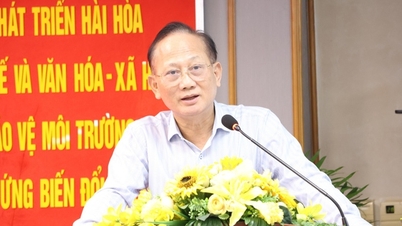
Analyzing the advantages of this power source, Mr. Nguyen Quoc Trung, Deputy General Director of NSMO, commented: "Rooftop solar power is a green energy source that contributes significantly to the environment and can be built extremely quickly. While a gas turbine thermal power plant takes 3 years or more to complete, a household-scale rooftop solar power system only takes about a week to put into operation."
Furthermore, in the context of geopolitical conflicts in the Middle East that are shaking the global energy market, rooftop solar power offers strategic autonomy. "The supply of rooftop solar power is not dependent on the world market. While fuel sources like coal, oil, and gas are strongly affected by international price fluctuations, driving up electricity production costs, rooftop solar power is completely immune to these shocks," Mr. Trung emphasized.
Energy expert Ha Dang Son, Director of the Center for Energy and Green Growth Research, assesses that the "duo" of electricity saving and rooftop solar power development (especially when combined with battery storage systems - BESS) is a key solution for the 2026-2027 period.
For households, hot weather means cooling devices like air conditioners have to work at full capacity. With the current progressive tiered electricity pricing system, high electricity consumption pushes bills to very high levels. "Installing self-sufficient solar power will help households cut through the high price tiers, thereby significantly reducing the pressure of monthly electricity costs," Mr. Son analyzed. For businesses, especially export businesses, rooftop solar power is not only a cost-saving solution but also a "passport" to enter the international market.
Currently, stringent technical barriers such as the Environmental-Social-Governance (ESG) standard or the European Carbon Border Adjustment Mechanism (CBAM) require businesses to demonstrate the source of clean energy. Partially self-sufficient in electricity from rooftop solar power makes it easier for businesses to demonstrate their efforts to green their supply chains.
To realize the goals set out in Prime Minister's Directive No. 10/CT-TTg dated March 30, 2026, on strengthening electricity saving (achieving at least 3% of total national electricity consumption this year; saving 10% during peak months) and developing rooftop solar power, the legal framework is being urgently finalized. One of the biggest bottlenecks for rooftop solar power in recent times, the mechanism for handling surplus electricity, is also being addressed.
Mr. Tran Hoai Trang, Deputy Director of the Electricity Department (Ministry of Industry and Trade), informed that the State management agency is continuing to study regulations on power system dispatch to manage and exploit rooftop solar power in a stable and sustainable manner.
In particular, the Ministry of Industry and Trade will soon propose policies to encourage the installation of battery storage systems (BESS) alongside rooftop solar power to increase system stability and the proactive power supply of rooftop solar power systems.
Source: https://vtv.vn/dien-mat-troi-mai-nha-chia-lua-cung-he-thong-quoc-gia-1002605251905164.htm




![[Photo] General Secretary and President To Lam presides over the meeting to approve the draft report on the results of the second inspection by the Politburo of the Standing Committee of the Hanoi City Party Committee.](https://vphoto.vietnam.vn/thumb/1200x675/vietnam/resource/IMAGE/2026/05/26/1779789811432_a2-bnd-4430-9620-jpg.webp)
























































































Comment (0)