


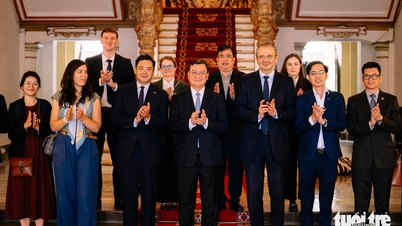
This was the content shared by experts at the "Ho Chi Minh City - South Korea Investment Cooperation and Business Networking Forum 2026," organized by the Ho Chi Minh City Trade and Investment Promotion Center (ITPC) in collaboration with the ASEAN-Korea Center (AKC) and the Trade Office of the Vietnamese Embassy in South Korea, on the afternoon of May 20th in Ho Chi Minh City.
According to Ms. Cao Thi Phi Van, Deputy Director of ITPC, after more than three decades of partnership, the Vietnam-Korea relationship is strongly shifting from traditional manufacturing cooperation to mastering future technology fields such as semiconductors, artificial intelligence (AI), digital finance, renewable energy, and global supply chains. In 2025, Ho Chi Minh City's economy is projected to grow by 8.03%; in the first quarter of 2026, it is expected to achieve a GRDP growth rate of 8.27%, the highest in many years. The city currently attracts 20,813 foreign investment projects with a total registered capital of over US$142 billion from 152 countries and territories; of which, South Korea ranks second in the number of projects with 3,349 projects, concentrated in the fields of processing and manufacturing, technology, trade, services, and logistics.
In this new phase, Ho Chi Minh City prioritizes attracting Korean businesses to invest in four key areas: developing an international financial center with digital banking and fintech sectors; developing an AI and semiconductor ecosystem; a startup and venture capital ecosystem; and smart cities and green growth. To meet these new growth targets, businesses in the city urgently need to expand their partnerships with Korean partners to participate more deeply in the supply chain, promote technology transfer, digital transformation, and green manufacturing development.

Mr. Jung Jung-tae, Consul General of South Korea in Ho Chi Minh City, stated that the leaders of both countries are aiming to increase bilateral trade to US$150 billion by 2030. Vietnam-Korea cooperation is also shifting from an export-centric model to a more balanced and sustainable approach through value chain linkages. Vietnam is not only a manufacturing hub but is emerging as an important partner in the global supply chain. Therefore, the forum is expected to create more substantive business connections and long-term cooperation opportunities for businesses in both countries.
Meanwhile, Mr. Kim Jae-shin, Secretary-General of the ASEAN-Korea Center, noted that Vietnam-Korea cooperation is entering a period of strong development. Vietnam is currently Korea's largest import and export partner in ASEAN; and is increasingly asserting its role as a new manufacturing hub in the region. Connecting and trade promotion activities will contribute to realizing the potential for cooperation and expanding opportunities for Vietnamese goods to penetrate deeper into the Korean market.
Mr. Kim Dae-young, Vice President of the Korea Importers Association (KOIMA), assessed that Vietnam has high competitiveness in the fields of electronics, information technology, textiles, agriculture , fisheries, and food industry. Currently, Vietnam has become South Korea's third largest trading partner globally. Vietnamese businesses need to increase their participation in trade promotion programs in South Korea, such as the Korea Import Expo, to update market demands, import standards, and international consumer trends, thereby expanding export markets more effectively.

Analyzing Vietnam's supply chain strategy, Mr. Bok Dug-Gyou, Representative of the Korea Trade-Investment Promotion Agency (KOTRA), stated that although FDI accounts for 73% of total export turnover, the domestic value-added ratio of Vietnam's manufacturing sector is currently only 12%, significantly lower than the ASEAN average of 33%. However, this also presents a large opportunity for domestic and foreign supporting industrial enterprises to participate more deeply in the value chain.
Mr. Bok Dug-Gyou believes that the efficiency of investment and business will be enhanced if investors leverage the specialized advantages of each region, such as the North developing high technology and automobiles; the Central region strong in agricultural and aquatic product processing and chemicals; and the South with advantages in textiles, footwear, and food processing. In addition, the expanding network of free trade agreements (FTAs) continues to create more competitive advantages for Vietnam in its strategy of restructuring global supply chains. Within the framework of the forum, Vietnamese and Korean businesses also participated in direct networking to seek partners, expand cooperation networks, and promote investment and trade projects in the future.
Source: https://baotintuc.vn/kinh-te/thuc-day-lien-ket-chuoi-cung-ung-viet-nam-han-quoc-20260520181006540.htm
![[Photo] Standing Committee member of the Party Central Committee Tran Cam Tu working with the Central Inspection Committee](https://vphoto.vietnam.vn/thumb/1200x675/vietnam/resource/IMAGE/2026/05/28/1779969579668_ndo_br_bnd-2495-jpg.webp)


























































Comment (0)