

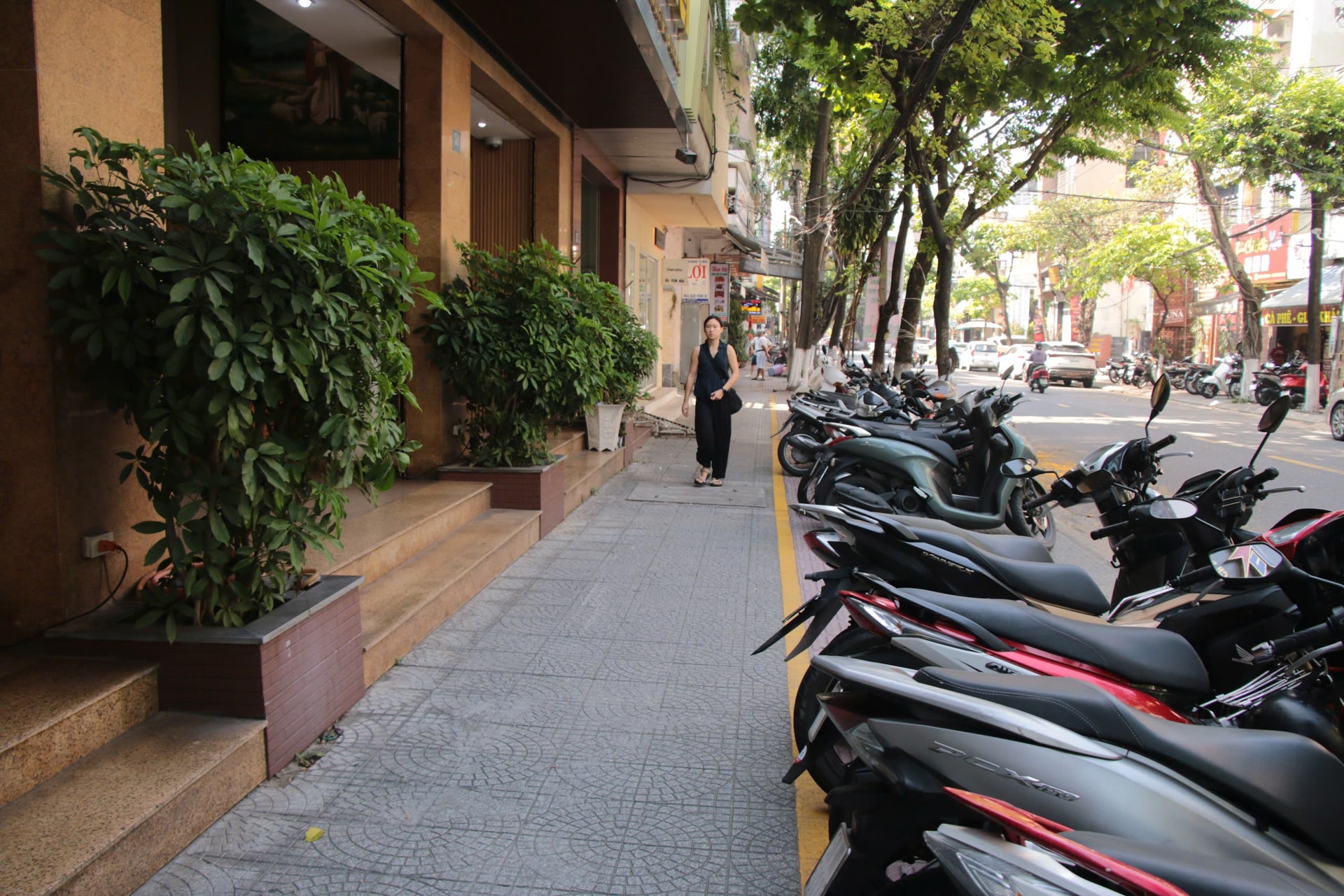
Ultimately, sidewalks in Vietnam have long ceased to be "exclusive walkways for pedestrians." Instead, they are a crossroads between state management and daily life, between urban planning and deeply ingrained habits spanning decades. Therefore, any efforts to restore order that merely focus on addressing violations are unlikely to create sustainable change.
A shift in urban management thinking.
In fact, the story of restoring order to sidewalks in Da Nang is not new.
In particular, from 2023 to the present, Da Nang has continuously issued decisions related to adjusting management and restoring urban order, focusing on further narrowing and standardizing sidewalk use, while also piloting and mobilizing citizens to participate in management.
In particular, Decision No. 81/2025/QD-UBND dated November 17, 2025 of the People's Committee of the city on the repeal of Decisions No. 55, 24 and 08 (2023) shows a clear shift in urban management thinking, from accepting and exploiting sidewalks as an economic resource to re-establishing sidewalks as truly public spaces.
In other words, this decision marks the end of the "sidewalk rental" model that has lasted for many years in Da Nang. From this, a new question arises: if there is no longer a mechanism to "legalize" the use of sidewalks for business purposes, how will the city manage this space to ensure urban order while avoiding major disruptions to the lives of residents, especially the poor?
Currently, one of the major bottlenecks lies in the overlapping management responsibilities. Sidewalks are part of the transportation infrastructure, but they are also linked to business activities, urban order, and the environment. When multiple agencies are involved in management but lack a single point of responsibility, the effectiveness of enforcement will be fragmented, and the integrity of the policy may even be undermined.
Even if the organizational structure is resolved, the core challenge remains livelihoods. In the past, social welfare policies of the government and various departments, agencies, and organizations, such as providing livelihood resources to poor and disadvantaged households, have used "sidewalk landmarks" as a free basis for supporting household economic development. This raises the question: when sidewalks on small, already crowded urban streets are reorganized, where will the sugarcane juice carts, bread stands, and other businesses of the poor go?
Transparency - Accountability - Flexibility
Not only Da Nang, but many cities around the world have faced the challenge of balancing urban order and the livelihoods of their residents.
In Tokyo, Japan, authorities allow small businesses to use a portion of the sidewalk during certain hours, provided they maintain cleanliness and do not obstruct pedestrians.
Similarly, in Barcelona (Spain), a "superblocks" model is implemented, zoning neighborhoods to prioritize pedestrians while still allocating reasonable space for small businesses. This policy helps reduce congestion, improve the quality of public spaces, and maintain the vibrant street economy.
International experience shows that effective sidewalk management models are based on three principles: transparency, accountability, and flexibility. Authorities do not use a single approach, but always place sidewalk management within the overall context of urban planning and socio-economic life.
More importantly, any policy, if it is to be implemented effectively, must be based on research data and real-life experiences. Surveying the needs for sidewalk use, assessing the impact on people's livelihoods, and monitoring the effectiveness after implementation will help the government make timely adjustments. In this way, sidewalk management will become a proactive and predictive operational process.
From this perspective, citizen participation is key. If citizens are merely "subjects to management," even the most reasonable policies will struggle to achieve sustainable effectiveness. Conversely, when they are involved in providing input, given opportunities to transition their livelihoods, or arranged suitable activities, consensus will become the foundation for maintaining long-term order.
This is also the expectation of many households whose livelihoods have rested on street vendors and small stalls on the sidewalks of Da Nang for many years. It's not difficult to find lives intertwined with every square meter of sidewalk. Each vendor and small stall is a part of the urban rhythm. Therefore, after the reorganization, the city needs to continue researching and arranging concentrated business areas, night markets, food streets, or controlled trading spaces so that sidewalks are restored to their proper function while still ensuring the operation of small businesses.
The ultimate measure of sidewalk order restoration lies not in the number of enforcement campaigns or the number of violations processed, but in whether the city can establish a stable urban order that citizens agree to and voluntarily maintain. At the same time, it is necessary to avoid repeating the "if you can't manage it, ban it" management mindset, and instead build flexible and transparent mechanisms that both ensure urban discipline and create conditions for the sustainable livelihoods of the people.
Source: https://baodanang.vn/thuoc-do-nang-luc-quan-tri-do-thi-3332125.html
![[Image] Nearly 125,000 Hanoi students completed the Literature exam for the 10th grade entrance exam.](https://vphoto.vietnam.vn/thumb/1200x675/vietnam/resource/IMAGE/2026/05/30/1780117233041_ndo_br_thiet-ke-chua-co-ten-2-png.webp)






























































































Comment (0)