

The boost from Resolution 57
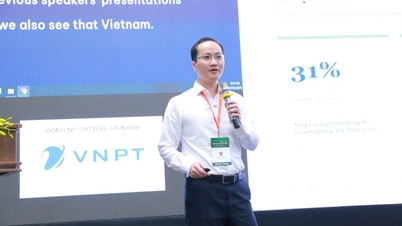
At the seminar "How has the commercialization of 5G impacted Vietnam's economy?" organized by the ICT Press Club on December 29th, Mr. Nguyen Quoc Khanh, Deputy Head of Technology Department, VNPT Group, shared: At the end of 2024, VNPT launched 5G, and in 2025, the group fulfilled its commitment to the Government to accelerate deployment so that by next year it will cover 55-60% of the population, prioritizing urban areas, industrial zones, ports, airports, etc.

According to Mr. Nguyen Tuan Huy, Deputy Head of Technology at MobiFone Corporation, MobiFone will also deploy 5G coverage in 2025, mainly in some industrial parks and urban areas. Although it is only in its initial stages, 5G has created a foundation for the digital economy , for new business models, and new digital solutions. Mr. Huy believes that in 2026, in line with the spirit of Resolution 57, 5G will truly experience a boom.
"For example, we are participating in the development of a smart city in Hanoi. The Smart City project will create many new business models for Hanoi in particular and the whole country in general in the future. Then there are examples of low-income businesses, using UAVs for delivery, and self-driving cars in new urban areas. Our country is currently implementing about 250 large-scale projects, some of which are very large, such as the 'super' Olympic urban area. We can absolutely implement a smart city from the initial steps of Smart City 3.0 based on data, real-time data, and automation models. We will strongly implement this in 2026," Mr. Huy shared.
At the seminar, Ms. Nguyen Ha Thanh – Deputy General Director of Viettel Telecom – stated: On December 22nd, Viettel was recognized by the Ministry of Science and Technology for exceeding its commitment to the Ministry and the Government regarding 5G deployment. By the end of December, Viettel had deployed 23,500 5G base stations in 2025 (in 2025 alone). With the 6,500 5G base stations deployed the previous year, Viettel now has 30,000 stations deployed. It is projected that Viettel will deploy an additional 15,000 stations in 2026. Thus, outdoor coverage has reached 90% and indoor coverage has reached 70%.

According to Ms. Ha Thanh, 5G infrastructure has been identified as a crucial strategic infrastructure by Resolution 57 of the Politburo and Resolution 03 of the Government. Therefore, Viettel has considered investing in 5G infrastructure as a guarantee for the nation's digital infrastructure. In the future, Viettel will continue to invest even more to truly become an infrastructure capable of creating a boom in 5G applications, serving not only the people but also the business community and the operational work of all levels of government...
According to Dr. Mai Liem Truc, former Permanent Deputy Minister of Post and Telecommunications, 5G deployment in Vietnam has exceeded expectations. Sharing this view, Mr. Nguyen Duy Lam, Senior Expert in Telecommunications Solutions at Huawei Vietnam, believes that 5G in Vietnam is progressing very rapidly and several applications have already been deployed.
When will 5G be widely commercialized in Vietnam?
According to a representative from Huawei Vietnam, globally, 5G deployment is divided into three main service groups: 5G to C (Consumer), 5G to home, and 5G to B (Business). Our development of e-commerce applications is also based on the experiences of other countries. This is the initial stage of adopting new technology. 2C applications are very easy to deploy; for example, users can use 5G for livestreaming. In China, the biggest contributor to data is streaming, livestreaming festivals and cultural events, so development in Vietnam is following a similar path to other countries.
Subsequent applications like 5G to B (smart city, factory) will take time. The development of 2B is more difficult because it requires the participation of businesses and government guidance. For 5G to B to develop strongly, it needs the participation of the entire society. If businesses are not enthusiastic or do not see immediate benefits, they will not participate. For example, the government provides guidance, the media promotes and highlights the benefits, influencing businesses to see the advantages. The consensus of the entire society is what will drive 5G, and it depends heavily on the policies of the government, network operators, and businesses.

Mr. Nguyen Anh Cuong, Deputy Director of the Telecommunications Department, Ministry of Science and Technology, emphasized that Vietnam has researched and issued a framework for digital infrastructure architecture. Most recently, this includes telecommunications and internet infrastructure (including fixed network infrastructure, 5G network infrastructure, and 4G network infrastructure), data infrastructure, data storage, and digital-physical infrastructure – IoT infrastructure. Government Resolution 57 sets the goal of rapidly deploying 5G nationwide. We highly appreciate the efforts of businesses in developing 5G.
According to Mr. Lam Thanh, General Director of TikTok Vietnam, 5G not only connects devices but also connects the dreams of farmers. When 5G is deployed nationwide, Vietnamese agricultural products will be able to reach further afield.
"Thanks to 5G, new business models have emerged. We went to Sin Ho and Sin Suoi Ho (Lai Chau province) and saw that ethnic minority people are very actively applying technology to sell their agricultural products. Previously, I thought that 5G applications were only strong in urban areas. In reality, 5G applications have changed traditional business methods to digital business, and in rural and remote areas, this has developed very strongly," Mr. Lam Thanh shared.
At the seminar, experts also argued that 5G development is not just a story about 5G technology alone, but also involves other platforms and technologies. Whether 5G commercialization is successful or not depends on businesses and end customers being willing to adapt alongside network operators, changing their organizations, investments, and business environment. Only then will it be successful.
Source: https://doanhnghiepvn.vn/kinh-te/thuong-mai-hoa-5g-khong-de-dang/20251229070643353



![[Photo] Standing Committee member of the Party Central Committee Tran Cam Tu working with the Central Inspection Committee](https://vphoto.vietnam.vn/thumb/1200x675/vietnam/resource/IMAGE/2026/05/28/1779969579668_ndo_br_bnd-2495-jpg.webp)

























































































Comment (0)