


Cu Lao Gieng Church. Photo: Hanh Chau
Cu Lao Gieng commune has 24 religious and spiritual sites such as Ba Le Pagoda, Tan My communal house, Duong family shrine, Nguyen clan shrine, etc. In addition, there is a unique complex of religious architecture such as Cu Lao Gieng Church, the Providence Monastery, the Franciscan Monastery, Thanh Hoa Pagoda, Phuoc Thanh Pagoda, Rach Sau Church… attracting many tourists for sightseeing and worship. Cu Lao Gieng commune also has traditional handicrafts, contributing to the diverse and rich tourism options for visitors. For a long time, travel agencies have developed interconnected tours in the region to promote tourism, such as combining spiritual and recreational tourism; visiting fruit orchards combined with outdoor activities; and community-based ecotourism combined with heritage tourism and cultural and festival tourism.
Located on the banks of the Tien River, the Cu Lao Gieng Church is an ancient architectural work commissioned by Father Gafignol (commonly known as Father Nho) in 1875, during the reign of Emperor Tu Duc. Building a large church on an island at that time was extremely difficult. Most of the building materials had to be imported from France. The construction was completed in 1887, during the reign of Emperor Dong Khanh. The Cu Lao Gieng Church features Romanesque architecture and is built on an area of 7,367 square meters. Nearly 140 years later, having weathered many historical upheavals, the Cu Lao Gieng Church remains almost intact. It can be said that this is also an ancient relic of the Catholic Church in Vietnam. According to old documents, this was the first church in Southern Vietnam, built 13 years before the Notre Dame Cathedral in Saigon.
Located approximately 1km from the Cù Lao Giêng Church is the Convent of Divine Providence, a French-style architectural structure situated in the middle of the island. Founded around 1874, it is one of the first three Catholic institutions built on Cù Lao Giêng, alongside the Cù Lao Giêng Church and the Franciscan Monastery. Here, visitors can admire the distinctive Romanesque architecture, evident in the arches, arched doorways, columns, and tall bell tower. The complex sits on approximately 7 hectares of land, surrounded by lush gardens, a lake, and ancient trees, creating a tranquil space, isolated from the hustle and bustle of the outside world. With its exceptional historical, architectural, and cultural value, the Convent of Divine Providence is not only a spiritual destination but also a part of the religious heritage of the Mekong Delta region.
The Franciscan Monastery, with its ancient and serene architecture spanning over 150 years, was built in the Gothic style: featuring pointed arches, numerous windows, and larger window sizes. In the late 19th century (1872-1946), the monastery served as a seminary for training priests for the Diocese of Phnom Penh, the seminary of the Southern region of Vietnam, encompassing the Mekong Delta provinces and Cambodia. In 1957, the facility was handed over to the Franciscan Order. The overall structure of the monastery consists of three symmetrical buildings forming a U-shape. The Franciscan Monastery is one of the attractive destinations for tourists visiting the Cu Lao Gieng area.
On this island, there is also the famous Phuoc Thanh Pagoda, also known as the Bird Pagoda, with its 9-story stupa, a unique architectural masterpiece of the Mekong Delta. Every year, this religious structure attracts many visitors from far and wide for sightseeing and worship. This pagoda is also recognized by Guinness Vietnam as having the largest statue of Amitabha Buddha (39m high) and 48 Bodhisattvas in the country. Phuoc Thanh Pagoda was initiated and built over 15 years by Venerable Thich Hue Tai (the pagoda's abbot). During holidays, festivals, and full moon days, a large number of visitors come to pay their respects.
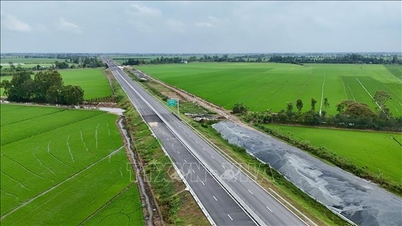
Tourism development here has always been a priority for the local authorities, through supportive policies, attracting investment, and encouraging tourism growth. Infrastructure investment, along with the new rural development program, has yielded initial results in transportation infrastructure construction (Tan My - My Luong bridge, paving rural roads, etc.), ensuring connectivity between waterway and road routes. Cu Lao Gieng is considered an attractive and convenient location in An Giang for international cruise lines to stop and bring tourists ashore on their journeys exploring the Mekong River from Saigon to Phnom Penh (Kingdom of Cambodia).
HANH CHAU
Source: https://baoangiang.com.vn/tiem-nang-du-lich-cua-cu-lao-gieng-a479220.html


![[Photo] Life on both banks of the river returns to its bustling pace on the day the Long Bien Bridge opens to traffic.](https://vphoto.vietnam.vn/thumb/1200x675/vietnam/resource/IMAGE/2026/05/28/1779949763708_cau-long-bien-minh-duy-7-3610-jpg.webp)

![[Image] Checking the security conditions at the exam site, ready for the 10th grade exam.](https://vphoto.vietnam.vn/thumb/1200x675/vietnam/resource/IMAGE/2026/05/28/1779943458889_z7872507660648-d764421a26e8cd7b61d70d142a48a685-jpg.webp)












![[Photo] Opening Ceremony of the National People's Council Conference on the Implementation of Directions and Tasks for the 2026-2031 Term](https://vphoto.vietnam.vn/thumb/1200x675/vietnam/resource/IMAGE/2026/05/28/1779939257690_ndo_br_bnd-1991-jpg.webp)














































Comment (0)