

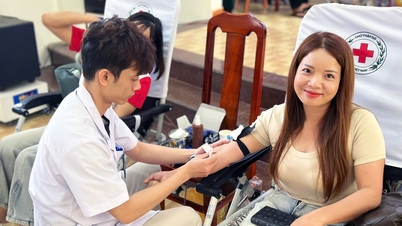
Attending the blood donation event, Associate Professor Dr. Dao Xuan Co, Director of Bach Mai Hospital, shared: "During the period leading up to the Lunar New Year, the demand for emergency care, accidents, and surgeries usually increases, while the supply of donated blood tends to decrease. 'Year-End Blood Donation 2026' helps replenish blood reserves, ensuring the hospital is not caught off guard in emergency situations and patients do not have to wait due to a shortage of blood for treatment. Blood is the 'flow of life' that cannot be produced by machines. Every unit of donated blood at the right time is a chance of survival for patients in emergency care, surgery, resuscitation, obstetrics, and cancer treatment."
Providing further information on advances in the treatment of malignant blood diseases (blood cancer), the head of the Hematology and Blood Transfusion Center at Bach Mai Hospital stated that many new methods have been and will be implemented. In particular, for diffuse large B-cell lymphoma, the hospital is aiming to master the entire CAR-T process (cell apheresis, bridging therapy, and post-transfusion resuscitation), giving refractory patients a greater chance of survival, even in their hometowns.
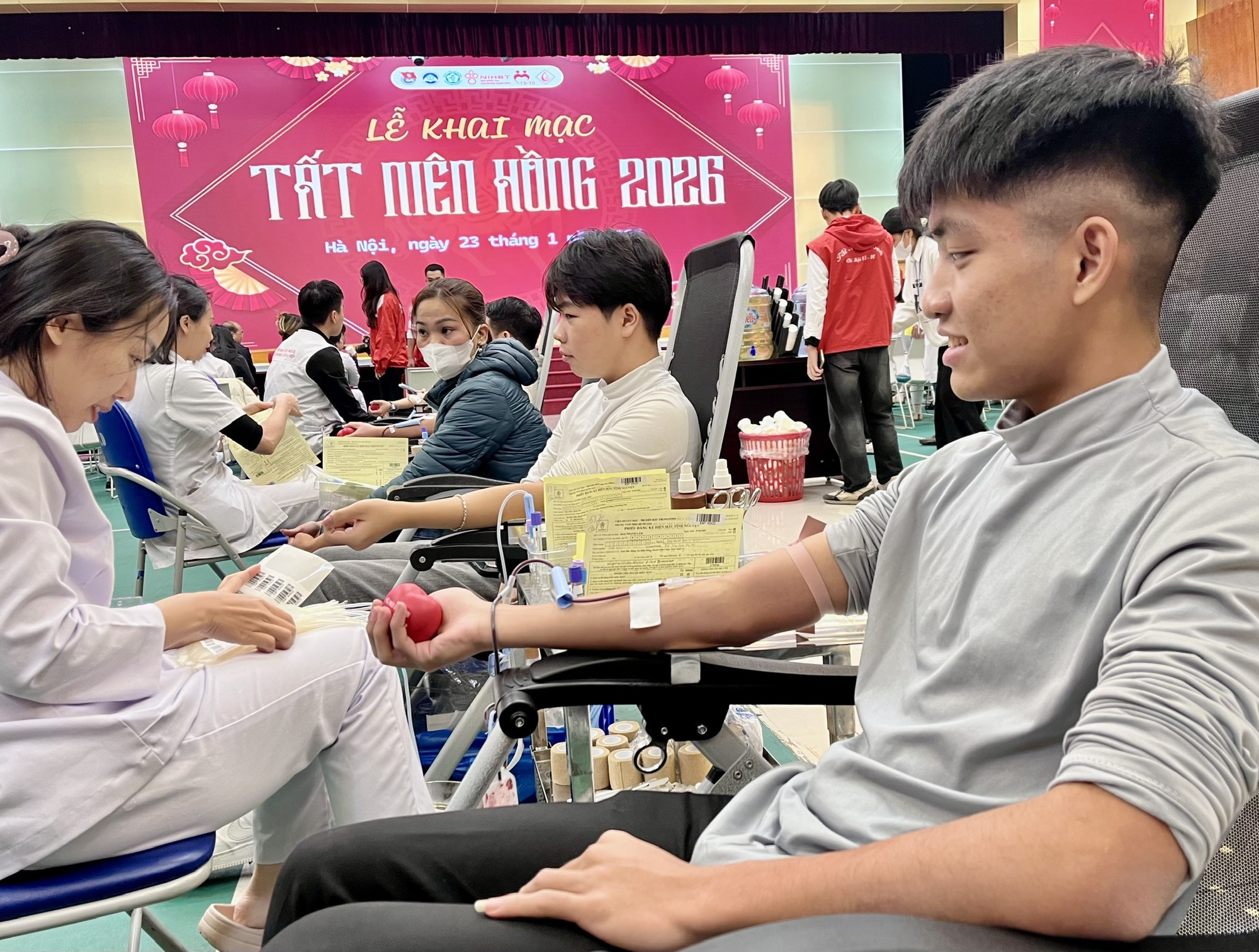
Each donated unit of blood offers a chance of survival for patients in emergency situations, surgery, intensive care, and cancer treatment.
PHOTO: LIEN CHAU
Recently, through professional cooperation between Bach Mai Hospital and Würzburg Hospital (Germany), a 61-year-old Vietnamese patient with diffuse large-cell B-cell lymphoma, resistant to various domestic treatment regimens, was treated with CAR-T therapy in Germany. The patient is now in complete remission and continues to be monitored at Bach Mai Hospital.
In Vietnam, approximately 3,500 new cases of diffuse large B-cell lymphoma are recorded annually. The number of patients with diffuse large B-cell lymphoma accounts for a significant proportion of malignant hematological diseases treated at Bach Mai Hospital. Despite advances in standard chemotherapy regimens, about 30-40% of patients still relapse or become refractory (do not respond or respond poorly to initial treatment).
Source: https://thanhnien.vn/tien-bo-moi-trong-dieu-tri-benh-mau-ac-tinh-185260124185728846.htm





















![[Video] Sunset at Lap An Lagoon – Where the sun sets over the fishing nets](https://vphoto.vietnam.vn/thumb/340x192/vietnam/resource/IMAGE/2026/05/31/1780192137701_beach-landscape-sea-water-nature-grass-745871-pxhere-com.jpeg)



![[Photo] The General Secretary, President and his wife lay flowers at the Ho Chi Minh Monument in Manila.](https://vphoto.vietnam.vn/thumb/1200x675/vietnam/resource/IMAGE/2026/05/31/1780219759477_anh-man-hinh-2026-05-31-luc-16-29-07.png)





























































Comment (0)