

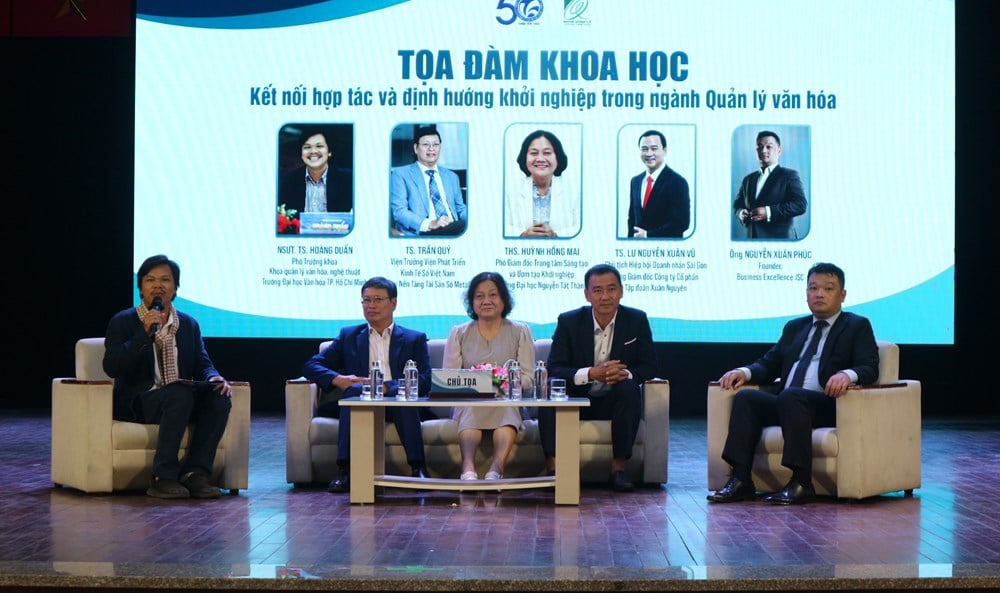
Taking place amidst the strong development of digital transformation and the creative economy , the seminar focused on discussing the new demands placed on the cultural management sector, from management thinking and models for organizing cultural activities to the orientation of human resource training.
"Living laboratory"
Dr. Vu Thi Phuong, Head of the Department of Cultural and Arts Management, emphasized that training and professional practice in the cultural field are at a critical juncture. On the one hand, cultural institutions must innovate their operating models, strengthen their management capacity, and improve the quality of public and cultural services. On the other hand, the creative cultural industry market is rapidly shifting towards digitalization, personalized experiences, and competition based on data, technology, and product design.
According to Dr. Phuong, if training continues to follow a purely academic model, detached from the market, students will lack practical skills; conversely, if it only chases trends, it will weaken the academic foundation and professional identity. Based on this reality, the Faculty has identified two pillars of action: Promoting sustainable cooperation in depth according to the "three-party" model (state - school - enterprise), with operational design and results measurement; and simultaneously creating an entrepreneurial orientation and dual competencies for students in cultural management.
In this model, collaboration goes beyond signing agreements or short-term internships, aiming to jointly identify problems, co-design project modules, implement them in the field, and evaluate outcomes. Cultural institutions and businesses are seen as "living laboratories," where students participate in real projects with quality standards and professional responsibility. For entrepreneurship, students need a solid foundation in culture and arts, along with skills in project management, product development, basic finance, digital communication, and data-driven thinking.
The Faculty of Cultural and Arts Management also proposed a direction for building a creative incubator model, centered around practical projects, linking training with applied products and suitable commercialization potential.
Cultivating an innovative mindset
Speaking at the seminar, Ms. Phan Thi Quy Truc, Deputy Head of the Technology Management Department (Ho Chi Minh City Department of Science and Technology), stated that startups in the cultural sector have distinct characteristics compared to conventional businesses. While traditional business products are primarily measured by their utility, revenue, and profit, cultural and artistic products first and foremost create cultural value, with two core layers of value: intrinsic value and instrumental value.
In this context, intrinsic value lies in artistic significance, identity, tradition, and creativity, existing independently of commercialization potential and being difficult to quantify or value according to conventional intellectual property criteria. Instrumental value reflects economic and social impact, public reach, revenue generation potential, promotion of tourism and related industries, but serves as a complement to the core cultural value.
According to Ms. Truc, the major challenges facing cultural startups today are insufficient awareness of their potential, policy barriers, limitations in branding, distribution, and intellectual property knowledge, and the mindset of artists who are less interested in business. In this context, the university startup model needs to be viewed as an open ecosystem, not confined to the "three stakeholders" but expanding to include investors, intermediary organizations, and international networks.
The entrepreneurial university model not simply encourages students to start businesses early, but more importantly, it aims to cultivate innovative thinking, project organization skills, career development paths, and the ability to connect knowledge with the market. For the cultural and artistic fields, this model needs to adapt to a smaller scale, focusing on preserving and promoting cultural values while supporting intellectual property. The university should act as an "interpreter" between art and business, and as a center for incubating and connecting social resources to form sustainable, innovative businesses.
Ms. Huynh Hong Mai, Deputy Director of the Innovation and Startup Incubation Center at Nguyen Tat Thanh University, emphasized an open, innovative approach to entrepreneurship linked to the sustainable commercialization of cultural heritage. Innovation does not mean replacing or destroying traditional values, but rather comprehensively and cyclically exploiting natural and cultural resources, ensuring the long-term continuity of heritage.
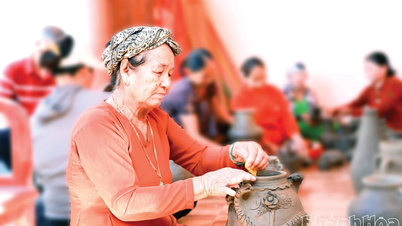
Based on her experience in training and incubating startups, Ms. Mai believes that cultural entrepreneurship needs to begin with awareness education , helping students understand that creative entrepreneurship is not just about ideas or products, but also about creating value for society through suitable business models that preserve Vietnamese cultural identity, traditional crafts, and cultural spaces. Startup projects can range from material recycling, handicraft design, and bio-product development, to combining tourism with performing arts and heritage cuisine.
She also emphasized the role of schools in building a safe entrepreneurial environment, equipping students with foundational knowledge in finance, digital transformation, management, and interdisciplinary ecosystem connections, instead of leaving them to "fend for themselves"...
From various perspectives, the seminar revealed that the picture of cultural entrepreneurship is no longer an isolated story of individuals or training institutions, but rather a multi-dimensional process of collaboration between schools, businesses, managers, investors, the technology sector, and social organizations, aiming towards a creative ecosystem linked to cultural identity and development requirements in the digital age.
Source: https://baovanhoa.vn/van-hoa/tim-mo-hinh-khoi-nghiep-quan-ly-van-hoa-189873.html



![[Photo] Standing Committee member of the Party Central Committee Tran Cam Tu working with the Central Inspection Committee](https://vphoto.vietnam.vn/thumb/1200x675/vietnam/resource/IMAGE/2026/05/28/1779969579668_ndo_br_bnd-2495-jpg.webp)
































































Comment (0)