
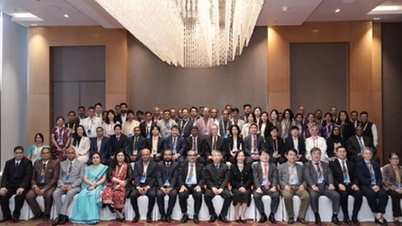
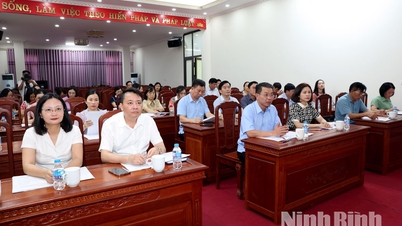
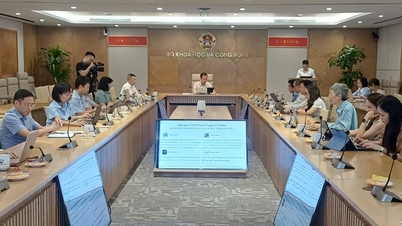
The delegates attending the workshop.
On May 20th, the Vietnam National University Ho Chi Minh City, in collaboration with the Regional Political Academy II and the Ho Chi Minh National Political Academy, organized a workshop on "Talent Visas and Policies to Attract High-Quality Human Resources for National Development."
Members of the Central Committee of the Party included: Ngo Dong Hai, Deputy Head of the Central Propaganda and Mass Mobilization Department; Le Hai Binh, Permanent Deputy Director of the Ho Chi Minh National Political Academy; Nguyen Thi Thanh Mai, Director of the Vietnam National University Ho Chi Minh City, along with experts and scientists .
The talent attraction policy lacks innovation.
In his opening remarks and guidance for the workshop, Comrade Ngo Dong Hai, Deputy Head of the Central Propaganda and Mass Mobilization Department, emphasized that in recent years, the Party and the State have implemented many sound policies on attracting and utilizing talent.

Comrade Ngo Dong Hai, Deputy Head of the Central Propaganda and Mass Mobilization Department, delivered a speech at the workshop.
However, the policies remain fragmented, lacking innovation, flexibility, and convenience, and do not include specific mechanisms regarding residency, employment, finance, and long-term livelihoods for international experts.
The working environment and compensation are not yet truly competitive internationally. The talent attraction ecosystem is not yet synchronized: the linkages between the State, businesses, research institutes, and universities are still limited. There is a lack of leading innovation centers, and regional and global talent hubs have not yet been formed.
Following that, Comrade Ngo Dong Hai suggested that the workshop focus on discussing and clarifying the theoretical and practical foundations of talent recruitment policies in the new context.
Conduct a scientific and comprehensive study of the experiences of pioneering countries such as Singapore, China, South Korea, and India to draw lessons and design policies, organize implementation, and build a talent ecosystem, finding a superior, open, and suitable talent visa model for Vietnam's institutional characteristics.
Propose models and policies suitable for Vietnam that shift from an "attracting" mindset to a "globally competitive" approach to talent, designing a flexible and competitive talent visa mechanism; and piloting specific regions and models. In doing so, boldly place businesses and markets at the center of the talent ecosystem.

Experts contributed their opinions at the workshop.
At the same time, a breakthrough solution is proposed. This includes building an innovation ecosystem such as "innovation clusters" and "talent cities" linked to major university centers like the Vietnam National University Ho Chi Minh City in training, connecting, and retaining talent…
Building an ecosystem to attract talent.
Professor, Dr. Nguyen Thi Thanh Mai, Director of the Vietnam National University Ho Chi Minh City, argues that talent visas should not be viewed simply as an immigration policy or an administrative procedure, but rather as a strategic tool in national competition for talent.
At the same time, "it is a gateway for Vietnam to connect with the global flow of knowledge; it is an institutional signal demonstrating the country's readiness to welcome, value, and create favorable conditions for talented people," Professor, Dr. Nguyen Thi Thanh Mai emphasized.

Professor, Dr. Nguyen Thi Thanh Mai, Director of the Vietnam National University Ho Chi Minh City, delivered a speech at the conference.
According to the Director of the Vietnam National University Ho Chi Minh City, based on international experience, many successful countries attract talent not only through financial incentives but also through a comprehensive ecosystem including flexible visa mechanisms, an open academic environment, modern research infrastructure, opportunities for entrepreneurship and commercialization, family benefits, and an attractive quality of life.
The current trend is not just about training human resources, but is shifting to managing the entire talent flow, from identification, attraction, mobility, circulation, retention, to developing high-quality resources.
To ensure the workshop is of high quality and delivers practical benefits, according to Comrade Le Hai Binh, Permanent Deputy Director of the Ho Chi Minh National Academy of Politics, experts and scientists should focus their discussions on training and developing high-quality human resources in line with the country's development requirements in the new era; talent visa policies; and building an ecosystem to attract and utilize talent…
Regarding talent visa policies, Comrade Le Hai Binh raised the issue that, in the context of increasingly fierce global competition for talent, many countries are using talent visas as a strategic tool.
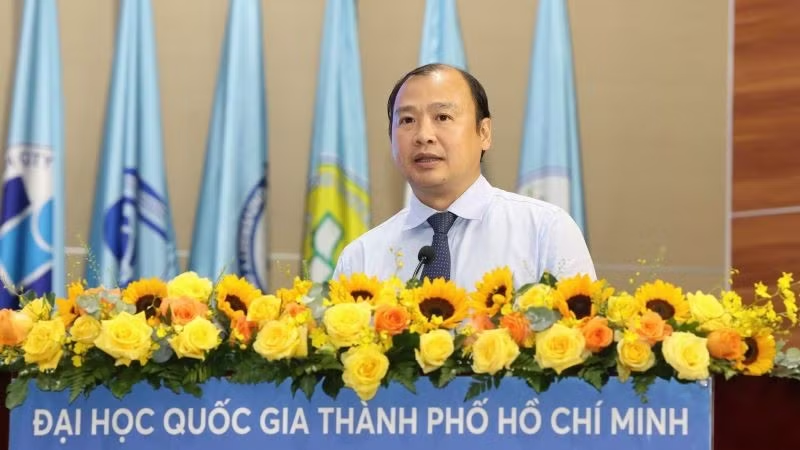
Comrade Le Hai Binh, Permanent Deputy Director of the Ho Chi Minh National Academy of Politics, delivered a speech at the seminar.
Which visa model should Vietnam choose? A thorough analysis of Vietnam's talent visa policy is needed to identify its strengths, weaknesses, opportunities, and challenges. What is the gap between the design and implementation of the current talent visa policy, and what are the solutions to bridge that gap?
Within the framework of the program, Ho Chi Minh City National University and the Regional Political Academy II signed a strategic cooperation agreement to strengthen the connection between theory and practice, between political science and science and technology, management and innovation; and to expand cooperation in interdisciplinary training, research and policy advice serving the sustainable development of the Southeast region and the whole country.
CAO TAN
Source: https://nhandan.vn/tim-mo-hinh-thu-hut-nhan-tai-trong-boi-canh-moi-post963430.html




![[Image] Close-up view of the interchange connecting the two expressways and Long Thanh Airport.](https://vphoto.vietnam.vn/thumb/1200x675/vietnam/resource/IMAGE/2026/05/25/1779703378210_ndo_br_z7863716673926-224453a31600126cce10622af6290afd-4549-jpg.webp)


![[Image] Hanoi's urban life under the challenge of a "scorching hot" environment](https://vphoto.vietnam.vn/thumb/1200x675/vietnam/resource/IMAGE/2026/05/25/1779706979265_nang-nong-t5-2026-minh-duy-7-4636-jpg.webp)

































































Comment (0)