

Grief and sorrow over losing his mother, his eyes went blind.
Despite his refined appearance, his patriotic spirit was unmatched. According to the Nguyen family genealogy , Nguyen Dinh Chieu (1822 - 1888), whose given name was Manh Trach and pen name was Trong Phu, later adopted the pen name Hoi Trai (the dark house) after his eyesight deteriorated. Nguyen Dinh Chieu's family history is recorded in Phan Van Hum's work, *The Heartache of Nguyen Dinh Chieu*, which states that his father, Nguyen Dinh Huy, had a wife in Bo Dien village named Pham Thi Huu. Later, he went south to work as a clerk in the Gia Dinh Governor-General's office of Le Van Duyet, where he married Truong Thi Thiet and had four sons and three daughters. The eldest son of Huy and Thiet was the scholar, physician, and patriot Nguyen Dinh Chieu.
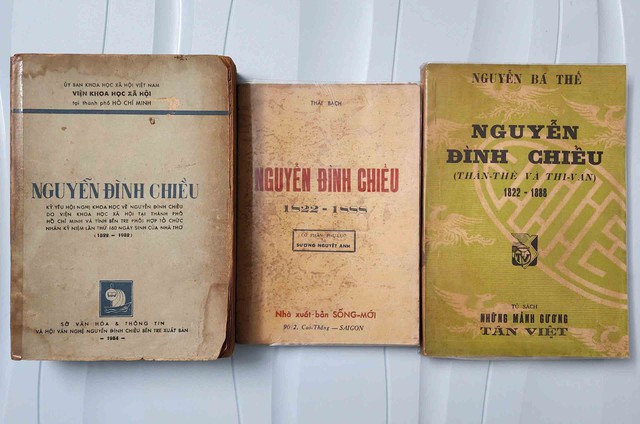
From left to right: Proceedings of the Nguyen Dinh Chieu Conference (1984) and two works about Nguyen Dinh Chieu, both printed in 1957.
PHOTO: TRAN DINH BA
In the year of Nhâm Thìn (1832), Governor-General Lê Văn Duyệt died, and Lê Văn Khôi caused a rebellion in Phiên An. Nguyễn Đình Chiểu was sent to Huế by his father to study. In the year of Tân Sửu (1841), he returned to Saigon and two years later participated in the Hương examination in Gia Định and passed. In the year of Đinh Mùi (1847), he went to Huế to prepare for the Hội examination. But then, as famous people of Southern Vietnam recorded, "suddenly a bolt of lightning struck, shattering the heart of the scholar and destroying his great dream of returning home in glory to repay the kindness of his parents." The news arrived from Đồng Nai by boat. It was that his mother had passed away on the 15th day of the 11th lunar month of the previous year (Mậu Thân, 1848) and had been buried in Tâm Triêm ward (now Cầu Kho). Chiểu then returned to the South with his younger brother, abandoning his academic pursuits.
He had to abandon his dreams of fame and fortune to fulfill his filial duty, but the grief over the loss of his mother caused him to weep so much that he developed an eye ailment and had to stay at the home of a traditional healer in Quang Nam for treatment. However, his eyes could not be cured, and he became blind at the young age of 27. This family tragedy left him unable to fulfill his filial duty and establish himself. Furthermore, a wealthy local man who had promised to marry his daughter to him broke off the engagement upon learning of his illness. So much sorrow overwhelmed him at once. Even so, true to his own words, he believed, "better to be blind than to uphold family values." Since this turbulent period in his life, the name Nguyen Dinh Chieu has not only been known in the six southern provinces of Vietnam, but has also been passed down through generations as an admiration for his talent, virtue, and patriotism.
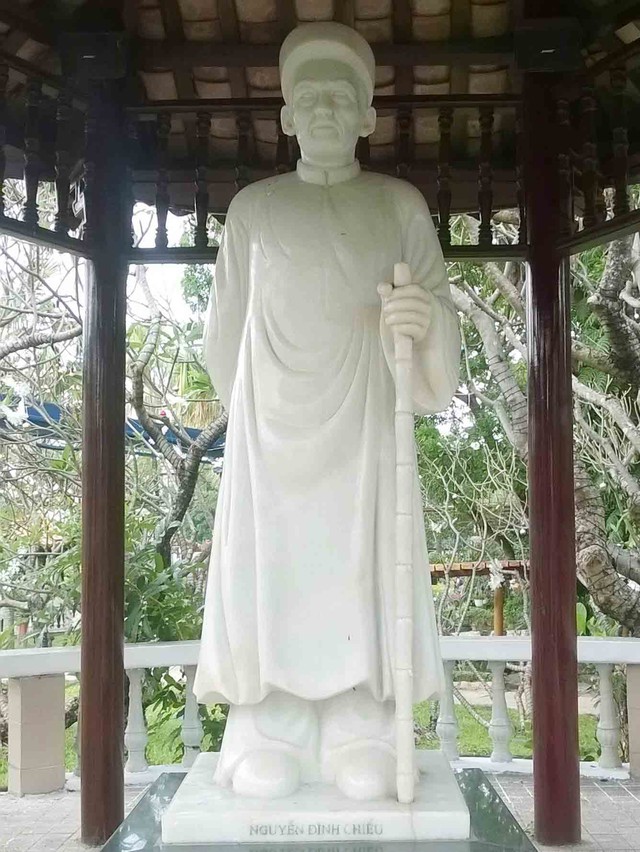
Statue of Nguyen Dinh Chieu in Dam Sen Tourist Park, Ho Chi Minh City.
PHOTO: TRAN DINH BA
Reject all material incentives.
His dreams of fame and fortune were shattered, his personal life was broken, but Nguyen Dinh Chieu overcame all adversity, pursuing the path of medicine to heal people. Then, around the year Canh Tuat (1850), he opened a school and began writing poetry and prose, which later became sharp weapons in the literary and ideological struggle. "Blind yet he taught sighted people. Blind yet he cured sighted people of their illnesses. Blind yet he wrote poetry, moreover, very long narrative poems. Blind yet he served as a strategist for the rebel army of Truong Dinh and Phan Tong. Blind yet he did not let the 'green eyes' of the French colonialists, even though they were watching him and wanted to bribe him, could not. Alas! His blindness was not an ordinary blindness," Hoang Trung Thong praised Chieu in his article "The Eyes of Nguyen Dinh Chieu" .
In the year of Mau Ngo (1858), the French army invaded the country. The following year, Gia Dinh citadel was captured, causing the scene of "Ben Nghe's wealth vanishing like foam on the water / Dong Nai's tiled roofs stained with clouds" (from the poem "Running from the Enemy "). Nguyen Dinh Chieu had to flee to his wife's hometown in Thanh Ba, Phuoc Loc district, Gia Dinh (i.e., Can Giuoc). In the year of Nham Tuat (1862), the Franco-Vietnamese Treaty was signed, and the three eastern provinces of Southern Vietnam (Bien Hoa, Gia Dinh, and Dinh Tuong) fell into French hands. Nguyen Dinh Chieu "sought refuge" in the still-free area of Ba Tri to live, resolutely refusing to cooperate with foreign powers. Then, the three western provinces were also occupied by the French in the year of Dinh Mao (1867), forcing him to move to An Binh Dong.
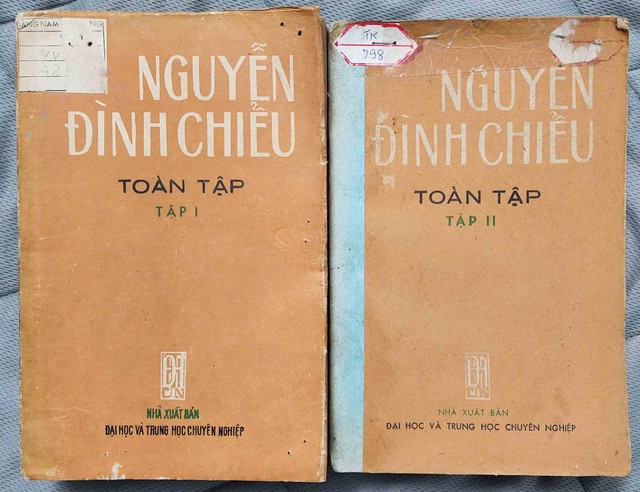
The complete works of Nguyen Dinh Chieu were published in 1980.
PHOTO: TRAN DINH BA
Knowing he was a patriotic poet with great influence among the people, the colonial government tried every means to bribe him. But "Better to be blind in front of one's eyes than to sit and watch the enemy and friend" (Excerpt from Fisherman and Woodcutter's Medical Questions and Answers ), he resolutely refused to cooperate with the French, living a life of integrity and rejecting all fame and fortune. Evidence of this spirit can be seen in some examples from Professor Tran Van Giau's article "Nguyen Dinh Chieu: The Way of Being Human" in the Proceedings of the scientific conference on Nguyen Dinh Chieu commemorating the 160th anniversary of the poet's birth (1822-1982): "The governor of Ponchon invited Nguyen Dinh Chieu to Ben Tre. The scholar feigned illness and did not go. The French offered to send him money as royalties for the translation of Luc Van Tien into French, but he resolutely refused, even though money was not something he could easily afford. The French wanted to return his land in Saigon that they had confiscated since he left for the resistance. He said: 'If even the king's land can be lost, what about my land?'"
The character and conduct of the patriotic poet earned the respect of even Michel Ponchon, the then governor of Ben Tre province: "Truly, the gentleman was a man of exceptionally noble and humble spirit..." "Furthermore, the gentleman refused all monetary gifts and considered life completely satisfying with the contentment of his family." (to be continued)
Source: https://thanhnien.vn/tinh-tu-dat-viet-tha-dui-ma-giu-dao-nha-18525121723345749.htm


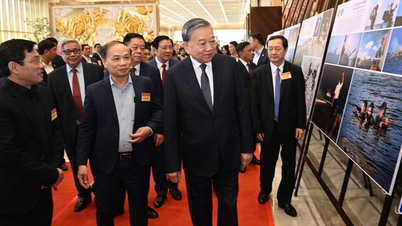
![[Photo] General Secretary To Lam visits the exhibition space showcasing books, photo exhibitions, and achievements of digital transformation in journalism.](/_next/image?url=https%3A%2F%2Fvphoto.vietnam.vn%2Fthumb%2F1200x675%2Fvietnam%2Fresource%2FIMAGE%2F2025%2F12%2F19%2F1766110879215_1766110240024-jpg.webp&w=3840&q=75)
![[Photo] Enchanting ancient rose garden on the mountainside in Nghe An](/_next/image?url=https%3A%2F%2Fvphoto.vietnam.vn%2Fthumb%2F1200x675%2Fvietnam%2Fresource%2FIMAGE%2F2025%2F12%2F19%2F1766109900916_vuon-hong-chin-do-thu-hut-du-khach-toi-check-in-o-ha-noi-3-20162778-1671624890024-1671624890104198100259.jpeg&w=3840&q=75)





















![[INFOGRAPHIC] Overview of the Hoa Phat Dung Quat Rail and Special Steel Production Plant Project](https://vphoto.vietnam.vn/thumb/402x226/vietnam/resource/IMAGE/2025/12/19/1766111183203_z7339170069817-126a3e5a095f62e606a0be41015c1b80.jpeg)






































Comment (0)