

Explaining the debates surrounding the poem "The Sound of Germinating Seeds" by Tô Hà
Speaking with a reporter from Dan Viet newspaper, Associate Professor Dr. Bui Manh Hung, Chief Coordinator of the 2018 General Education Curriculum Development Board and General Editor of the Vietnamese Language and Literature textbooks in the "Connecting Knowledge with Life" series, said: "Recently, there have been conflicting opinions on social media regarding the poem 'The Sound of Germinating Seeds' by author To Ha, which was used as reading material in Lesson 5, themed 'The World of Childhood,' in the Vietnamese Language 5 textbook, part of the 'Connecting Knowledge with Life' series."

Assoc. Prof. Dr. Bui Manh Hung, Principal Coordinator of the 2018 General Education Curriculum Development Board, General Editor of the Vietnamese Language and Literature textbooks in the "Connecting Knowledge with Life" series. Photo: Provided by the author.
The opinions mainly focused on certain words considered strange and difficult, especially the word "ánh ỏi" (loud/noisy); the rhyming scheme seemed awkward, difficult to read and remember; and the content was vague and abstract. These opinions may stem from the following reasons:
1. Reading the poem hastily, without fully understanding the work, and then judging it prematurely (possibly due to the influence of the "crowd").
2. Outdated notions about poetry, especially poetry used in textbooks. According to many, poetry must have strict rhyme, and if it rhymes, it must be a perfect rhyme; poetry used for teaching must be easy to read and understand, and its content must be clear.
3. Outdated views on education. Many people only want today's students to learn the poems they learned in the past, regardless of the fact that many things have changed today, for example, students now prefer different types of music , and their tastes in clothing, food, etc., have also changed.
4. Education and reading comprehension skills, especially the ability to appreciate poetry, are very limited. Many opinions indicate that participants in the exchange have very poor Vietnamese skills, writing short sentences with numerous spelling and grammatical errors. They may have never encountered the word "ánh ỏi" (which is not unusual), but when they do, they lack the habit of looking it up in a dictionary. They confuse Tô Hà with Tô Hoài, fail to understand the basic content of the poem, and confuse the target audience of students who studied the poem (normal students) with the students mentioned in the poem (hearing-impaired students).
Fortunately and thankfully, many opinions have promptly affirmed the unique value of the poem, with some even providing the public with useful information about To Ha, a poet who is meticulous in his craft and possesses a respectable character. These opinions all praised To Ha's "The Sound of Germinating Seeds" as a remarkable, humane, and highly creative poem; primary education experts and teachers even stated that the poem is perfectly suitable for fifth-grade students.
Regarding the most controversial word "ánh ỏi" (meaning "shrill" or "loud"), Associate Professor Bui Manh Hung explained: "In the phrase 'The golden sunlight shines brightly,' there is a shift in sensory perception between hearing and seeing, creating a bright space filled with light and sound. The word 'ánh ỏi' refers both to the loud, clear sound and to the space full of light surrounding those sounds. 'Ánh ỏi' contains both 'inh ỏi' (loud/noisy), 'rộn ràng' (lively/bustling), and 'lấp lánh' (sparkling/glittering). Words in poetry always have a creative quality. A poet can create new words or combine new words to simultaneously express both the objective characteristics of an object and their subjective impressions and emotions about that object."
For fifth-grade students, teachers don't need to delve deeply into the creative use of words by the poet. However, introducing students to this creativity will help them understand poetry better, so that in higher grades, they can independently analyze the secrets behind how a poem, despite its ordinary and easily understandable content, can evoke special aesthetic pleasure in the reader.
The reading comprehension questions immediately below the text provide information about the events depicted in the poem; therefore, there is no need to add the context of its creation to the textbook, as some have suggested. If readers were to see this system of reading comprehension questions, they would surely agree with the opinions of primary education experts and teachers regarding the appropriateness of this poem for learners."
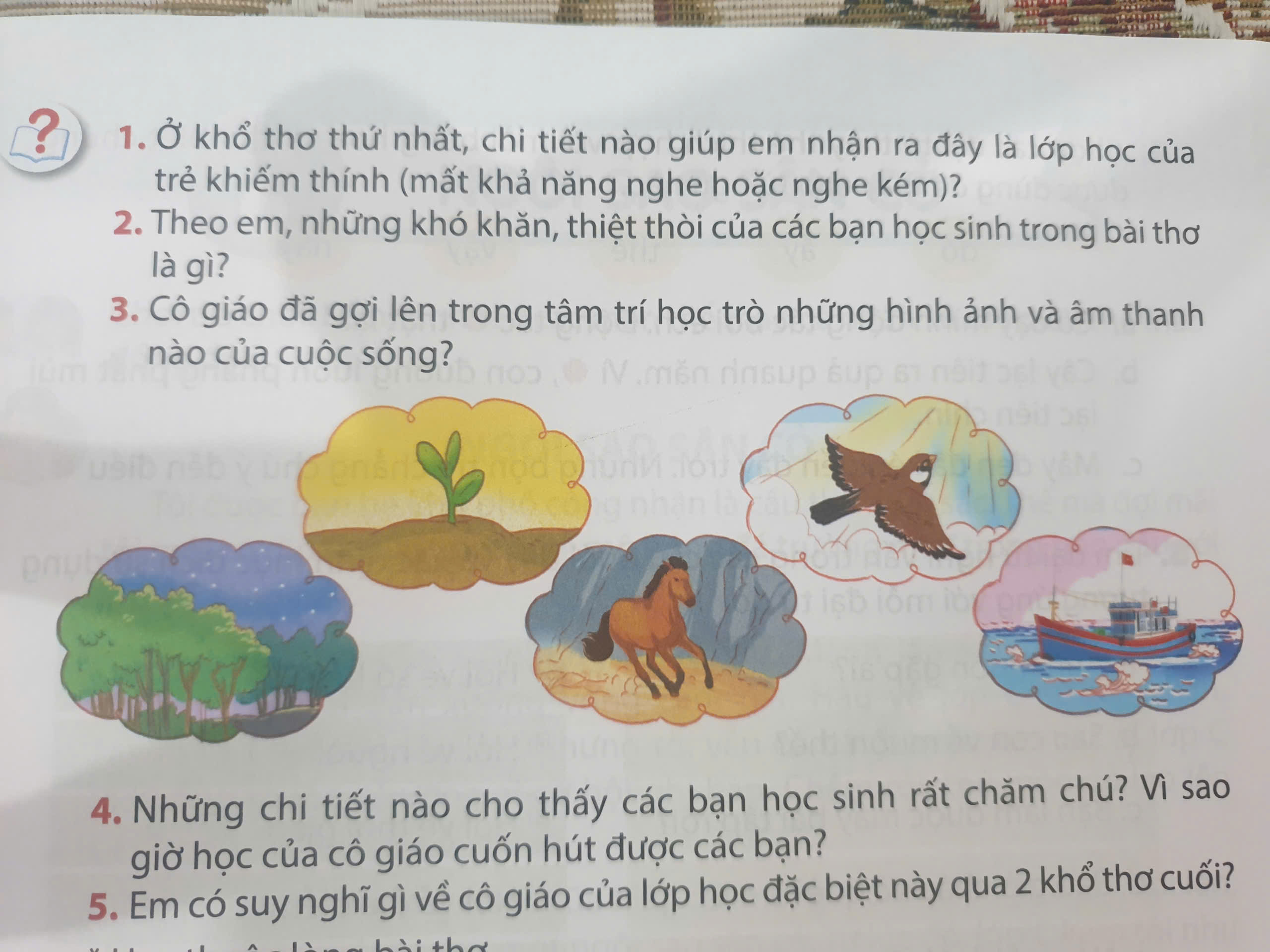
To organize the teaching of this poem, the textbook designs a system of questions for teachers and students below the reading text, reflecting the requirements for reading comprehension of this poem for 5th graders. Photo: CMH
What can we learn from this debate?
From this debate, Associate Professor Bui Manh Hung shared two issues that deserve attention.
"Firstly: Reforming the curriculum and textbooks is an extremely difficult and arduous journey. Writing textbooks is a very 'risky' task in the current context."
For Vietnamese language and literature textbooks, the main problem stems from the source material. A poem with humanistic content, expressed through distinctive and carefully selected poetic words and imagery by a renowned and respected poet, can still be severely criticized. If that's the case, then many other literary works in textbooks are likely to become victims of social media criticism. A complete Vietnamese language and literature textbook series from grades 1 to 12, like the "Connecting Knowledge with Life" series, contains approximately 600 reading texts (works, excerpts), not including hundreds of texts selected as reference materials for the Writing Practice section and hundreds of short passages used as source material for the Vietnamese Language Practice section. Just a few texts, usually literary texts, with differing opinions can easily create a public outcry.
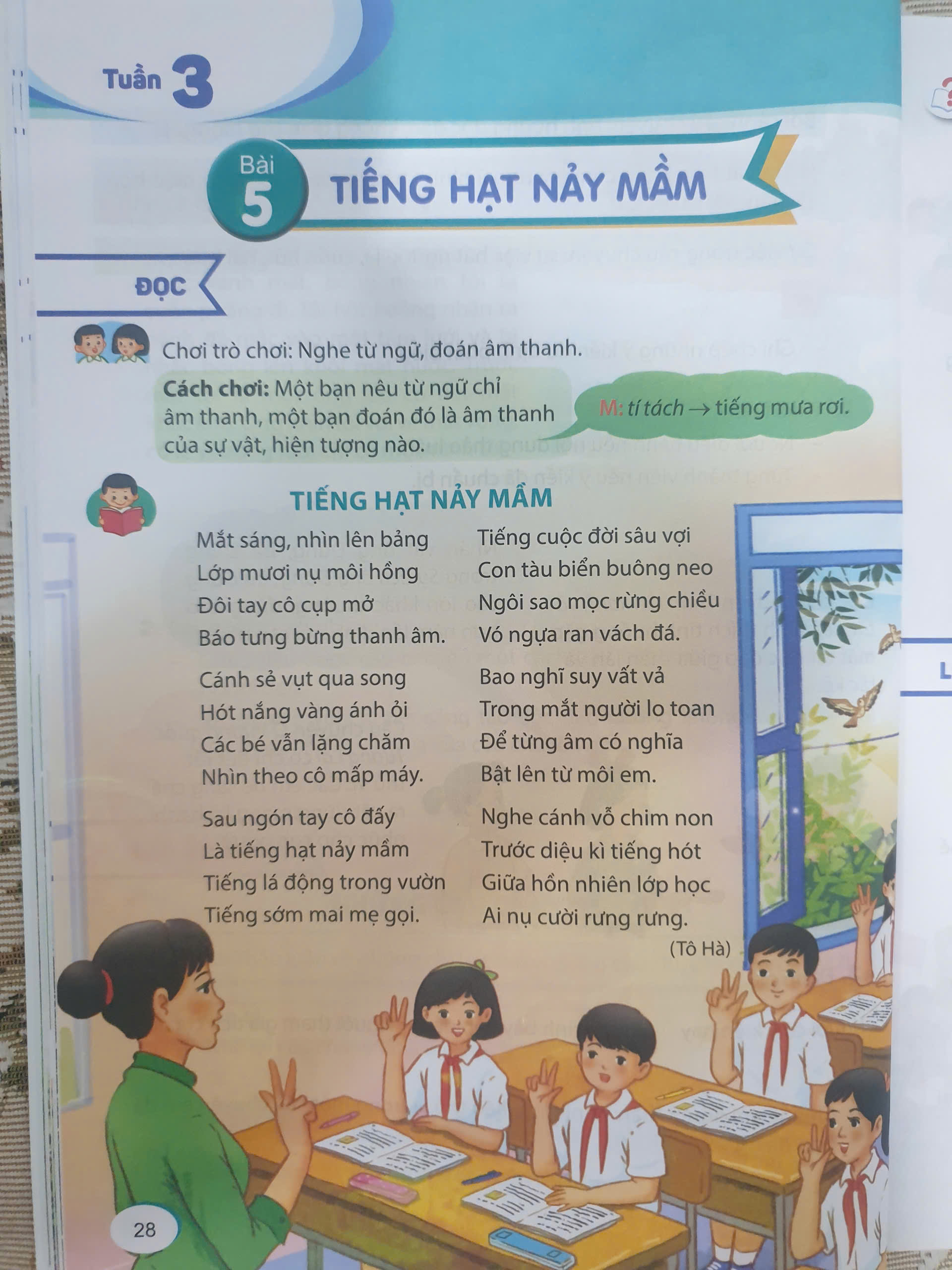
The poem "The Sound of Germinating Seeds" in the 5th grade Vietnamese textbook. Photo: CMH
The newer the work (whether newly created or little known to the public), the more likely it is to provoke conflicting reviews. It's important to note that selecting 600 high-quality texts is difficult enough; choosing that many high-quality texts that also meet the curriculum requirements, the thematic framework of the textbook, the comprehension abilities of students in each grade level, and address issues of author credentials and copyright, is exponentially more challenging.
Traditional views on literature and the teaching of Vietnamese language and literature, with some shortcomings, still dominate the perceptions of many people, leading to conflicting opinions when evaluating the materials in the new textbooks. For many, poems with rhymes and flexible rhythms are not considered good poetry, or even "not poetry at all." The current perspective on the goals and content of Vietnamese language and literature teaching has also undergone changes that many are not yet ready to accept. One of these changes is that the materials in textbooks must be diverse in genre, text type, and content; not only focusing on classic works but also using fresh texts that address contemporary issues to give students the opportunity to broaden their life experiences, encourage them to present and discuss pressing issues around them, thereby fostering emotions, raising awareness, and developing Vietnamese language skills, helping learners enter life and participate in the labor market successfully.
From the 2006 curriculum and especially with the 2018 curriculum, the Literature subject no longer focuses on providing students with knowledge about the achievements of Vietnamese literature over several centuries, as was the case when the grandparents of today's students were still schoolchildren.
It's difficult to know exactly how many of those who posted negative feedback about the poem "The Sound of Germinating Seeds" were teachers, but it's certain that some were, and in considerable numbers. This suggests that a segment of teachers still lack reading comprehension skills and literary appreciation. If teachers possessed strong professional expertise, good interpersonal skills, and a positive attitude towards educational reform, the reasons for the excessive feedback I mentioned above would no longer be such a major issue.
Concerned about this situation, some people have raised the question: Why not train and improve teachers' skills before reforming the curriculum and textbooks? In principle, that's the case, but before the curriculum and textbooks are in place, what will be used to train teachers? Even if there is training, it will likely be general, ineffective content like what has been done before.
However, we readily agree that teacher training and professional development have lagged behind the implementation of the curriculum and textbooks, and the quality of training and professional development has not met expectations. This is not to mention the living and working conditions of teachers, and the lack of significant improvement in facilities and equipment. While the majority of teachers possess good professional qualifications and are dedicated to educational reform, many others are struggling and reluctant to change, posing a considerable obstacle to curriculum and textbook reform. Therefore, I propose that the National Assembly closely monitor the process to ensure that the 20% of the national budget allocated annually to education is fully and appropriately utilized.
Secondly: Social media is an important communication tool with a significant influence on public opinion. Those with malicious intentions or conservative, outdated views can easily exploit social media to negatively impact the community, but progressive ideas and positive information also have the opportunity to spread quickly and effectively combat negativity, conservatism, and backwardness.
Through the debate surrounding the poem "The Sound of Germinating Seeds," many people have undoubtedly learned valuable lessons in their own way. Even those who initially had negative reactions have had the opportunity to reconsider the issue and will be able to act more cautiously and appropriately in the future when dealing with important and sensitive matters.
We hope the public will gain a better understanding of the difficulties faced by textbook writers, empathize with them, and support progress.
Educational reform is never easy, and controversies and conflicts are inevitable, even in developed countries. Vietnamese education is facing many challenges in meeting the demand for high-quality human resources for national development, while investment in education remains insufficient, and negative aspects of education have not been significantly addressed. Deficiencies, limitations, and even errors in textbook compilation are unavoidable, but they are not as serious as some people are deliberately exaggerating.
The texts included in the textbooks are the result of a highly professional, meticulous, dedicated, and responsible search and selection process by the team of authors; careful and thorough editing by the publishing house's editorial team; input from teachers conducting pilot programs; the publishing house's internal review board; independent critiques from education experts and researchers; and finally, the rigorous (often harsh) and dedicated evaluation by the national textbook review board before the textbooks are approved by the Minister of Education and Training.
The texts included in textbooks vary greatly in quality, belonging to different genres and types of texts, meeting the curriculum requirements from different perspectives. Therefore, the authors of these texts also belong to many different "levels," but all deserve respect (or at least should not be insulted), and the efforts of the textbook authors as well as other parties involved in the textbook creation and evaluation process should be acknowledged. If there are differing viewpoints or perspectives on a particular issue, they should be discussed in a spirit of understanding and respect. Regardless, almost all Vietnamese children aged 6 to 18 attending school daily are currently studying from the three sets of textbooks approved by the Ministry.
The debate surrounding the poem "The Sound of Germinating Seeds" by poet Tô Hà may be nearing its end. However, the root issues that caused the controversy surrounding this poem remain.
Associate Professor Dr. Do Hai Phong, former Head of the Department of Literature, Hanoi Pedagogical University, was right when he wrote on his personal Facebook page: "The ignorance of the online readership has only temporarily subsided. It still raises its fangs, lurking for opportunities to crush genuine values whenever someone 'accidentally' shares their concerns with the entire online community. I hope that teachers, parents, and thoughtful readers will be vigilant. Please do not contribute to this kind of ignorance, like 'carving a plow on the internet,' anymore."
Source: https://danviet.vn/tong-chu-bien-sgk-mon-tieng-viet-ngu-van-viet-sach-giao-khoa-la-mot-cong-viec-rat-nguy-hiem-20241008162045099.htm

















![[Photo] Prime Minister Pham Minh Chinh attends the Conference on the Implementation of Tasks for 2026 of the Industry and Trade Sector](/_next/image?url=https%3A%2F%2Fvphoto.vietnam.vn%2Fthumb%2F1200x675%2Fvietnam%2Fresource%2FIMAGE%2F2025%2F12%2F19%2F1766159500458_ndo_br_shared31-jpg.webp&w=3840&q=75)
















































Comment (0)