
The Nhieu Loc - Thi Nghe canal in Ho Chi Minh City is now spacious and clean after being renovated - Photo: TRI DUC
Over the years, the Ho Chi Minh City Party Committee and People's Committee have identified flood control, wastewater treatment, and urban beautification as key priorities.
In this context, canal renovation is not only an environmental solution, but also a matter of living space and sustainable development. As a result, these canals are gradually being revived.
The canals change color
On a May morning, the Nhieu Loc - Thi Nghe canal area appears clear and fresh after the first rains of the season. On both banks of the canal, rows of green trees provide shade, and the pedestrian walkways are bustling with people exercising and children playing.
The water is no longer as dark as it was many years ago; instead, it has a softer hue, reflecting the gradually changing rhythm of urban life.
Many people still remember that, more than 20 years ago, this area was one of the most severely polluted spots in the city. The Nhieu Loc - Thi Nghe canal renovation project, launched in 2002, lasted for many years and involved the relocation of tens of thousands of households along the canal.
Upon completion, the nearly 10-kilometer-long canal not only improved the environment but also became an important urban landscape axis.
In particular, the Hoang Sa - Truong Sa road, running along both banks of the canal, has now become a space for transportation and community activities, where cultural events and river festivals of the city regularly take place.
Leaving the city center and heading west, the Tan Hoa - Lo Gom canal also shows noticeable changes.
From a heavily polluted canal overflowing with garbage, this area has now been transformed into a combined canal and road, improving the environment while reducing traffic congestion in the densely populated area.
In 2011, Ho Chi Minh City began implementing a project to renovate the Tan Hoa - Lo Gom canal, combining open canal and box culvert construction. The canal was upgraded, and new roads were formed on both sides, contributing to a transformation of the urban landscape in the western area.
In addition to renovating major canals, Ho Chi Minh City has also reopened canals that had been filled in, including the Hang Bang canal - an area closely associated with the trading history of Cho Lon.
Returning to Hang Bang Canal today, both banks have been reinforced with sturdy embankments, planted with trees, fitted with railings, and transformed into pedestrian areas. The water in the middle of the canal is clearer than before, replacing the dark, polluted image that persisted for many years.
Ms. Nguyen Hoang Y (55 years old), a long-time resident of the area, recalled: "In the past, the water was black and smelled foul, and everyone hoped it would be renovated soon. Now it's clean, there are trees, and people feel much happier coming out to exercise in the afternoons."
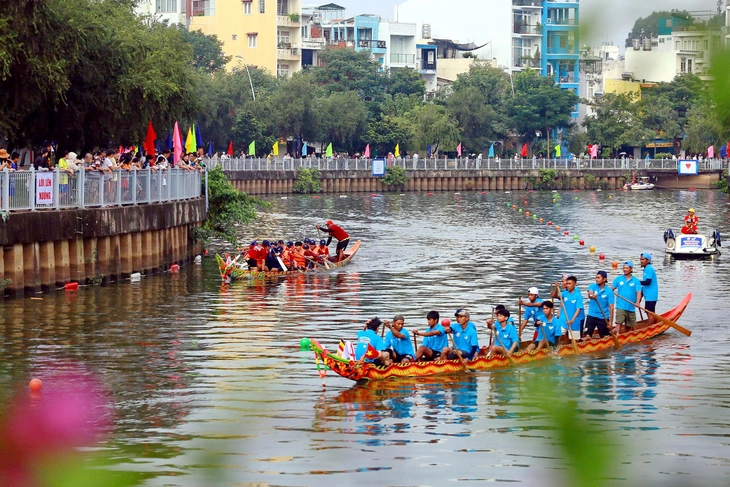
The Nhieu Loc - Thi Nghe canal, notorious for its pollution over 20 years ago, has now become a venue for many festivals and community activities in Ho Chi Minh City - Photo: LE PHAN
Improving the environment is linked to ensuring the well-being of the people.
In this new phase of development, Ho Chi Minh City is gradually rediscovering its identity as a "city of rivers and canals" - not only in historical memory but also in present-day life, where the canals are gradually being revived in connection with the goal of ensuring the well-being of the people.
The resolutions of the Ho Chi Minh City Party Congress for the 2020-2025 and 2025-2030 terms both identify flood control, wastewater treatment, and urban beautification programs as crucial for socio-economic development, aiming for double-digit growth in the coming period.
In fact, the Ho Chi Minh City Party Committee and People's Committee have focused resources on these programs, considering them a key solution to address flooding, improve the canal environment, and enhance the quality of life for residents.
The approach is also changing: from simply addressing infrastructure to an integrated model of urban renewal, environmental improvement, and living space development.
After each project, it's not just embankments, culverts, or roads that are built, but also parks, walkways, and community spaces along the canal.
In addition, the city has implemented many flexible mechanisms for compensation, support, and resettlement, especially for cases where houses along canals and waterways lack legal documentation, in order to accelerate the progress of land clearance and urban renovation.
Mr. Phuong Thai Hoang (74 years old), who lived for many years along the Doi Canal, is one of the households relocated under the resettlement program.
More than two decades ago, he bought a house of less than 30 square meters right on the edge of the canal because it was cheap, and then gradually expanded it to accommodate his multi-generational family.
The house, about 2.5 meters wide, is built on a foundation of mangrove wood, and it shakes whenever boats pass by. "We only live here out of necessity; nobody wants to live there," he said.
For Mr. Hoang, life by the canal was fraught with insecurity: rats crawled into his house during the flood season, foul odors emanated from the canal, and the foundation of his house repeatedly sank due to rotting piles.
Every few years, the family has to spend tens of millions of dong to reinforce their homes. The cramped space and closely packed houses create a constant risk of fire and theft. When the plan to relocate was announced, he worried that the compensation would not be enough to help him settle into a new life.
But after being introduced to resettlement areas by the local authorities, he chose the new apartment because it was convenient for his children and grandchildren to study and work.
"What makes me happiest is that the children now have a cleaner, more stable place to live," he said, because after years of living precariously by the canal, the biggest change for him wasn't just the new place, but the feeling of security.

Graphics: TAN DAT
The green space of the city, connecting different areas.
Commenting on Ho Chi Minh City's policy of reviving its canals, Dr. Ngo Viet Nam Son, an architect and scientist, stated that Saigon - Ho Chi Minh City is inherently a city of rivers and waterways, with many canals previously filled in during the urbanization process (such as the areas around Nguyen Hue or Ham Nghi streets today, which were formerly canals).
Therefore, renovating and restoring this system is of great significance to urban identity.
According to Mr. Son, reviving the canals and waterways will first and foremost help to revive urban memories, while also promoting the inherent cultural values of the city. In the past, trading and commercial activities along the rivers and canals were very bustling.
Nowadays, these spaces can be fully recreated through waterfront urban activities, thereby reviving areas that were once trading centers such as Binh Dong Wharf or many canals that have been filled in.
The areas along canals and rivers are also considered valuable public land with significant landscape potential, which can be combined with the development of cultural facilities and community services, creating new destinations for the people.
At the same time, the water system also contributes to improving the urban climate, helping to reduce heat, air pollution, filter dust, limit noise, and support drainage in the context of rapid urbanization.
Mr. Son further emphasized that the system of rivers and canals in the future can be seen as a "green framework" of the city, connecting green spaces, water bodies and public works, becoming a space for relaxation and recreation for people after work.
Regarding the current approach to canal renovation, he believes that prioritizing drainage in some areas and preserving the natural features of the water surface in others are both appropriate, as long as they meet the objectives of each project.
"A single model should not be applied to the entire canal system. Where appropriate, three objectives should be combined simultaneously: drainage, waterway transportation, and ecological space," Mr. Son said.
Clearing waterways and connecting road transport.
Beyond simply renovating canals and waterways, some projects also help to reopen the waterways that were once an advantage for Ho Chi Minh City.
For example, the Tham Luong - Ben Cat - Nuoc Len canal project, after a period of stagnation, has seen some sections completed.
Two canal-side roads connecting the Vam Thuat River to Binh Dien Bridge are gradually taking shape. Once completed, these will be the main transportation arteries connecting the western and northern parts of the city, relieving traffic congestion on inner-city roads.
The canal plays a crucial role in connecting the former Long An province via the Cho Dem River, as well as the former Binh Duong and Dong Nai provinces via the Saigon River.
Binh Duong area: implementing major drainage systems to combat flooding.
In Ho Chi Minh City and the former Binh Duong area, characterized by numerous industrial zones and rapid urbanization, canal and waterway renovation projects are typically large-scale and linked to inter-regional drainage networks.
Large-scale drainage systems have been completed and put into use, such as the Chòm Sao - Suối Đờn drainage system (in the former Thuận An city area), and the Bình Hòa drainage system has been renovated and upgraded, resolving flooding issues for a catchment area of nearly 2,900 hectares, including part of National Highway 13 and the VSIP 1 industrial park…
Currently, Binh Duong province continues to implement many large-scale drainage projects. Among them is the Suoi Giua - Bung Cau drainage project, with a scale of over 3,300 billion VND, which will drain rainwater and wastewater for an area of over 4,500 hectares in the wards of the former Thu Dau Mot City.
The project, to be implemented between 2026 and 2031, will renovate the Bung Cau and Ba Co canals, combining the construction of transportation infrastructure and planting trees, thereby contributing to urban beautification.
Massive relocation and resettlement
According to a report by the Ho Chi Minh City Department of Construction, the city aims to relocate more than 23,000 houses located on and along canals and waterways during the period 2026-2030.
The aim is to contribute to improving the living environment, reducing pollution, and increasing drainage capacity for urban areas...
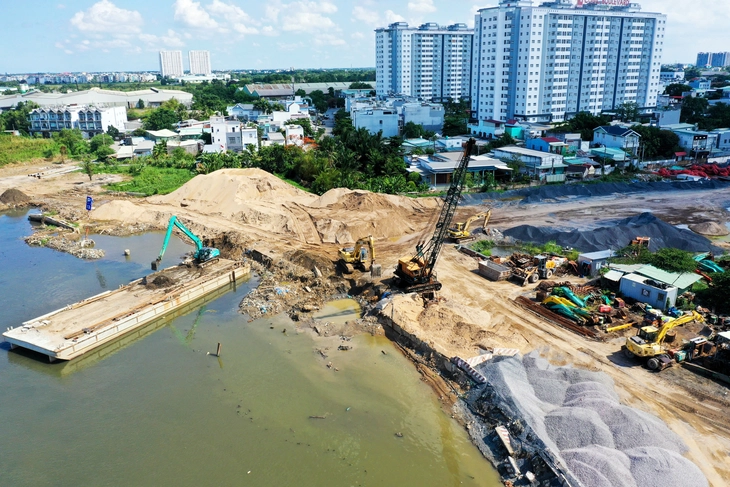
Construction workers are seen working on package XL-01 (near Nuoc Len Bridge, An Lac Ward, Ho Chi Minh City) of the Tham Luong - Ben Cat - Nuoc Len canal renovation project on the afternoon of May 22nd - Photo: TRI DUC
Implement resettlement before land clearance.
The relocation and land clearance efforts are focused on major routes such as the Doi Canal, Te Canal, and Ong Lon Canal. Smaller, scattered areas will be left to local authorities to manage independently.
To achieve that goal, the Ho Chi Minh City People's Committee has implemented a plan to organize the implementation of the urban renovation project for houses on and along rivers, canals, and streams in the city from 2025 to 2030.
It is planned to implement 40 projects funded by the state budget and 4 projects funded through social mobilization, involving the relocation of 23,429 houses. Of these, the Ho Chi Minh City Urban Infrastructure Investment and Construction Project Management Board will implement 38 out of 44 projects (the remaining 6 projects will be implemented by other units).
The Urban Infrastructure Project Management Board believes that the effective implementation of resettlement work will significantly contribute to the overall success of the project program.
Therefore, the committee has closely coordinated with the local Departments of Construction right from the investment policy stage to implement contents such as developing plans and arranging resettlement projects in parallel with the investment preparation phase; ensuring that resettlement plans are approved concurrently with the approval of the investment policy.
In cases where a resettlement project is necessary, it must be implemented first to ensure the livelihoods of the people during the land compensation and clearance process.
With new policy mechanisms, especially specific support mechanisms in compensation and resettlement, along with proactive allocation of investment resources, many urban renovation projects in the city have been accelerated and have gained the consensus of the people.
完善 policy framework on compensation and resettlement
In further discussion with Tuoi Tre newspaper, Mr. Dau An Phuc, Director of the Ho Chi Minh City Urban Infrastructure Investment and Construction Project Management Board (the unit involved in the renovation of many large canal projects), said that the Standing Committee of the City Party Committee has concluded on the policy of applying different support measures and levels when implementing two urban beautification and housing relocation projects on and along canals: the North Bank of Doi Canal project and the Xuyen Tam Canal project.
And the application of appropriate support levels has helped to create a high level of public consensus, thereby resolving one of the biggest bottlenecks in urban renovation projects.
"Based on the positive results achieved during the implementation of the two aforementioned projects, the city has continued to refine its policy framework on compensation, support, and resettlement, notably by adopting appropriate measures and support levels for housing cases on and along canals and waterways," Mr. Phuc said.
Furthermore, according to Mr. Phuc, the city also assigned the task of preparing for investment early and ensuring funding for many projects right from the beginning of the term. As a result, many canal and waterway renovation projects have been prepared for investment early (such as the Van Thanh canal project, the Ong Be canal project, the Ba Lon canal project...).
Land acquisition is a crucial step in canal and waterway renovation projects.
In a recent survey on the implementation of the urban renovation project for residential areas on and along rivers, canals, and streams in the city from 2025 to 2030 in the three wards of Binh Dong, Chanh Hung, and Phu Dinh,
Chairman of the Ho Chi Minh City People's Council Vo Van Minh requested simultaneous implementation using a "parallel" approach, with compensation and land clearance identified as the key step that determines the progress of the entire project.
LE PHAN - PHUONG NHI - BA SON
Source: https://tuoitre.vn/tp-hcm-hoi-sinh-kenh-rach-danh-thuc-do-thi-song-nuoc-20260523093740655.htm


![[Photo] General Secretary and President To Lam presides over the meeting to approve the draft report on the results of the second inspection by the Politburo of the Standing Committee of the Hanoi City Party Committee.](https://vphoto.vietnam.vn/thumb/1200x675/vietnam/resource/IMAGE/2026/05/26/1779789811432_a2-bnd-4430-9620-jpg.webp)







![[Photo] "The green gem" in the middle of the Dong Nai River](https://vphoto.vietnam.vn/thumb/402x226/vietnam/resource/IMAGE/2026/04/10/1775811290783_ndo_br_1-resize-7934-3119-jpg.webp)




























































Comment (0)