

On May 27th, the Ho Chi Minh City People's Committee issued a document approving the implementation of a software application for managing the temporary use of roads and sidewalks throughout the city. This initiative was implemented based on a proposal from the Department of Construction to serve state management, streamline administrative procedures, and enhance transparency in the licensing of temporary road and sidewalk use in the city.
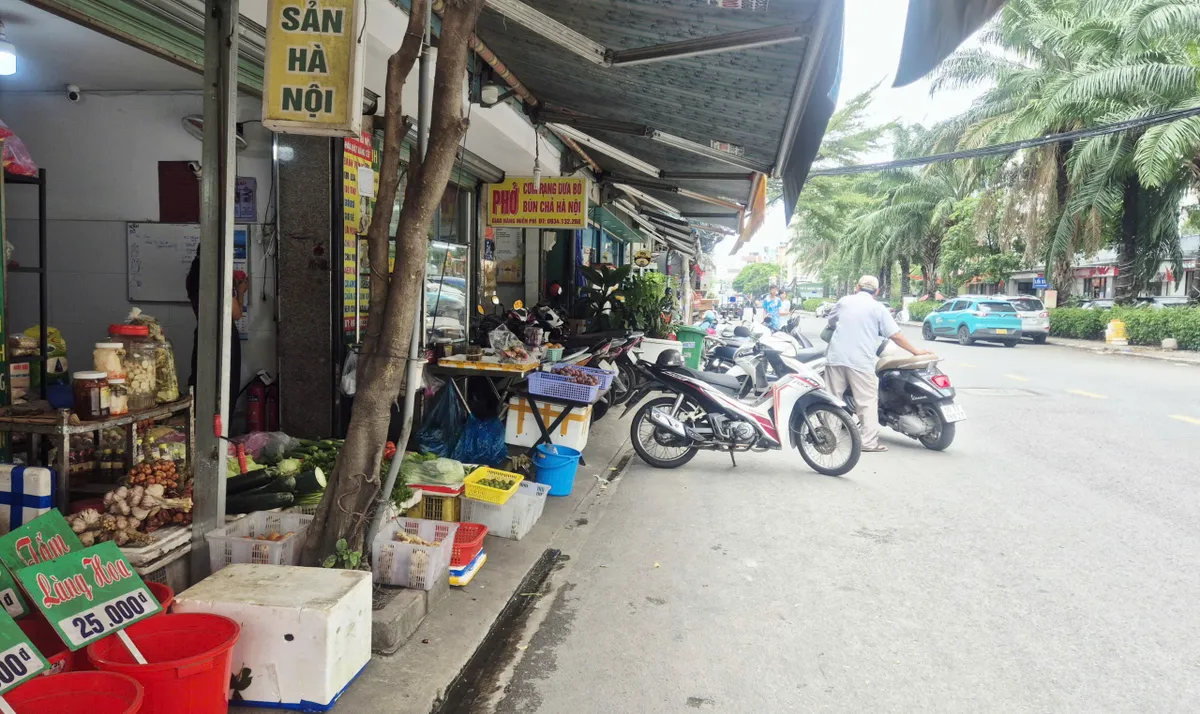
Street vendors operate on the sidewalks and roadsides along a street in Binh Trung Ward, Ho Chi Minh City.
According to the plan, the implementation of registering for the use of a portion of sidewalks via software will be carried out within 18 months from the date of issuance. After that phase, the Ho Chi Minh City People's Committee will review the implementation based on a comprehensive assessment of the actual results, while ensuring compliance with the Law on Bidding and other relevant legal regulations.
This move is seen as a new step in the city's transition from a "clearing encroachments" mindset to managing and utilizing sidewalks using technology, digital data, and a licensing mechanism.
An Dong Ward was the first unit to pilot the fee-based licensing of partial sidewalk use starting from May 15th. As of May 29th, representatives of the Ward People's Committee stated that they had received 51 applications for temporary sidewalk use, the majority of which were for parking, followed by applications for use during traffic construction and for organizing activities.
"All collected fees will be transferred to the temporary holding account of the Ward People's Committee at the State Treasury," a representative of the ward said.
The leaders of An Dong Ward People's Committee noted that after the pilot program of granting permits for the temporary use of a portion of sidewalks in the ward, there has been a great deal of interest from residents. Besides the purpose of managing urban order, the granting of temporary permits for the use of a portion of sidewalks also stems from the practical needs of organizations, businesses, and households wishing to use sidewalks as a place for stable, orderly, and standardized business activities.
From July 1st, 2025 to the present, An Dong ward has fined over 700 cases of violations with a total amount exceeding 650 million VND. This figure reflects the huge demand for sidewalk use, while the urban order management force at the local level is increasingly thin, and encroachment often occurs at night, outside of working hours. This is also the reason why the locality is promoting digital transformation in sidewalk management, instead of relying entirely on direct inspection forces.
Based on this model, Ho Chi Minh City is considering deploying management software on a large scale, moving towards building a digital map of sidewalks, managing permits using QR codes, and connecting with the electronic administrative procedures system. At the summary meeting on urban business and order management in the area on May 25th, the People's Committee of An Dong ward also stated that granting temporary sidewalk use permits stemmed from the "very high demand" of organizations, businesses, and households wishing to use sidewalks for stable and orderly trading in accordance with regulations.
Previously, in 2024, Ho Chi Minh City implemented a fee for the temporary use of roads and sidewalks according to Resolution 15/2023 of the City People's Council and Decision 32/2023 of the City People's Committee. During this period, many districts allowed the temporary use of a portion of sidewalks for activities such as parking, serving construction projects, organizing events, and some service activities. According to the Department of Transport at that time, if implemented comprehensively and effectively, Ho Chi Minh City projected it could collect more than 1,500 billion VND per year from the exploitation of roads and sidewalks.
The Department of Construction's assessment also noted that Decision 32 has gained public consensus, contributing to ensuring traffic safety, urban aesthetics, and gradually changing the awareness of organizations and individuals regarding sidewalk usage. However, implementation across districts and counties lacks uniformity, encroachment for business purposes remains common, and pedestrians still face many difficulties in traffic flow. By the end of 2025, Decision 32 will be repealed due to adjustments according to the Law on Road Traffic Safety and Government Decree 165/2024.
Nguyen Tuan Anh, a Master's graduate of the Fulbright Vietnam Program, suggested that Ho Chi Minh City could consider allowing business operations on a portion of sidewalks, but this must be done "cautiously, with conditions, and according to a roadmap."
According to him, sidewalks are primarily public spaces for pedestrians, but they are also connected to livelihoods, urban culture, and the distinctive street life of the city.
"We shouldn't adopt a strategy of absolute prohibition or widespread permission, but rather shift to a management mindset based on planning, standards, and accountability," Mr. Tuan Anh commented.
Currently, the Department of Construction has stated that it has proposed to the Ministry of Construction to review and amend Decree 165/2024 to grant more authority to provincial People's Committees in regulating the use of roadbeds and sidewalks for other purposes, in accordance with the actual conditions of each locality.
The adjustments aim to create a legal basis for Ho Chi Minh City to manage and utilize roadways and sidewalks in a way that suits the practical needs of the people while ensuring traffic safety and urban aesthetics.
Mr. Tuan Anh suggested that if sidewalk businesses are allowed, the city needs to categorize each street, clearly define the pedestrian zone, manage it with time-limited permits, collect fees publicly, and apply technology such as digital maps, QR codes, and surveillance cameras.
"The most important thing is to recognize sidewalks as public property and shared urban living space. Economic exploitation is only a part of it; the larger goal is to build an orderly, civilized city with harmonious interests," Mr. Tuan Anh said.
Source: https://vtv.vn/tp-ho-chi-minh-tung-buoc-mo-duong-cho-kinh-te-via-he-100260601145029802.htm

![[Photo] Delegation attending the 14th Congress of the Vietnam Trade Union visits the Mausoleum of President Ho Chi Minh.](https://vphoto.vietnam.vn/thumb/1200x675/vietnam/resource/IMAGE/2026/06/03/1780451842301_ndo_br_img-3824-jpg.webp)




















































































Comment (0)