

Having already met Basel III standards, TPBank continues to raise these standards to a higher level by deploying capital using internal rating methods (basic and advanced).
The bank recently held a launch ceremony for the Basel III Capital Stabilization Project based on Internal Rating Methods, including both basic and advanced (FIRB & AIRB). Attending the event were representatives from the State Bank of Vietnam, the Department of Banking Supervision, and representatives from KPMG Vietnam Co., Ltd. – the project implementation partner.
Implementing IRB not only helps banks optimize their cost of capital but also contributes to improving their management capabilities by applying IRB results to their business operations. One of the most prominent applications of IRB is in credit management, such as determining credit limits, loan pricing, and performance measurement. Simultaneously, it enables proactive portfolio management based on risk levels, risk-adjusted returns, and the bank's risk appetite for specific risk categories, thereby contributing to effective capital allocation decisions and capital planning/strategy development. In addition to these applications, TPBank will continue to research and apply IRB results in its upcoming projects to further enhance the bank's risk management capabilities.
At the event, Mr. Le Trung Kien, Deputy Director of the Department of System Safety Supervision of Credit Institutions, highly appreciated TPBank's orientation and proactive approach in implementing the Basel III project.
According to Mr. Kien, applying standards in the development of credit institutions, alongside scale development, technology is the foundation for maintaining and ensuring the safety of the banking system. This project, with its short timeline for achieving its goals as set out, will be a significant challenge for TPBank, but success will create a new step forward in risk management and increase core long-term values.
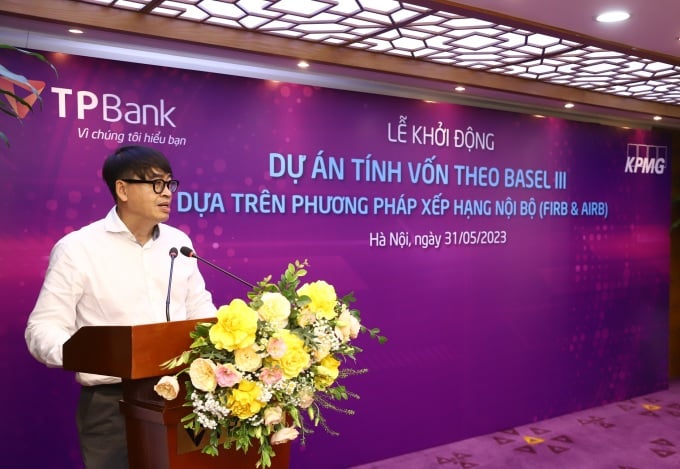
Mr. Le Trung Kien, Deputy Director of the Department of System Safety Supervision of Credit Institutions, speaks at the event. Photo: TPBank
Basel refers to the banking supervision agreements issued by the Basel Committee on Banking Supervision with the goal of enhancing financial stability through improved banking supervision worldwide. Specifically, the Basel III agreement sets out key requirements for capital and liquidity management. Higher standards entail stricter capital requirements, along with the mandatory application of larger buffers to reduce operational risk. With the previous Standards Approach (SA), bank assets were assigned fixed risk weights, specifically defined for different asset classes based on their respective risk levels. This helped banks ensure adequate liquidity, leverage, and capital reserves to adapt to market fluctuations and withstand economic shocks.
"However, the possibility of holding more capital reserves than necessary is a drawback of this method, as it directly affects the bank's profitability and returns," a representative from TPBank shared.
Meanwhile, the IRB allows banks to use their internal risk management models and practices to self-assess the risk components and risk levels of their asset portfolios, thereby calculating capital requirements more accurately than the simple risk weighting percentages prescribed by the SA. Instead of applying a rigid risk weighting as in the old method, estimating risk parameters through specific models allows for more accurate risk measurement, most closely reflecting the risk level of each customer/loan and providing opportunities for capital savings if the bank holds a sound credit portfolio.
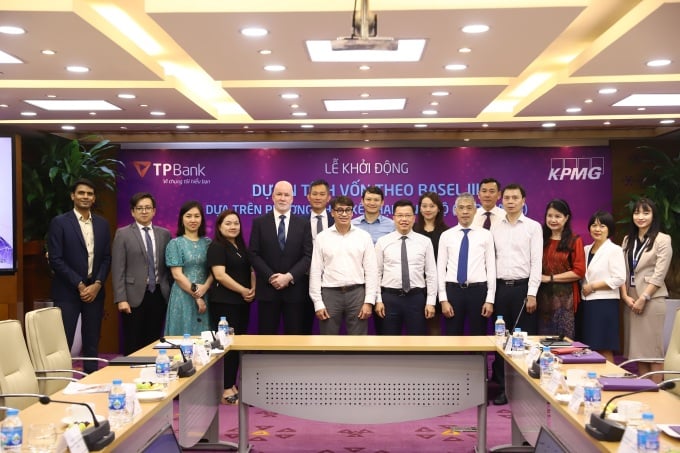
Representatives from TPBank and guests/partners at the launch ceremony of TPBank's Basel III-based capital calculation project. Photo: TPBank
In November 2021, TPBank announced the completion of all Basel III and IFRS 9 requirements and began comprehensive implementation in the fourth quarter. At that time, TPBank was the first Vietnamese bank to have its results independently audited and recognized by a third party, KPMG Vietnam Co., Ltd. In 2022, while many banks in Vietnam were still applying Basel II, TPBank had completed the implementation of Basel III and Basel III Reforms according to SA. By May of this year, the bank continued to implement the Basel III Capital Stabilization Project based on internal rating methods (FIRB & AIRB).
To perform calculations using IRB, banks must meet requirements for data quality and model governance. The data used to build IRB models must simultaneously ensure completeness, integrity, and reasonableness, with a minimum length of 5-7 years. Therefore, banks need to invest resources in data collection, building, and managing datamarts with very large data volumes. Simultaneously, the large number of models to be built, monitored, and validated also requires banks to have a robust model governance framework with a highly skilled professional team.
The data collection and development of models for assessing expected credit losses under IFRS-9 were previously validated by an independent third party – Ernst & Young Malaysia – which showed that the quantitative models in the internal measurement system were of good quality, creating a favorable foundation for TPBank to continue researching, developing, and refining PD, LGD, and EAD models according to IRB - Basel III. In addition, the bank has implemented advanced technologies such as AI algorithms and machine learning to support the development and management of these models.
According to the bank's representative, to achieve this, the bank must sacrifice short-term profits to address the significant investment costs, especially in information technology systems, data processing, the application of advanced algorithms, as well as the costs of recruiting, training, and retaining high-quality personnel to meet the bank's requirements.
"TPBank's development orientation is to become one of the leading banks in complying with and applying international risk management standards to its practical operations. We have sufficient foundation in technology, data, and high-quality personnel to continue implementing capital calculation according to IRB this year," said Mr. Nguyen Hung, General Director of TPBank.
According to the bank representative, applying these advanced international standards requires significant effort, expense, and self-regulation of its operations to meet the stringent requirements of these standards.
An Nhien
Source link









































































































Comment (0)