

In Ho Chi Minh City, to experience the roar of the engine, the sight of exhaust fumes when accelerating, and the sharp turns and collisions like in a real race, Nguyen An Khai, like many other students, had to invest time and effort to create realistic racing models.
In early March, Cao Thang Technical College (District 1) launched the "Mini Car Racing" competition for students passionate about designing model cars, both inside and outside the school. Nguyen An Khai, a third-year automotive engineering student at Ho Chi Minh City University of Industry, along with other like-minded individuals, registered to try their hand at it.
For the race participants, the first task was to design a car model. Khai and his friends attended four workshops to gain knowledge about mechanical design and programming the car's control system. Combining this knowledge, the group brainstormed and designed the car using 3D software, experimenting with engine placement, steering, transmission, suspension, etc. Afterward, the group built a simulation environment to evaluate the car's performance before manufacturing it.
The team conducted test runs to check the model's functionality. After numerous adjustments to the driveshaft system and testing various vehicle support platforms, "we were finally satisfied with the third version," Khai said.
To protect the driveshaft system, the team used two side supports on the vehicle. When the car is running at high RPMs, the axle will sag, so the supports are needed to prevent the axle from breaking. To increase the car's ability to move over rough terrain or climb hills, the team designed a four-wheel drive system (two traction and push systems) on all four wheels. During the race, if one of the axles malfunctions, the other axle will either pull or push, helping the car continue to operate.
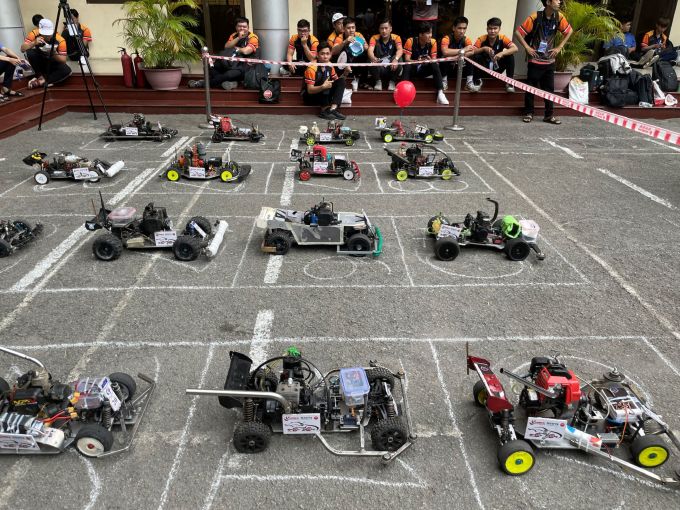
Model cars powered by gasoline engines, created by students from universities and colleges in the South, participated in the "Mini Car Racing" competition at Cao Thang Technical College on June 17th. Photo: Ha An
Nguyen Tuan Thanh, a mechatronics student at Cao Thang Technical College, said that luckily, one member of the group had a family member working at a mechanical workshop in Bien Hoa ( Dong Nai province ), so they were able to ask for help during the model assembly process. On weekends, the group traveled more than 30 km by motorbike from the center of Ho Chi Minh City to Dong Nai to complete the vehicle.
According to the team, the materials used to make the car are a crucial factor. While aluminum is lightweight, it is easily deformed upon collision with other vehicles or hitting the boundary barriers on the racetrack. Therefore, the materials commonly chosen are iron and steel, and they are engineered to provide better impact resistance.
Besides mechanical design, according to Thanh, model cars require optimized control algorithms for the connection between the car and the smartphone during operation. If the control system is unstable, it can easily lead to delayed operation, even loss of connection, and the inability to control the car. Compared to RF control, Thanh believes that controlling a car via smartphone and Wi-Fi is more difficult, requiring students to have programming knowledge and code to complete the software running on the phone app.
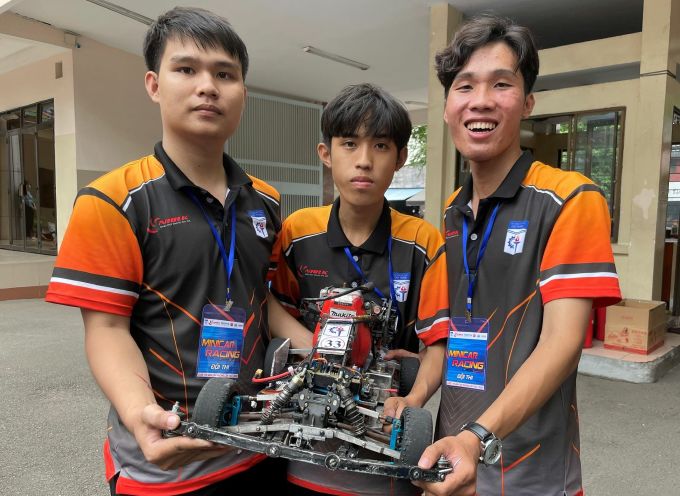
Nguyen Tuan Thanh (left) and other members stand beside the model car designed by the group. Photo: Ha An.
Khải explained that the team added antennas to the car to improve signal reception and connectivity, improved the microcontroller circuit, and optimized the software on the phone to reduce interference and enhance vehicle control.
According to the student groups, the cost of completing a model car depends on the materials, engine, and design of the parts, averaging around 4-7 million VND. Despite the time, expense, and effort involved, Khai and his team members had a "memorable experience: hearing the roar of the engine, seeing the exhaust fumes when accelerating, and witnessing the cornering and collisions between cars, making them feel like they were on a real racetrack."
Model car racing is a popular activity organized by several universities and colleges over the years, such as Cao Thang College, Ho Chi Minh City University of Technology, and Lac Hong University (Dong Nai)... Students are allowed to use gasoline engines with a displacement of less than 50 cm3, designing model cars with structures and operating principles similar to real cars, with a minimum of 50% of the overall vehicle being self-made. The race track is designed with curves, obstacles, slopes, and rough surfaces to challenge the vehicles' performance.
According to Master Nguyen Ngoc Thanh, Head of the Automotive Engineering Department at Cao Thang Technical College, model car racing competitions help students apply theoretical knowledge to practice, improve teamwork skills, and gain interdisciplinary knowledge. Besides mechanical design, students must have knowledge of electrical circuit fabrication and apply information technology knowledge to program control software on mobile phones. Because interdisciplinary knowledge is needed to complete the model car, students must work in teams. "This process helps them learn many new things that will support their future work," said Master Thanh.
Mr. Tran Quoc Toan, Chairman of the Ho Chi Minh City Automobile and Power Equipment Association, assessed that model car playgrounds are places for young people to create car models. This is an important factor in bringing students closer to the automobile manufacturing process.
According to Mr. Toan, it usually takes businesses from three months to a year to train newly graduated students to meet their needs. However, with practical training through model car workshops, students hone their professional skills, helping businesses reduce training time and costs.
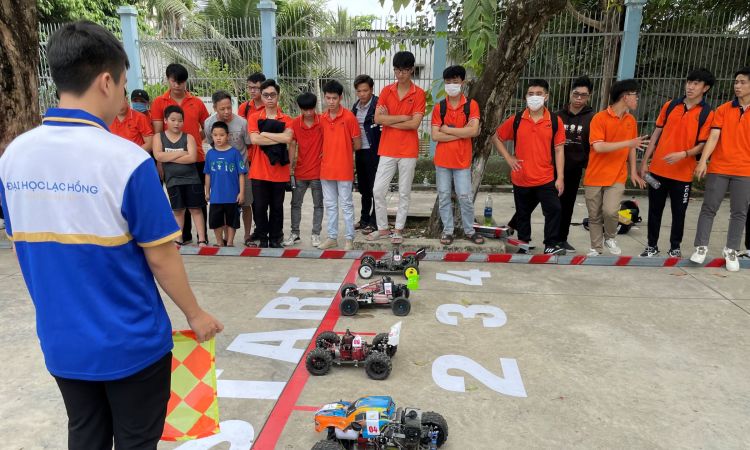
Model car racing playground organized by Lac Hong University in March. Video : Ha An
Ha An
Source link


![[Photo] Prime Minister Pham Minh Chinh receives the Chinese Ambassador to Vietnam](https://vphoto.vietnam.vn/thumb/1200x675/vietnam/resource/IMAGE/2026/04/05/1775397481797_ndo_br_dsc-5512-jpg.webp)



































































Comment (0)