

Data recently released by Vietnam Investment Credit Rating Joint Stock Company (VIS Rating) shows that in the first half of 2024, the amount of newly issued corporate bonds reached VND 202,400 billion. Of this, 70% was issued by commercial banks with interest rates significantly higher than regular savings deposit rates.
The race to issue bonds.
Typically, the Vietnam Bank for Agriculture and Rural Development ( Agribank ) recently successfully raised 10,000 billion VND through a public bond offering in 2024 from over 5,000 individual and institutional investors, both domestic and foreign. Agribank's bonds offer an interest rate of 6.68% per year, significantly higher than the bank's 24-month term savings deposit interest rate of 4.8% per year.
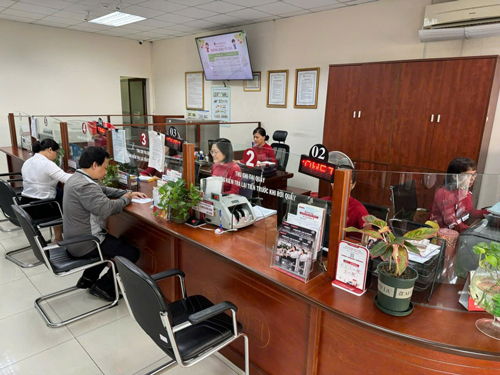
Agribank also joined the race to issue bonds to raise capital.
Ho Chi Minh City Development Bank ( HDBank ) also offered its second tranche of bonds to the public with a face value of VND 100,000 per bond, totaling VND 1,000 billion. This bond issue has a 7-year term and a floating interest rate calculated as the reference interest rate plus a margin of 2.8% per year (approximately 7.5% per year).
Meanwhile, Viet Capital Bank (BVBank) is offering bonds to the public (Phase 1) with a fixed interest rate of up to 7.9% per annum for the first year. Accordingly, with just 10 million VND, individual customers can purchase and hold BVBank bonds for a term of 6 years.
Previously, a number of commercial banks also competed to issue bonds to raise capital, such as MB with 10,000 billion VND, VietinBank with 5,000 billion VND,SHB with 3,000 billion VND, etc.
According to some investors, these interest rates are more competitive than current savings deposit rates. This is attracting many people to shift their idle funds from savings to buy bonds in order to earn higher interest rates.
Ms. Ngoc Tu (residing in District 7, Ho Chi Minh City) recently decided to use 1 billion VND of her idle funds to purchase publicly issued bonds from a commercial bank with an interest rate of approximately 8% per year. "The real estate market remains sluggish, the stock market has high risks, and gold is also not an easy investment. I decided to choose publicly issued bank bonds because the interest rate is higher than savings accounts and the risk is lower than other channels," Ms. Ngoc Tu explained.
According to Mr. Ngo Minh Sang, Director of the Individual Customer Division at BVBank, bank bonds are a safe and effective investment channel. These bonds are issued and offered by the bank itself and will be centrally registered at the Vietnam Securities Depository and Clearing Corporation, and listed on the Hanoi Stock Exchange (HNX) trading system after the offering period ends.
What should you keep in mind when buying bank bonds?
Speaking with a reporter from Nguoi Lao Dong newspaper, economist Dr. Dinh The Hien also stated that bank bonds are a safe and effective investment channel compared to regular savings accounts at the present time.
Currently, interest rates for term deposits exceeding 12 months at state-owned commercial banks are around 4.7% per year, while those at joint-stock commercial banks are around 5%-5.5% per year. Bank bonds and savings deposits are similar because they are essentially loans to the bank, and the bank is obligated to pay interest on that amount.
"However, investing in bank bonds requires idle capital for a longer period (usually 3-7 years) compared to regular savings deposits. Buying bank bonds is safer and less risky than other investment channels. If capital is needed, customers can also pledge or mortgage the bonds to borrow money to repay the issuer, so liquidity remains high," analyzed Dr. Dinh The Hien.
According to Ms. Nguyen Thi Thao Nhu, Senior Director of Individual Clients at Rong Viet Securities Company (VDSC), interest rates on bank bonds, around 7%-8% per year, may be lower than investing in stocks or real estate, but the risk is lower. Bank bonds are generally considered a safer investment channel, especially in the context of a volatile financial market, due to the stability of the issuing bank and strict control from regulatory authorities.
However, Ms. Nhu noted that when buying bank bonds, investors should prioritize bonds from reputable banks with sound financial statements to minimize risk. In addition, they should carefully consider the bond's maturity period to suit their needs. Long-term bonds usually offer higher interest rates but are less flexible.
Ms. Thao Nhu compared: "Fixed bond interest rates are different from market interest rates, which can fluctuate. If market interest rates rise, fixed-rate bonds may become less attractive, and vice versa. Bonds may also be difficult to resell on the secondary market if resale is needed early, so investors need to consider this risk."
One factor noted by many experts at securities companies is that although bank bonds have a higher level of reliability, investor confidence in the corporate bond market has not recovered after the crisis of the past two years, which could affect the resale value and market price of bonds.
Analysts at Maybank Securities believe that bank bonds have a high level of safety, so interest rates are usually lower than those of non-bank bonds (corporate bonds). Interest rate is only one factor when evaluating an investment product, alongside potential losses, bond term, resaleability in the secondary market, and the issuer's ability to repay.
Riding the year-end credit wave
According to the August 2024 corporate bond market report published by credit rating agency FiinRatings, in the first seven months of this year, the total value of privately issued corporate bonds reached VND 178,500 billion, an increase of 57% compared to the same period last year.
According to FiinRatings, to meet the rapidly increasing credit growth demand since June while not yet having increased charter capital, credit institutions need to continue strengthening their medium- and long-term capital sources (over 3 years) through bond issuance. Improved absorption of bank bond capital will help revitalize the corporate bond market.
Source: https://nld.com.vn/trai-phieu-ngan-hang-hap-dan-nha-dau-tu-196240902200922906.htm


![[Photo] The courage of new recruits of Brigade 144 on the training ground.](https://vphoto.vietnam.vn/thumb/1200x675/vietnam/resource/IMAGE/2026/05/27/1779881651341_anh-man-hinh-2026-05-27-luc-18-32-52.png)


![[Photo] The heat at the fireworks display site on the opening night of the Da Nang International Fireworks Festival 2026](https://vphoto.vietnam.vn/thumb/1200x675/vietnam/resource/IMAGE/2026/05/27/1779889741485_ndo_br_z7872039145157-fecaba5112f39e8352544099d7ef4738-5140-jpg.webp)



































































































Comment (0)