With hundreds of layers of security but inadequate procedures and penalties, it will never be possible to control the amount of contaminated food entering supermarkets.

Following the article "With multiple layers of inspection, why does contaminated food still get into supermarkets?", many readers expressed their concern and indignation.
"With hundreds of layers of management but inadequate procedures and penalties, the quality of food in supermarkets will never be controlled," a reader from Da Nang lamented.
Reader Tran Quoc Tuan recounted: "I bought carrots at a supermarket, and they remained fresh for over 6 months in the refrigerator. I sent a complaint to the supermarket and provided the sealed bag of carrots that I had purchased. The supermarket replied that the supplier had all the necessary food safety documents when they received the goods."
Meanwhile, the carrots I bought from the market spoiled and went bad after only a week in the refrigerator."

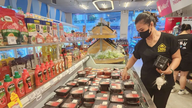

Reader Tô Vũ stated that he had always had some trust in the suppliers of goods to supermarkets. However, after the incident involving allegedly contaminated vegetables at Bach Hoa Xanh, it seems that "clean vegetables" in supermarkets are not much different from those sold at street markets.
A reader named "Saigon man" offered some consolation, suggesting that unscrupulous traders who want their goods sold in supermarkets should initially produce goods that meet clean product standards, then later resort to fraudulent practices to increase profits. Another reader, Le Quang Tuan, added that while regulatory agencies conduct inspections, they are not frequent enough.
Therefore, according to reader Bich, it is necessary to strictly control the import process of distribution facilities, in which sample testing is a crucial step.
Reader Lan Le added her opinion on how easy it is to inspect goods at supermarkets, suggesting the following measure: Strictly and transparently penalize supermarkets when substandard goods are found, as is done in other countries.
There will absolutely be no issues with contaminated or substandard goods.
According to the account kh**@uel.edu.vn, if suppliers do not provide sufficient documentation proving that their products are clean and safe, supermarkets, restaurants, hotels, and kitchens will not import them. If any samples are found to be in violation during inspection, the source will be immediately traced back to the manufacturer.
Sellers want speed and low costs to maximize profits. Ultimately, consumers bear the brunt. "Now the only way is to go directly to the farms and production sites to monitor the entire product lifecycle from start to finish!" - reader Tuan added.

Believing that every citizen should be a food safety inspector, reader Thanh suggests that people should warn other consumers about food they find harmful when eating or buying it elsewhere, encouraging them to boycott those places.
Only heavy penalties, like those in the traffic sector, or prosecution might deter wrongdoers; very few consumers rely on their conscience.
Many readers also agree that there should be severe penalties and criminal prosecution for the production and distribution of unsafe food, because the consequences of unsafe food are even greater than those of traffic accidents.
Source: https://tuoitre.vn/tram-tang-kiem-tra-thuc-pham-ban-van-lot-vao-sieu-thi-neu-20250106203957258.htm


![[Photo] Prime Minister Le Minh Hung presides over the thematic session on promoting science and technology development and innovation.](https://vphoto.vietnam.vn/thumb/1200x675/vietnam/resource/IMAGE/2026/06/23/1782207872934_ndo_br_dsc-1724-jpg.webp)