

Chinese researchers say they have successfully developed a wireless power transmission system that can power multiple moving targets simultaneously, opening up prospects for building solar power stations in space in the future.
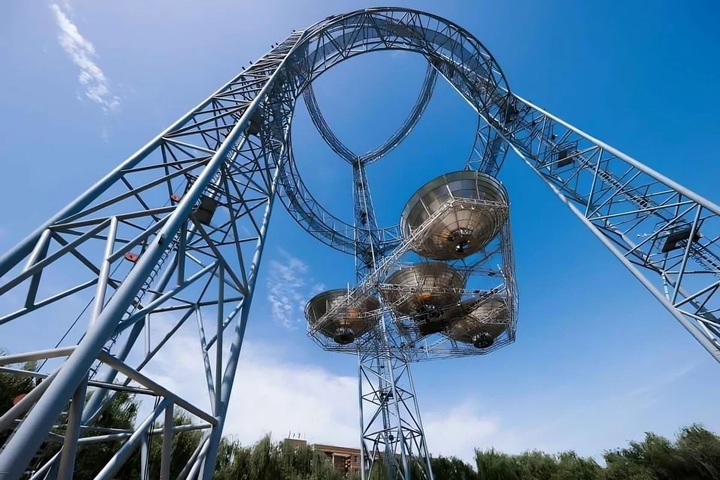
The central tower of the wireless power transmission system developed by a research team at Xidian University. (Photo: Xinhua News Agency)
The system was developed by a research team at Xi'an University of Electronic Science and Technology in Xi'an (Shaanxi Province, northwestern China), centered around a 75-meter-high test tower.
The facility is designed to verify the entire process of energy transmission on the ground before deployment into orbit.
According to Xinhua News Agency , the research team perfected the technology verification platform in 2022 and recently successfully tested its ability to simultaneously transmit electricity to multiple moving targets.
In one test, the system transmitted 1,180 watts of power over a distance of approximately 100 meters, while maintaining precise control of the microwave beam. This is considered a key factor if wireless power supply is desired for satellites, drones, or facilities on the Moon in the future.
The research team, led by engineer Duan Baoyan, also tested transmitting electricity to a drone while the device was flying at a speed of 30 km/h. The results showed that the drone received approximately 143 W of power at a distance of nearly 30 m.
According to Xinhua News Agency , the overall wireless power transmission efficiency of the system reached 20.8%, meaning that about one-fifth of the input power is transmitted and converted into usable electricity.
Although this number is not yet high, researchers believe the biggest challenge lies in maintaining a stable connection with constantly moving targets, rather than simply optimizing performance in a stationary environment.
For comparison, NASA's Jet Propulsion Laboratory (JPL) conducted a microwave power transmission experiment in 1975 with an overall efficiency of 54%. However, that experiment took place under tightly controlled conditions and did not involve tracking and powering moving targets like China's current system.
Wireless microwave power transmission technology has long been considered a potential foundation for space-based solar power projects.
In this model, solar panels placed in orbit will continuously collect energy and transmit it back to Earth using microwaves, instead of depending on weather or day-night cycles like ground-based solar power.
Source: https://vtcnews.vn/trung-quoc-dat-buoc-dot-pha-trong-cong-nghe-truyen-dien-khong-day-ar1018996.html


![[Image] Pleasant weather helps students enter the 10th grade entrance exam with confidence.](https://vphoto.vietnam.vn/thumb/1200x675/vietnam/resource/IMAGE/2026/05/29/1780034401612_ngay-1-thi-lop-10-minh-duy-8-5009-jpg.webp)

![[Photo] Ba Lang An Lighthouse - the "eye of the sea" amidst the "rock museum" of Quang Ngai province.](https://vphoto.vietnam.vn/thumb/1200x675/vietnam/resource/IMAGE/2026/05/29/1780038698840_anh-man-hinh-2026-05-29-luc-14-10-42.png)



















































































Comment (0)