

.jpg)
The General Headquarters - codenamed House D67 - is a special building constructed in 1967 within the grounds of Thang Long Imperial Citadel.
Special military installation
Following the entrance to the Thang Long Imperial Citadel from Hoang Dieu Street, after passing through Doan Mon Gate, you will reach Kinh Thien Palace. Here, the pair of stone dragons from the early Le Dynasty still stand, having survived for over 550 years. Continuing towards Hau Lau, at the end of the path on the left, there is a modest building nestled amidst lush green gardens.
But it was here that the most turbulent moments of Vietnamese revolutionary history took place - especially during the 12 days and nights of the US using B52 "flying fortresses" to bomb North Vietnam in December 1972, and particularly the crucial decisions made during the historic Ho Chi Minh Campaign, liberating South Vietnam and unifying the country in April 1975.
Tracing back through history, after conquering Hanoi, the French colonialists began constructing military facilities within the Thang Long Imperial Citadel, including an artillery command post on the site of the Kinh Thien Palace. Upon taking over the capital in 1954, the Politburo, the Ministry of National Defense , and the Central Military Commission transformed this location into their headquarters.
By 1967, about 30 meters from this headquarters, the Ministry of Defense built a special structure – an above-ground building connected to an underground bunker 10 meters below, to withstand air raids using the most modern American bombs at the time. The structure was codenamed "House D67" – also known as the General Headquarters; from September 1968, it became the venue for meetings of the Politburo, the Central Military Commission, the Ministry of Defense, etc.
Given its importance, despite its modest and small exterior, the single-story structure, nearly 8 meters high and built within a 600 square meter area, is a remarkable construction. The outer walls are 60 centimeters thick, while the inner walls are nearly 30 centimeters thick, with soundproofing. The roof is made of special reinforced concrete with two layers of ceiling and roofing, with a layer of sand in between to prevent bomb fragments and rockets from entering. The doors are also double-layered, with the outer layer made of 1 cm thick steel.
Immediately beyond the main entrance is a meeting room with a long wooden table, on which are currently displayed 24 bronze nameplates of the leaders who attended the expanded Politburo meeting from December 18, 1974, to January 8, 1975, to discuss plans and make decisions to liberate the South and unify the country.
To the right of the meeting room is a rest room, followed by a door leading to the office of the Minister of National Defense, General Vo Nguyen Giap. The door to the left of the meeting room leads to the office of the Chief of General Staff, General Van Tien Dung. From these two offices, two doors open onto a corridor leading down to an underground bunker, also known as the Central Military Commission bunker.
After the victory in the Spring of 1975, the General Headquarters - House D67 - continued to be used by the Ministry of National Defense and the General Staff of the Vietnam People's Army. In 2004, it was handed over to the Hanoi Citadel Management Board - and today it has become a special tourist attraction within the Thang Long Imperial Citadel system.
.jpg)
The Da Nang Campaign in the General's recollections at the General Headquarters.
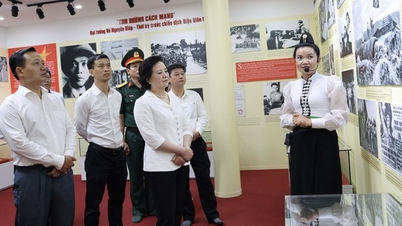
Although his private residence was at 30 Hoang Dieu Street – not far from the General Headquarters within the Imperial Citadel – General Vo Nguyen Giap frequently worked and rested there to promptly handle any situation. Therefore, House D67 was an indispensable part of the life of this renowned general. In the book "General Headquarters in the Spring of Total Victory" – Memoirs of General Vo Nguyen Giap (written by Pham Chi Nhan) – many unforgettable moments of the command staff during these momentous historical days at House D67 are recorded.
On March 26, when the General Staff sent Deputy Chief of Staff Giap Van Cuong as an envoy to Da Nang to prepare, General Vo Nguyen Giap summoned the newly appointed Commander of the Quang Da Front Le Trong Tan, Commander of the Navy Nguyen Ba Phat, Deputy Chief of Staff Cao Van Khanh, and several other generals and officers to discuss the plan to attack Da Nang.
At 6:00 AM on March 27th, while discussing the plan to liberate Da Nang with Commander Le Trong Tan and intelligence commanders, and studying the enemy situation, in response to suggestions that the enemy would withdraw within three, five, or seven days, General Vo Nguyen Giap decided to "instruct the preparation of a plan to attack the enemy based on the scenario of their withdrawal within three days."
That same day, after hearing the latest situation report from the Military Intelligence Department, General Vo Nguyen Giap sent another telegram to the II Corps with more specific instructions: “The enemy in Da Nang is in disarray... We need to quickly attack Da Nang. If there is any sign of enemy withdrawal, we must immediately launch a full-scale assault. If they regroup and hold their ground, we must surround them tightly and pin them down to prevent their retreat. At the same time, concentrate forces along Highway 14 and Highway 1, destroy the enemy, occupy the western and northwestern areas of the city, penetrate deep into the Trinh Minh The bridge, and block the enemy's retreat route through the Son Tra peninsula. Signed: Van.”
Following the complete victory in the campaign to liberate Da Nang on March 29, 1975, on April 1, the Central Military Commission sent a telegram of commendation from the General Headquarters to the Quang Da Front troops: “The Central Military Commission wholeheartedly commends all officers, soldiers, party members, and youth union members of the main and local forces, elite special forces, and self-defense forces of the Quang Da Front for thoroughly obeying orders, acting boldly and promptly, and coordinating with the people, in a very short time, destroying and dispersing all enemy forces, liberating the entire Quang Da province, especially Da Nang city, a most important enemy military base in South Vietnam. The Central Military Commission commends the merits of all comrades in the entire army for the brilliant victory achieved. Signed: Van.”
Source: https://baodanang.vn/tu-nha-d67-den-da-nang-ngay-29-3-1975-3329968.html
![[Photo] The courage of new recruits of Brigade 144 on the training ground.](https://vphoto.vietnam.vn/thumb/1200x675/vietnam/resource/IMAGE/2026/05/27/1779881651341_anh-man-hinh-2026-05-27-luc-18-32-52.png)


![[Photo] The heat at the fireworks display site on the opening night of the Da Nang International Fireworks Festival 2026](https://vphoto.vietnam.vn/thumb/1200x675/vietnam/resource/IMAGE/2026/05/27/1779889741485_ndo_br_z7872039145157-fecaba5112f39e8352544099d7ef4738-5140-jpg.webp)












































![[Photo] The courage of new recruits of Brigade 144 on the training ground.](https://vphoto.vietnam.vn/thumb/402x226/vietnam/resource/IMAGE/2026/05/27/1779881651341_anh-man-hinh-2026-05-27-luc-18-32-52.png)
















Comment (0)