

Streamlining must go hand in hand with improving management capacity.
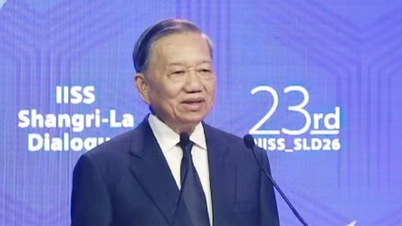
The first message from General Secretary and President To Lam's speech was the need to shift strongly from "completing the organizational restructuring" to "ensuring the smooth operation of the system." Organizational restructuring is necessary, even a prerequisite, but it is not the ultimate goal. The goal must be better governance, a more smoothly functioning political system, a more effective government, and a public service that truly puts the people and businesses at the center of its service.
Simply reporting how many departments have been eliminated, how many organizations have been restructured, and how many tasks have been transferred only reveals the "surface" of the reform. What needs to be examined more deeply is whether the new system addresses overlapping responsibilities, buck-passing, and avoidance of accountability; whether procedures are faster; whether citizens have to travel less; whether businesses reduce time and opportunity costs; and whether grassroots levels have the capacity to handle daily tasks. It is from these questions that organizational reform truly becomes substantive.
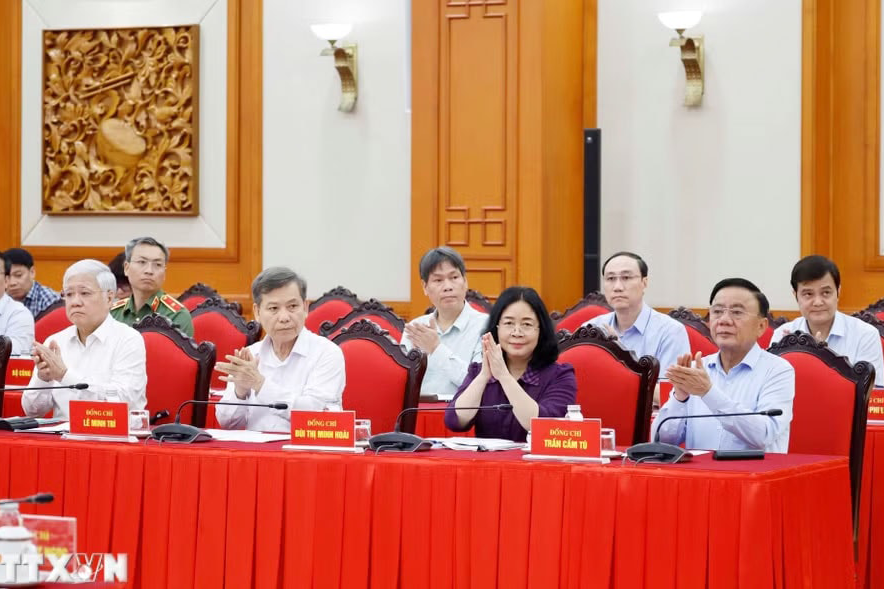
This message is particularly significant in the context of the country entering a new phase of development, with demands for higher growth, greater competitiveness, and better quality public service. A cumbersome bureaucracy will slow down development opportunities; but a streamlined system that doesn't operate smoothly will also fail to meet expectations. Therefore, streamlining must go hand in hand with improving governance capacity. Organizational stability must go hand in hand with innovation in working methods. Task assignment must go hand in hand with measuring results. Reform cannot simply be about "reorganizing," but about "doing better."
Decentralization and delegation of power must be accompanied by conditions for the exercise and control of power.
The second key message is that decentralization and delegation of power must be accompanied by conditions for the implementation and control of that power. This directly addresses one of the biggest issues today. We all agree that we must decentralize more strongly and grant more power to local and grassroots levels, because those closest to the people best understand their lives, their needs, and the bottlenecks in practice. But delegation of power cannot simply be a matter of transferring tasks from higher to lower levels. Delegation of power must be accompanied by the allocation of resources, tools, data, personnel, and mechanisms, while simultaneously establishing appropriate inspection and supervision mechanisms.
If tasks are assigned without adequate preparation, subordinates will find it difficult to perform, and officials will struggle to implement them. In reality, some tasks are delegated quickly, but officials haven't received sufficient training; procedures are decentralized, but the software, data, and infrastructure aren't interconnected; authority is granted, but financial resources are insufficient; and the demands for service are higher, but working conditions at the grassroots level are inadequate. In such cases, decentralization can become a burden, even a risk, for the implementing officials.
If decentralization is strong but lacks checks and balances, evaluation criteria, and mechanisms to control power, it can easily lead to misconduct, abuse of power, or a mentality of acting cautiously and fearfully, hesitant to make decisions or take responsibility. Therefore, true decentralization must be responsible, conditional, supervised, and protect those who dare to think, act, and take responsibility for the common good. This is the way to transform correct policies into correct results in life.
This message is all the more significant as commune-level governments are taking on many new responsibilities. The commune level is the closest to the people, where citizens interact with the government most frequently, and where all policies, no matter how significant, must pass through to become public services, administrative procedures, and ultimately determine people's satisfaction or dissatisfaction. If the commune level is weak, the entire operational model will be hampered. If the commune level is strong, adequately equipped with human resources, finance, data, digital infrastructure, and specialized support mechanisms, then reforms will truly impact the daily lives of the people.
A stronger, more efficient system that serves the people better.
The third message, and the overarching one, is that the ultimate goal of administrative reform is not to mechanically create a system with fewer bureaucracies, but to build a stronger, more transparent, more responsible, more efficient system that better serves the people. This is the highest measure of any reform. The administrative apparatus does not exist for its own sake. It exists to serve the nation, serve the people, create development, protect national and ethnic interests, and enable every citizen to enjoy the fruits of development.
Modern governance requires not only a rational structure but also modern leadership, management, operational, and implementation methods. This necessitates a strong shift from an administrative mindset to a service-oriented mindset; from management based on fragmented paperwork to data-driven governance; from evaluation based on workload to evaluation based on the quality of impact; and from general recommendations to recommendations that are clear, specifying authority, responsibility, roadmap, and specific address.
Here, digital transformation and data are not just technical tools, but the foundation of new governance. Technology is only effective when coupled with the right institutions, the right people, and the right public service culture. Good software cannot replace poor service; a large database cannot compensate for a lack of accountability; a new organizational model cannot succeed if old work habits remain.
Therefore, after a year of operating the new model, it is crucial to face the reality squarely. Areas that have performed well should be commended and replicated. Areas where there are still difficulties must have their causes clearly identified. Only by daring to look directly at the situation, speaking truthfully, and making accurate assessments can timely adjustments be made and social trust be built.
We are facing the demand for faster, more sustainable, more innovative, and deeper integration. To achieve this, the government apparatus must be capable of leading development. A nation cannot break through if its apparatus lags behind life, policies lag behind reality, procedures lag behind opportunities, and officials fear responsibility more than they aspire to action. Conversely, when the apparatus is efficient, institutions are transparent, responsibilities are clear, and authority is commensurate with resources, citizens and businesses will feel the reforms not in reports, but in their specific work.
Reforming the organizational structure must be thorough, but thorough doesn't just mean completing the reorganization; it means making the system function better every day. Decentralization must be strong, but it must provide sufficient conditions for subordinates to perform their duties. Control must be tight, but it shouldn't stifle the spirit of initiative. The system must be streamlined, but more importantly, it must be powerful. The government must be close to the people, but more importantly, it must be able to solve the people's problems.
This is also a requirement of modern national governance: efficiency in organization, effectiveness in implementation, efficiency in service, and humanistic goals. When reforms to the system are based on this foundation, we will not only have a more streamlined political system, but also one strong enough to lead the country into a new phase of development with greater confidence, courage, and aspirations.
Source: https://daibieunhandan.vn/tu-tinh-gon-bo-may-den-nang-cao-chat-luong-phuc-vu-10419072.html


![[Photo] Delegation attending the 14th Congress of the Vietnam Trade Union visits the Mausoleum of President Ho Chi Minh.](https://vphoto.vietnam.vn/thumb/1200x675/vietnam/resource/IMAGE/2026/06/03/1780451842301_ndo_br_img-3824-jpg.webp)




















![[Image] Affirming the aspirations and new standards of the Vietnamese real estate market in the new era.](https://vphoto.vietnam.vn/thumb/1200x675/vietnam/resource/IMAGE/2026/06/03/1780441948766_giai-thuong-bat-dong-san-2026-minh-duy-6-7364-jpg.webp)






























































Comment (0)