

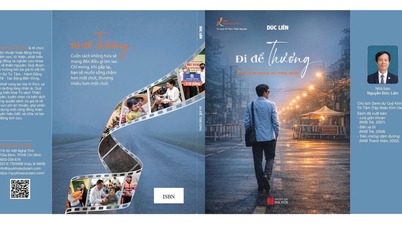
Scrolling through social media, I came across a post from a colleague who works at a publishing house about a recently published book with a rather paradoxical title: "Honeymoon in the Hospital."
Passing by with a song
I read the title again. People usually go on honeymoons by the sea, in the mountains, or in some faraway city to begin a new journey of marriage. But "honeymoon in a hospital"—it sounds both paradoxical and strangely sad.
But it was this very paradox that made me read on. And then, I delved into the story of Mr. Nguyen Trong Hung and Ms. Nguyen Thi Thien - a story that, the more I read, the more I understood: It seems that sometimes love has to go through a "death trap" to reveal its true form.
In 2019, Mr. Hung was diagnosed with acute leukemia. The devastating news came like a sudden thunderstorm in the middle of a sunny afternoon. A small, peaceful family suddenly had to learn to walk on a completely different path – the path of hospitals. From Nghe An to Hanoi , over three hundred kilometers, then from Hanoi back to their hometown, and then back again…
Those journeys were no longer measured by geographical distance, but by bone marrow biopsies, chemotherapy sessions, sleepless nights, and silent handshakes. Clearly, some families navigate illness with tears, grief, and despair. They persevere by optimistically holding each other's hands tightly.
Ms. Thien quit her job, leaving her young child with her mother to accompany her husband throughout his treatment. She didn't utter grandiose words; she was always by his side like a shadow. But that very shadow became the place he leaned on during the most painful days of his life.
There were days when the pain was so intense that "even a normal breath made my bones and marrow ache." He could only lie motionless in his hospital bed. Only after the doctors combined various painkillers and chemotherapy drugs could he sit up and eat a few spoonfuls of porridge. Yet, along the ward corridor, people still mentioned him with a very special remark: "We miss Rộ's singing voice so much."
I smiled involuntarily as I read that. It turns out that some people go through the hospital not just with medical records and exhausting injections. They also go through it with their singing. He once wrote: "There are days when I'm so tired I can't even say a word. But after a few days at home, when my chest pain eases a little, I start singing again. Please don't criticize my weak voice too harshly."
Their shared stories were as light as a breeze. But behind them lay an extraordinary spirit of resilience. Nearly seven years of treatment, sometimes they only got to go home once every three months or so. The hospital gradually became so familiar that they could name every corridor, every staircase, every window. People often say the "honeymoon" is the most beautiful time of a marriage. But for this couple, it was a six-year "honeymoon" spent in the hospital.
Once, he asked, "If there's a next life, would you still want to love Dad?" She replied softly, "If there's a next life... Dad, please don't be sick anymore, okay? I'm so afraid to see you in pain." He continued, "From the day he was born until the day he died, Dad only loved Bờm."
People often call phrases like that "cheesy." But when someone says it after hundreds of injections and thousands of hours of chemotherapy, it's no longer just words. It's a vow written in the very time they've spent together.
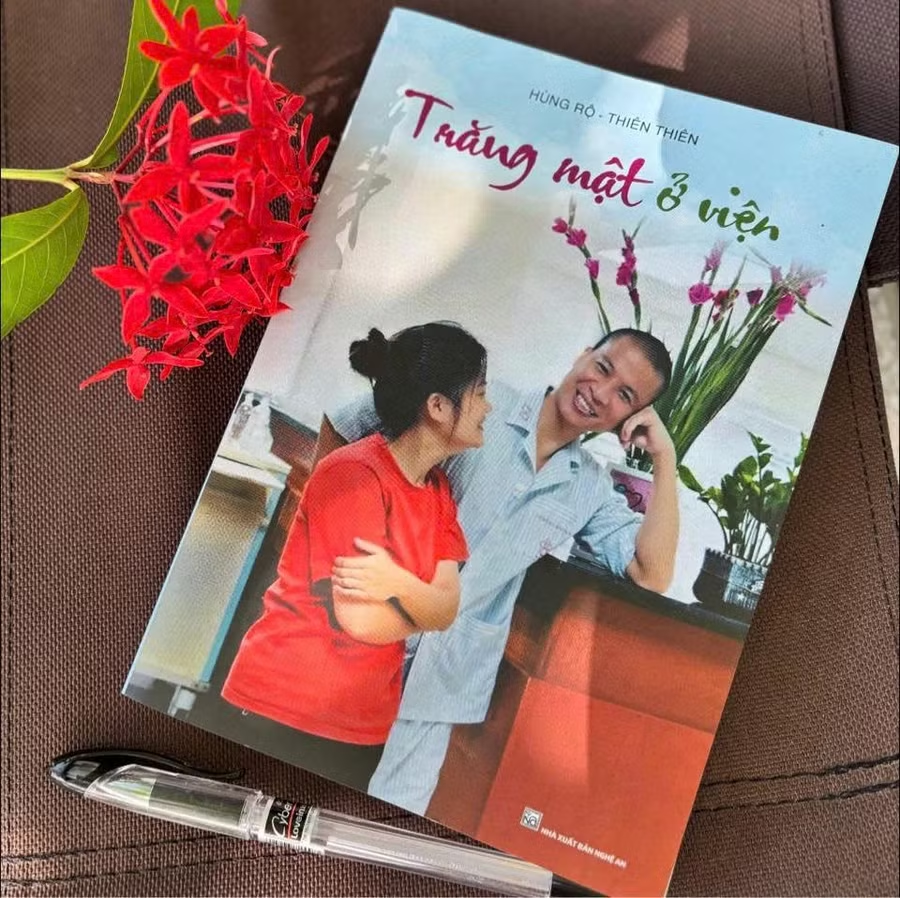
To love for one more day
What moved me most in their story wasn't their rare days of good health, but their most painful days. The days he spent in a wheelchair down the hospital corridor. The days she slept on the floor of the hospital room. The days they knew exactly what awaited them, yet they lived as if there were still many days ahead to love. And the day he smiled and passed away forever.
He once wrote: "The universe operates according to the law of impermanence. Because of impermanence, life is precious. To live another day is to cherish another day. To live another day is to love another day."
Reading those words, I suddenly understood that sometimes people only truly see the value of a day alive when they are very close to the fragile boundary of life. Perhaps not everyone needs to go through illness to understand this, but it was his calm words that made me realize: Living is not just about existing for another day, but about knowing how to love for another day – while we still can.
He once asked, "Why doesn't God grant Dad a miracle?" She replied, "Dad and I have been creating miracles for over six years now."
That's right. A miracle isn't about getting better. A miracle is about staying together. Staying together through every pain. Staying together through every chemotherapy session. Staying together until the very last day.
He left on April 19th. As lightly as someone who had kept a promise.
He once said, "Dad will leave on a beautiful sunny day." And he kept his word. After that day, she wrote, "Dad, come back to me. We'll plant flowers together and listen to the birds sing every day."
I read those lines very slowly. Then I suddenly understood why she called their journey a honeymoon in the hospital. Of course, it wasn't because the hospital was a beautiful place. But because it was there that they spent their closest, most loving days together.
She also wrote a line that I will always remember: "Dad isn't human, is he? Because humans want to live with the person they love."
I think you know the answer. He didn't leave like a person disappearing from this world. He's still here. He's still here in the songs that still echo somewhere along the hospital corridors. He's still here in the staircases they once walked slowly together through each treatment session. He's still here in the way you still call him by that very special name: "Bờm".
That lingering presence reminds me of the image of two skeletons intertwined in Victor Hugo's "Notre Dame de Paris"—where death could not separate two people who had loved each other their entire lives.
There are loves that aren't measured by the number of years spent together, but by how people held each other's hands through the most difficult times. And when you've held hands like that, even if one person goes away, the love remains – as a part of life, as a part of memory, as a part of who the other person is.
This morning, as I finished writing the story "Honeymoon in the Hospital," I suddenly thought: Perhaps we often believe we have plenty of time to love. But sometimes, the most precious thing in life is simply being together for one more day. One more day to hold hands, to call each other's names, to fully experience a "honeymoon"—no matter where in this world it may be.
Source: https://giaoducthoidai.vn/tu-trang-sach-phep-mau-la-van-o-lai-ben-nhau-post778605.html
![[Photo] Standing Committee member of the Party Central Committee Tran Cam Tu working with the Central Inspection Committee](https://vphoto.vietnam.vn/thumb/1200x675/vietnam/resource/IMAGE/2026/05/28/1779969579668_ndo_br_bnd-2495-jpg.webp)


























































Comment (0)