

The 500-year-old statue has become a treasure of Tra Lien village.
With a history spanning hundreds of years, Tra Lien village (Ai Tu commune, Quang Tri province ) is closely associated with history, having been chosen by Lord Nguyen Hoang as the location for establishing a garrison and building fortifications in 1558. Over the centuries, while the structures have been destroyed by time and war, a nearly 500-year-old ancient statue remains, preserved and protected, becoming a treasure of the village.
According to Mr. Ho Si Ut (77 years old, head of Tra Lien village), this statue depicts Grand Tutor Nguyen U Di, a founding figure of the Nguyen dynasty and also the maternal uncle who assisted and nurtured Lord Nguyen Hoang.
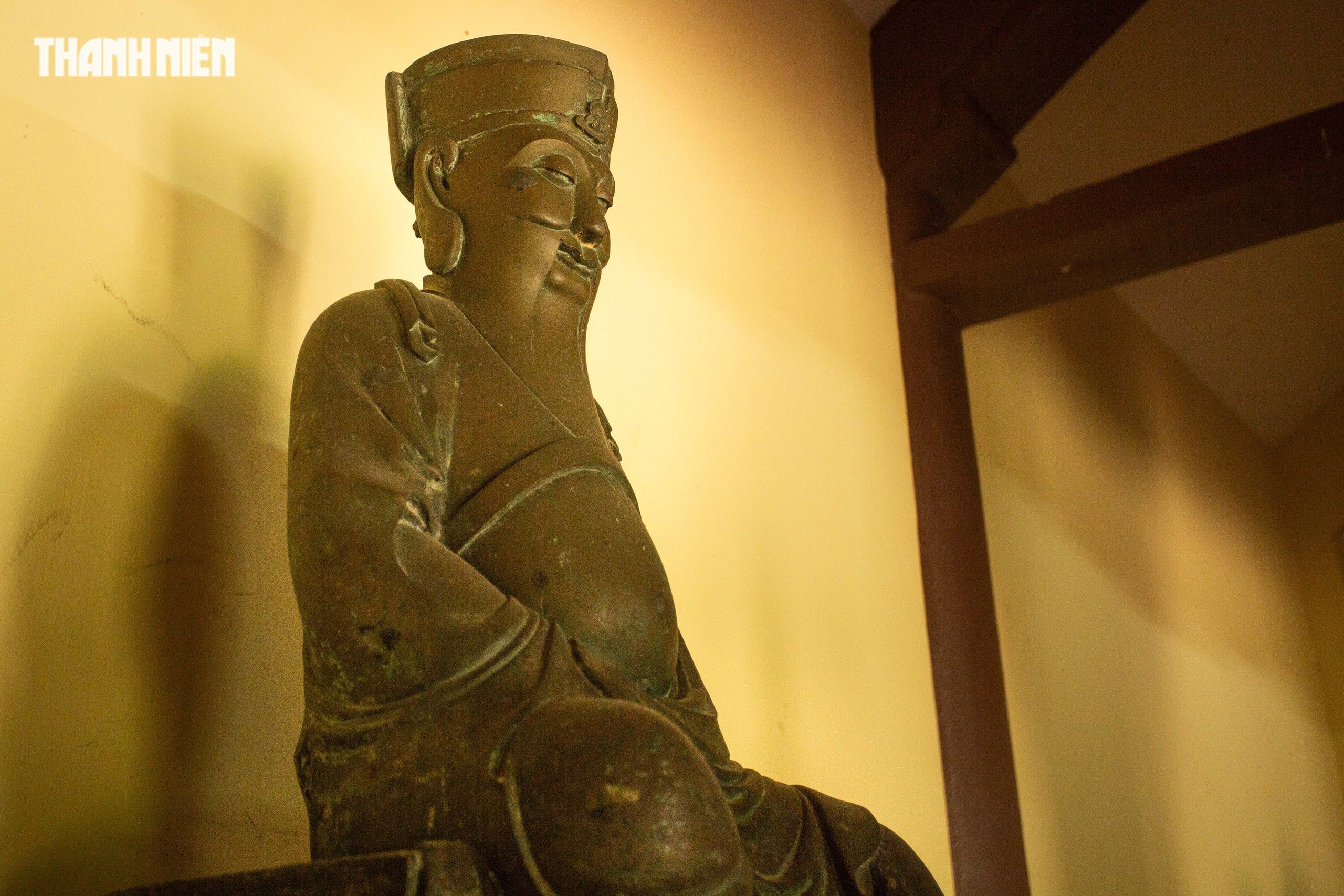
The statue of Grand Tutor Nguyen U Di is cast in solid bronze and weighs over 300kg.
PHOTO: BA CUONG

For the people of Tra Lien village, this statue is the embodiment of a saintly figure, the "guardian deity" of the village, worshipped with many spiritual rituals.
PHOTO: BA CUONG

No one knows the exact author and age of the statue, but according to the elders in Tra Lien village, the statue is around 500 years old.
PHOTO: BA CUONG
"The exact year the statue was created is still unknown, but from what I've learned from historical records, after the death of Grand Tutor Nguyen U Di, Lord Nguyen Hoang had the statue cast in what is now Thanh Hoa province, and then brought it to be worshipped at Lieu Ba Pagoda in Tra Lien village," Mr. Ut said.
In 1972, the Lieu Ba pagoda was destroyed by war, and the statue was moved to the communal house of Tra Lien village, placed inside a small shrine. During this period, until 2016, the statue was repeatedly stolen but was always found and remains in Tra Lien village to this day.

Mr. Ut has been taking care of and protecting the statue for the past 6 years.
PHOTO: BA CUONG

The temple dedicated to Thái phó Nguyễn Ư Dĩ was completed in 2022 on a plot of land approximately 1 hectare in size in Trà Liên village.
PHOTO: BA CUONG


The two central pillars of the temple are carved with Chinese characters praising the founding achievements and peaceful life brought to the people by Grand Tutor Nguyen U Di.
PHOTO: BA CUONG
"The last time the statue was stolen was in 2016 when it was still worshipped at the village temple. Thieves took the statue across the river in a bamboo boat, but the boat unexpectedly broke, and they buried it on the riverbank. The whole village, from the local authorities to the villagers, searched for it. We even relied on spiritual beliefs, and after three days we knew where the thieves had hidden the statue," Mr. Ut recounted.

Mr. Ut said that the statue of the Grand Tutor is very sacred and has become a treasure of the entire village.
PHOTO: BA CUONG

Mr. Ut pointed out the signs of thieves breaking into the house and stealing the donation money.
PHOTO: BA CUONG
In 2020, local authorities and philanthropists donated funds to build a temple dedicated to Thái phó Nguyễn Ư Dĩ in an area about 100 meters from the old Liễu Ba pagoda. In 2022, the statue was solemnly carried by the villagers to the newly built temple, and since then, the statue of Thái phó Nguyễn Ư Dĩ has been worshipped by the people as a sacred treasure of the village.

Among the founding fathers of Lord Nguyen Hoang, Grand Tutor Nguyen U Di was the foremost figure due to his immense contributions in helping Lord Nguyen Hoang establish his great empire.
PHOTO: BA CUONG
"Not long ago, a thief broke into the temple and stole over 4 million dong from the donation box. While prying open the door, the thief was injured when the door hit him in the neck, which helped us track down the thief. From a spiritual perspective, many people believe that the statue is very sacred and that no wrongdoing should be done here," Mr. Ut added.
According to historical records, Grand Tutor Nguyen U Di was a historical figure closely associated with the southward expansion of Lord Nguyen Hoang. In 1558, Lord Nguyen Hoang, then 34 years old, was assisted by Nguyen U Di in choosing Ai Tu land, now Ai Tu commune (Quang Tri province), to establish his encampment, beginning the southward expansion of the country by the Nguyen lords and the later Nguyen dynasty.
Source: https://thanhnien.vn/tuong-co-500-nam-tuoi-4-lan-bi-danh-cap-van-tro-ve-lang-185260508163127492.htm

![[Image] Close-up view of the interchange connecting the two expressways and Long Thanh Airport.](https://vphoto.vietnam.vn/thumb/1200x675/vietnam/resource/IMAGE/2026/05/25/1779703378210_ndo_br_z7863716673926-224453a31600126cce10622af6290afd-4549-jpg.webp)



![[Image] Hanoi's urban life under the challenge of a "scorching hot" environment](https://vphoto.vietnam.vn/thumb/1200x675/vietnam/resource/IMAGE/2026/05/25/1779706979265_nang-nong-t5-2026-minh-duy-7-4636-jpg.webp)















































































Comment (0)