

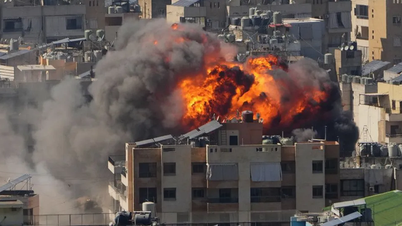
The United Arab Emirates (UAE) has conducted dozens of airstrikes against Iran during the conflict, with a much deeper level of involvement than had previously been publicly disclosed, according to a Wall Street Journal report citing sources familiar with the matter.
According to reports, the air campaign began in the early days of the war and continued until a day after the ceasefire was announced in April.
Deepening internal disagreements in the Gulf region.
Sources indicate that these attacks were carried out in coordination with the United States and Israel, both of which provided intelligence for the operation.
The targets of the airstrikes included the islands of Qeshm and Abu Musa in the Strait of Hormuz, the port city of Bandar Abbas, oil refineries on Lavan Island in the Persian Gulf, and Iran's Asaluyeh petrochemical complex.
Some of the attacks targeted Iranian energy facilities directly, believed to be in retaliation after Tehran targeted the UAE's oil and gas infrastructure.
Notably, the airstrike targeting the Asaluyeh petrochemical complex, carried out in coordination with Israel, drew strong reactions from the international community. According to the Wall Street Journal , the incident prompted Washington to urge Tel Aviv to cease attacks on Iranian energy facilities.
Among the Gulf states, the UAE is believed to have suffered the most intense attacks from Iran. Tehran has launched more than 2,800 missiles and drones targeting the UAE, more than any other country, including Israel.
The scale of the UAE's military response is seen as a sign that Abu Dhabi is increasingly willing to use force to protect its core strategic interests, according to Turkye Today . This approach differs significantly from many of its Gulf neighbors, who have opted for a more cautious stance toward Iran.
According to reports, in early April, Saudi Arabia expressed concern to the US that the UAE's attacks risked making energy facilities in the region targets for Iranian retaliation.
Riyadh reportedly wants Washington to pressure the UAE to end its retaliatory airstrikes and engage more in regional diplomatic efforts.
Meanwhile, the UAE Foreign Ministry asserted that Iran bears full responsibility for the attacks and the resulting consequences of the conflict.
Unlike Abu Dhabi, Saudi Arabia publicly condemns attacks in the Gulf region but maintains a less confrontational approach, prioritizing diplomatic means to manage tensions.
Are UAE-Israel relations becoming closer?
According to the Wall Street Journal , the war also helped to elevate cooperation between the UAE and Israel to a new level.
During the conflict, Israel deployed Iron Dome air defense systems and troops to the UAE to help protect the Gulf nation. Dozens of Israeli soldiers remain stationed at a military facility in the UAE.
The report also revealed that Israeli Prime Minister Benjamin Netanyahu, along with several high-ranking security officials, including the leaders of Mossad, Shin Bet, and the Chief of Staff of the Israeli army, secretly traveled to the UAE during the conflict to coordinate operations related to Iran.
Beyond the military front, the UAE also supports draft resolutions at the United Nations authorizing the use of force if necessary to end Iran's control over the Strait of Hormuz.
Abu Dhabi is also believed to have implemented numerous economic pressure measures against Tehran, including closing schools and clubs linked to Iran in Dubai, and denying visas and transit rights to Iranian citizens.
In recent times, Iran has repeatedly accused the UAE of participating in the military campaign led by the US and Israel against Tehran.
However, according to the Wall Street Journal , the UAE's stance has recently shown signs of softening as it increasingly promotes diplomatic solutions, amid a protracted conflict that puts its strategic energy facilities at direct risk.
Source: https://znews.vn/uae-bi-mat-cung-my-israel-khong-kich-iran-post1655553.html


![[Image] Nearly 125,000 Hanoi students completed the Literature exam for the 10th grade entrance exam.](https://vphoto.vietnam.vn/thumb/1200x675/vietnam/resource/IMAGE/2026/05/30/1780117233041_ndo_br_thiet-ke-chua-co-ten-2-png.webp)

















































































Comment (0)