

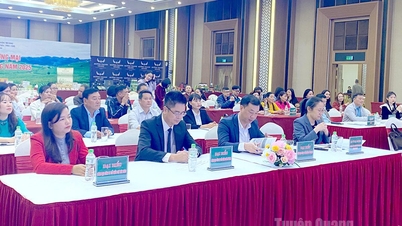
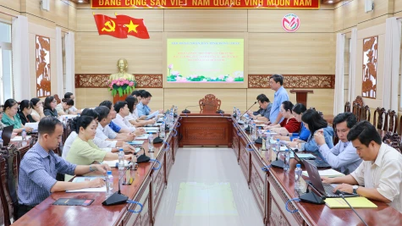
The conference focused on tasks and solutions to strengthen, expand, and improve the operational efficiency of cooperatives; and to integrate relevant projects and programs to effectively implement the task of linking rice production with consumption through contracts in 2025.
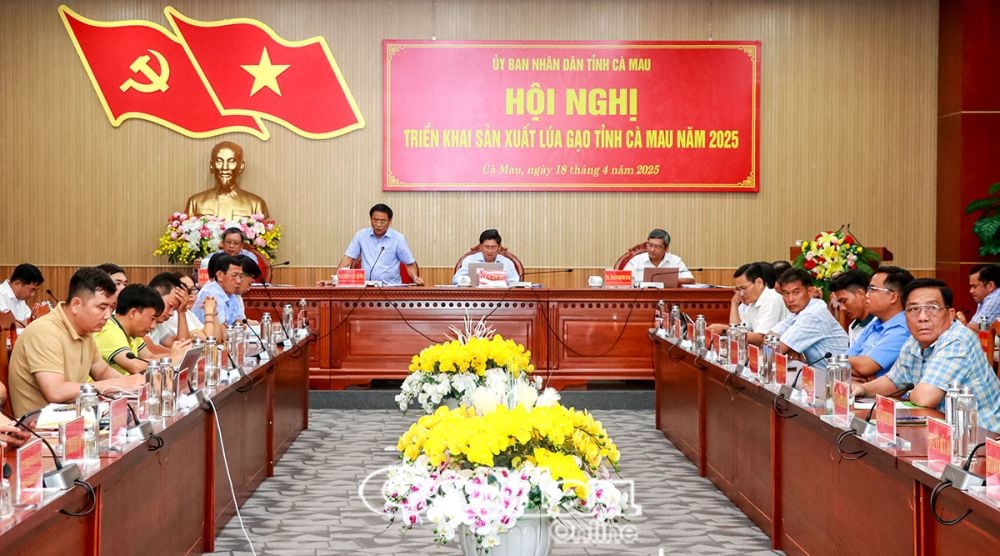
Ca Mau province has several favorable natural conditions for producing high-quality rice, especially meeting VietGAP, GlobalGAP, and organic standards both domestically and internationally.
To date, the province has a total rice production area of 75,000 hectares, including 35,000 hectares of double-cropping rice, 37,000 hectares of rice-shrimp farming, and approximately 3,000 hectares of seasonal rice; the average yield is 5 tons/ha; about 40% of the production is consumed within the province and 60% is for export. Regarding the structure of rice varieties planted over the years, high-quality rice accounts for about 60-65% of the area, specialty rice accounts for 30%, and medium-quality rice accounts for 5-10%.
Despite many favorable conditions, rice production in the province also faces numerous challenges.
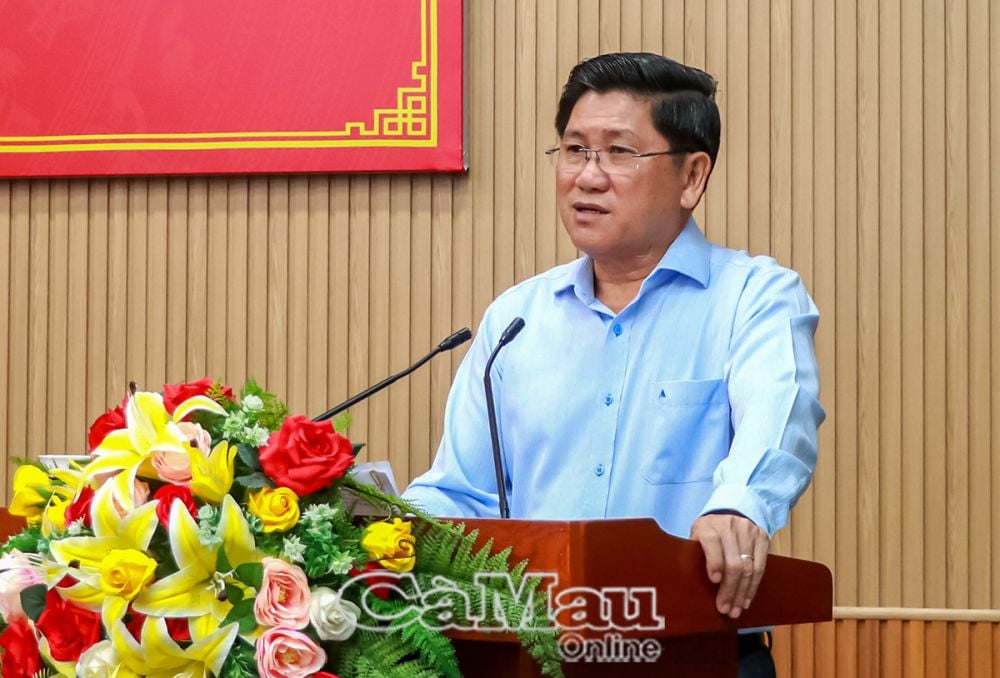
Speaking at the conference, Vice Chairman of the Provincial People's Committee Le Van Su pointed out difficulties such as: the province's rice production is dependent on weather conditions and lacks access to supplementary freshwater from the Mekong River, making it difficult to proactively manage water resources during the dry season; production organization remains fragmented, cooperative economic activities and production and consumption linkages are very limited and unsustainable; the application of new technologies such as digital transformation and mechanization in rice production, although progressing, is still slow; and the utilization and development of by-products other than rice have not been fully exploited.
Over the past period, to develop the rice industry, various sectors and local authorities have implemented over 50 models of rice production. Typical examples include safe rice production, organic rice, ecological rice, rice-shrimp farming, rice-fish farming, and colored rice production. Specifically, 400 hectares of rice meet Vietnamese organic standards, 330 hectares meet USDA, EU, and JAS standards, 1,248 hectares meet VietGAP and GlobalGAP standards, and 3,000 hectares meet ecological rice standards. Three rice raw material zones have been established: a high-quality rice zone of 25,000 hectares, a specialty fragrant rice zone of 10,000 hectares, and a processing rice zone (OM 576, OM 2517) of 5,000 hectares.
The entire province has established 22 rice production and consumption linkage chains (2020-2022) covering an area of 8,000 hectares and consuming 40,000 tons of rice, accounting for 8% of the province's total rice production. However, from 2023 to the present, these linkage chains have broken down, with businesses shifting to ordering rice from traders and cooperatives closer to harvest time.
According to Mr. Le Thanh Tung, Vice President and General Secretary of the Vietnam Rice Industry Association (VIETRISA), for sustainable linkages to be maintained, businesses, farmers, and cooperatives must aim not only for profit but also to preserve the long-term value of the product. At the same time, local authorities must also get involved to support farmers and businesses.
"The market trend is towards safe products, and now the time has come when if a product cannot be traced back to its origin, we cannot sell it, let alone at a high price," Mr. Tung stated, highlighting the reality.
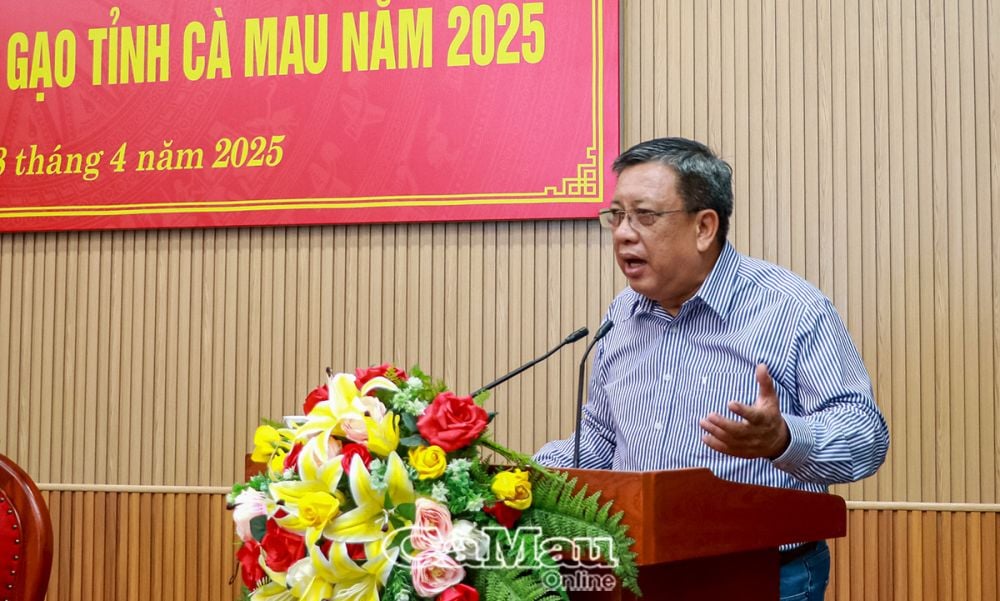
Mr. Huynh Chi Phuong, Director of SDC Co., Ltd., said that the company has not invested in Ca Mau in the past because investing there carries higher risks compared to other provinces and cities. This is because rice grown on shrimp farming land in Ca Mau is mainly harvested by hand, and this harvesting method reduces the quality of the rice, especially during stormy weather. Furthermore, local people want to harvest both rice and shrimp.
According to Mr. Nguyen Tran Thuc, Head of the Department of Crop Production and Plant Protection, the plan for 2025 is for the entire province to cultivate rice on an area of 81,500 hectares, with a total planted area of 116,651 hectares. Of this, over 60% will utilize advanced farming techniques; fertilizer and pesticide use will be reduced by 25% or more; and greenhouse gas emissions will be reduced by 10%.
The goal is to achieve a production output of 550,000 tons; of which, approximately 350,000 tons of paddy rice, equivalent to 200,000 tons of milled rice, will be consumed outside the province and for export. The aim is to establish production linkages with consumption (through contracts) covering 15% of the cultivated area. Simultaneously, a pilot model for high-quality, low-emission rice production linked to green growth will be implemented on a scale of 1,180 hectares.
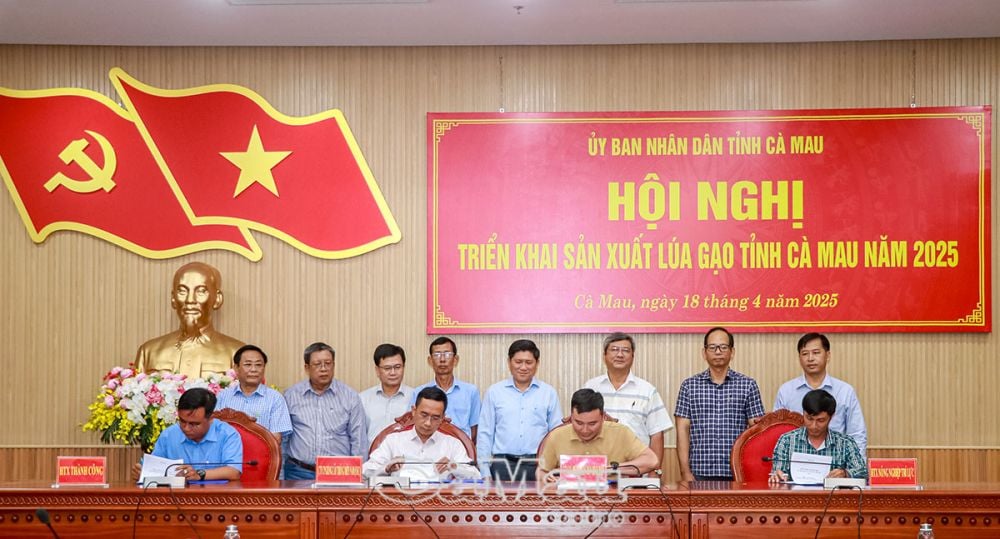
To achieve this plan, Vice Chairman of the Provincial People's Committee Le Van Su directed the Department of Agriculture and Environment and the Office to review and advise the Provincial People's Committee on future tasks, focusing on developing new technologies, mechanization in production, seeds, etc.
“The Department of Agriculture and Environment, in coordination with relevant units, will review current rice production processes, quality management, and contract implementation in the linkage, in order to build a rice production linkage chain. In carrying out this task, it is necessary to clearly define the timeframe, the person in charge, and the required results,” the Vice Chairman of the Provincial People's Committee emphasized.
The Vice Chairman of the Provincial People's Committee also directed localities to focus on reorganizing the production of cooperatives, with an emphasis on linkages and cooperation in production through services such as joint purchasing and joint selling, etc.
Nguyen Phu
Source: https://baocamau.vn/ung-dung-cong-nghe-moi-vao-san-xuat-lua-gao-a38453.html

![[Photo] Enchanting ancient rose garden on the mountainside in Nghe An](/_next/image?url=https%3A%2F%2Fvphoto.vietnam.vn%2Fthumb%2F1200x675%2Fvietnam%2Fresource%2FIMAGE%2F2025%2F12%2F19%2F1766109900916_vuon-hong-chin-do-thu-hut-du-khach-toi-check-in-o-ha-noi-3-20162778-1671624890024-1671624890104198100259.jpeg&w=3840&q=75)

![[Photo] General Secretary To Lam visits the exhibition space showcasing books, photo exhibitions, and achievements of digital transformation in journalism.](/_next/image?url=https%3A%2F%2Fvphoto.vietnam.vn%2Fthumb%2F1200x675%2Fvietnam%2Fresource%2FIMAGE%2F2025%2F12%2F19%2F1766110879215_1766110240024-jpg.webp&w=3840&q=75)





















































Comment (0)