

The Hien Luong-Ben Hai historical site is located in the communes of Vinh Thanh, Vinh Giang, Vinh Son, and the town of Cua Tung in Vinh Linh district, and Trung Hai commune in Gio Linh district, Quang Tri province. Whenever the Hien Luong bridge is mentioned, the people on both banks of the river in Vinh Linh and Gio Linh districts of Quang Tri province cannot help but feel nostalgic and emotional, remembering the poignant verses of a bygone era: "Hien Luong, one stream, two currents / Though people are on one side, their hearts are on the other."
 |
Every moment by the Hien Luong River was filled with emotion. |
These verses, imbued with the sentiments of Quang Tri, also reflect the feelings of an entire nation that endured the division of its land. The Hien Luong Bridge now stands as both a historical landmark and a symbol of the aspiration for peace, the will to unify the country, and the national pride that remains ever-present in the heart of every Vietnamese person.
 |
A vibrant atmosphere prevails in anticipation of the national reunification celebration. |
Amidst the painful years of separation, in 1957, on a melancholic afternoon, composer Hoang Hiep wrote the song "A Song by the Banks of Hien Luong River," expressing the unending longing of a mother from the South for her son who had relocated to the North, the faithful message of a wife to her husband, and the steadfast love of a couple separated by war.
 |
The red flag with a yellow star flies proudly in the wind. |
The simple lyrics: "Oh boat, oh boat, do you remember the shore? The shore steadfastly waits for the boat" or "Tell whoever always keeps their vow/Through the storm, their heart remains true" have become the shore, the landmark of faith, the symbol of unwavering loyalty and the never-ending aspiration for reunification.
 |
People from all over the country come here to commemorate those historical years. |
It took 21 years of protracted resistance, with countless losses and sacrifices from comrades and compatriots, for our nation to regain independence and reunify the country in the spring of 1975. Today, the Hien Luong-Ben Hai historical site has become an attractive tourist destination, rich in cultural and historical value.
With indelible marks on the journey of the struggle for independence and national reunification, the historical site plays an important role in educating about patriotic traditions, fostering national pride, and raising awareness of sovereignty , independence, and territorial integrity for present and future generations.
 |
Both sides shared the joy of reunification. |
Recognizing this significant value, on December 9, 2013, the Prime Minister signed Decision No. 2383/QD-TTg classifying the Hien Luong-Ben Hai riverside historical site as a special national historical site.
Throughout our nation's history, there have been rivers that have carried the weight of so much sorrow, longing, and heartbreak. The Ben Hai River and Hien Luong Bridge in the narrow central region bear the scars of that time's division. The boundary was where "the North built mounds, the South built ramparts," the two regions separated by only a hair's breadth, yet they had to wait endlessly for the day of reunification.
The Hien Luong Bridge is 183.65m long, 5.50m wide, with a traffic lane of 3.20m. Construction began in 2001 and it was inaugurated in 2008 (the bridge was destroyed by American bombs in 1967). To preserve this historical landmark, the bridge was reconstructed according to the design of the iron bridge built by the French in 1952.
 |
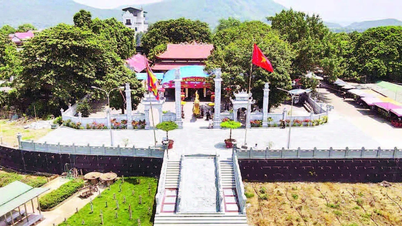
The national flag pole stands majestically, symbolizing the aspiration for peace. |
The historical site also includes a reconstructed multi-story building, modeled after a four-roofed stilt house, with its facade facing National Highway 1A. The Hien Luong Flagpole (Hien Luong Monument) consists of a base and a flagpole. The base is a whole architectural structure built higher than the surrounding ground level of the site. The flagpole has a total height of 28 meters and is made of six interconnected steel pipe sections.
In addition, the historical site also features a loudspeaker system and an exhibition hall titled "The 17th Parallel and the Aspiration for Unification," built on the south bank. This hall includes a ceremonial hall (with a statue of President Ho Chi Minh and a bas-relief behind it) and an exhibition hall. This space currently houses 53 documents and artifacts directly related to the fighting of our army and people on both banks of the Hien Luong-Ben Hai River during the resistance war against the US for national liberation.
 |
Many tourists dream of walking across Hien Luong Bridge – an important landmark of the nation's history. |
The "Aspiration for Unification" monument complex, located on the south bank of the Ben Hai River, east of National Highway 1A, covers an area of 2,700 square meters and consists of two parts: the base, with its side panels featuring bas-reliefs assembled from numerous stone blocks of varying sizes; and the statue itself, depicting a mother from the South and her son, crafted from green stone, representing the unwavering faith of the people of the South in a future victory and national reunification.
 |
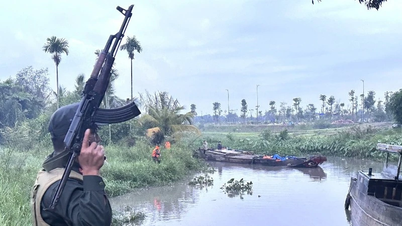
The Ben Hai River flows peacefully and poetically alongside the remnants of war. |
Along the Hien Luong-Ben Hai riverside historical site, there are many ferry landings. The Cua Tung ferry landing (ferry landing A) is located within an area of 187.6 square meters and is surrounded by a fence. The memorial plaque depicts boats braving the waves to transport cadres and soldiers across the river.
The Tung Luat ferry landing (ferry landing B) used to stretch along a 150-meter section of the Hien Luong River on the north bank, in Tung Luat village, Vinh Giang commune. The memorial features images of boats speeding forward, defying all dangers and enemy bombs, transporting goods and soldiers to the battlefield to fight the Americans night after night. In addition, there is the Luy ferry landing, now only a trace remaining and no longer in use; the Thuong Dong and Duc Duc ferry landings...
 |
In the late spring, early summer sunshine, the landscape bursts with life. |
According to the Monument Management Board, in addition to preservation and restoration, the National Reunification Festival is held here on April 30th every year. This is a unique revolutionary festival, exclusive to the Hien Luong-Ben Hai historical site, with deeply meaningful and sacred content, creative forms, fulfilling the task of educating about revolutionary traditions, attracting tourists, and contributing to the socio-economic development of the locality.
 |
Many tourists have traveled long distances by motorbike to witness firsthand the beauty of the Hien Luong-Ben Hai riverbanks. |
The writer Xuan Duc (a former soldier of the 270th Regiment, a unit that protected the border during the war against the US to save the country) wrote emotionally in his eulogy read at the first National Reunification Festival in 2000: "Taking the shirt to the river to wash, the shirt is worn out but the heart remains pure/Taking the net down to the dock to dry, the net is dry but the eyes are filled with blood/Love in a letter, a folk song on Hien Luong dock..."
Regarding the archetype of the woman who "takes her clothes to the river to wash them," writer Xuan Duc once shared that it was the image of Mrs. Tran Thi Dinh. The writer heard many people in the village recount that her house was quite far from the Ben Hai River bank, but every day she would use the excuse of going to the river to wash her clothes so she could look across to the north bank, where her husband, an armed police officer, stood guard on the north bank of Hien Luong Bridge.
Source: https://nhandan.vn/ve-dep-thanh-binh-cua-doi-bo-hien-luong-ben-hai-post871305.html
![[Photo] Delegation attending the 14th Congress of the Vietnam Trade Union visits the Mausoleum of President Ho Chi Minh.](https://vphoto.vietnam.vn/thumb/1200x675/vietnam/resource/IMAGE/2026/06/03/1780451842301_ndo_br_img-3824-jpg.webp)






















































Comment (0)