

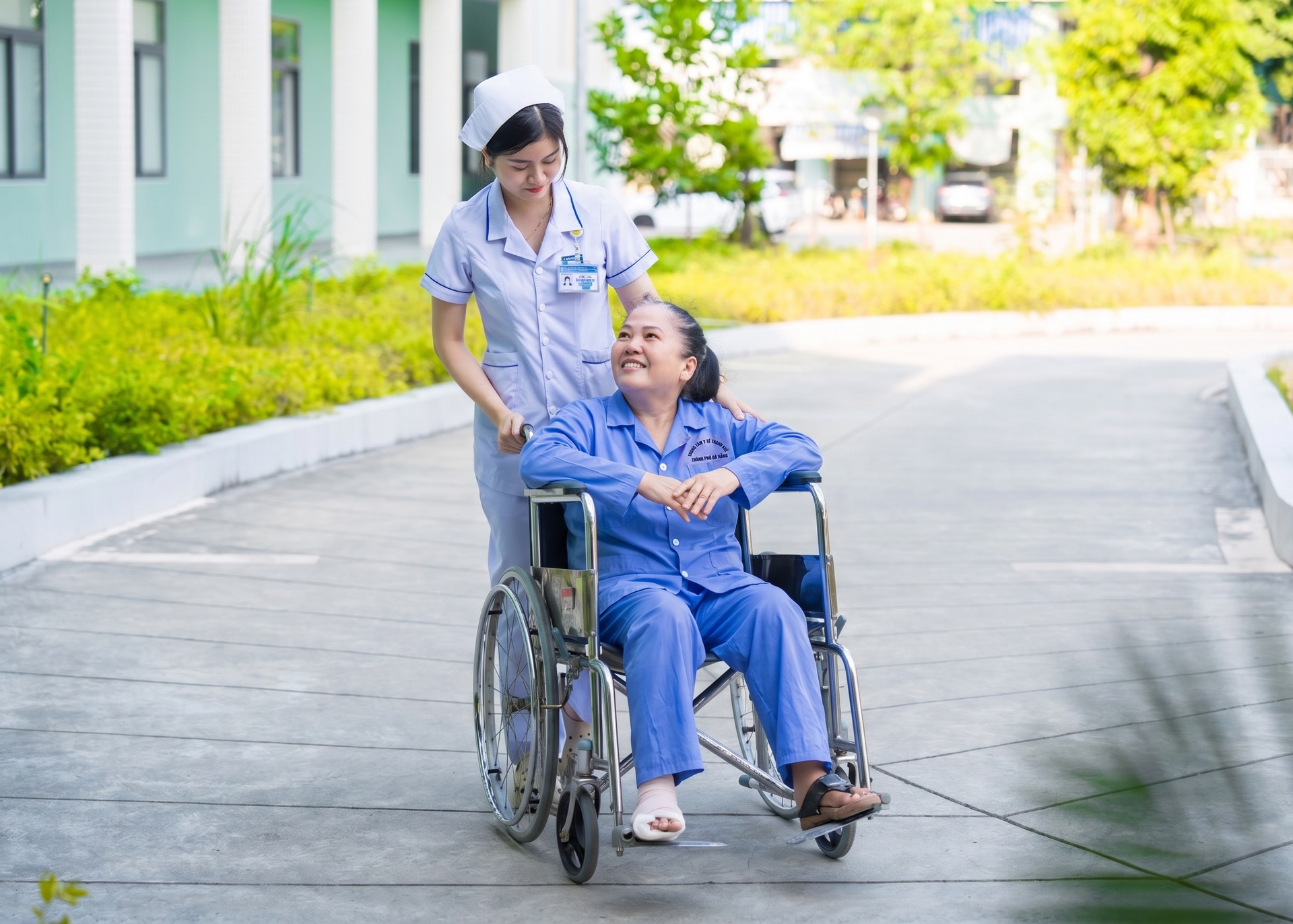
This year's International Nurses Day theme affirms the core role of nurses in the healthcare system and the importance of empowerment to improve the quality of care, thereby saving more lives. On this occasion, in an interview with Da Nang Newspaper and Radio & Television, Ms. Nguyen Thi Phuc, President of the Da Nang City Nurses Association, shared insights into the current transformation of nurses, midwives, and medical technicians.
* Madam, how has the role of nurses in the healthcare system changed compared to the past?
- Nurses are present at every stage, from receiving and guiding patients, monitoring their vital signs, performing care techniques, assisting doctors in treatment, to providing health education and counseling, and accompanying patients after discharge. In many cases, nurses are the ones who spend the most time with patients and are able to promptly detect even small changes in their health.
While nurses were previously primarily seen as assisting doctors, carrying out medical orders, and providing care as assigned, this role has now changed significantly.
Nurses not only perform functions dependent on medical orders but also develop a more independent function in nursing assessment, diagnosis, planning, implementation, and evaluation of care interventions.
At the same time, nurses coordinate with doctors, pharmacists, medical technicians, and other professional staff in the process of treating and caring for patients. Through this, nurses play a crucial role in monitoring patient progress, providing health education and counseling, preventing complications, controlling infections, and ensuring patient safety.
In daily practice, nurses closely monitor patients' condition. Small changes in pulse, blood pressure, respiratory rate, consciousness, risk of falls, or signs of infection all require meticulous observation and timely response.
Currently, nursing practices in healthcare facilities are organized with a patient-centered approach, emphasizing comprehensive, continuous, humane, and evidence-based care. Nurses today are no longer passive "stand-in" but have become professional partners with patients and their families throughout the treatment process.
.jpg)
* How is digital transformation impacting the work of nurses, Madam?
- Digital transformation is creating profound changes in the daily work of nurses. While previously care record keeping was primarily paper-based, many healthcare facilities have now implemented electronic medical records, electronic care forms, and patient management software.
The application of technology helps reduce paperwork, increase accuracy in record-keeping, support patient monitoring, and improve the effectiveness of quality care supervision. If implemented effectively, digital transformation also allows nurses more time for direct care and communication with patients.
However, this process also presents many challenges as nurses must adapt to new software and update their IT skills while maintaining a heavy workload. In some remote areas, where technological infrastructure is limited, appropriate support plans are needed.
During the 2025-2030 term, the Da Nang City Nursing Association identifies digital transformation as one of its key tasks, aiming to enhance the application of information technology in membership management, implement electronic care records, and provide digital skills training for nurses.
How would you assess the professional quality of the current nursing staff?
- Overall, the professional quality of nurses, midwives, and medical technicians in the area is constantly improving. Many members proactively pursue further education, obtaining undergraduate and postgraduate degrees, participating in continuing education, scientific research, and quality improvement activities.
During the period 2023-2025, the Da Nang City Nursing Association organized numerous training programs on nursing management, specialized care, infection control, and nursing research. In 2025, the association will implement training courses on the themes "Modern Nursing Practice: Standardization - Connectivity - Digitalization" and "Application of Artificial Intelligence in Nursing."
Scientific research activities have also been intensified, with approximately 20-30 research projects or innovative initiatives each year, many of which are presented at domestic and international scientific conferences.
Despite the achievements, there are still difficulties such as uneven professional qualifications across different levels; limited foreign language and scientific research capabilities among some members; and high work pressure making participation in continuous training less convenient.
* In your opinion, what needs to be done to improve the status of the nursing profession in society?
- First and foremost, we need to change societal perceptions of the nursing profession. Nursing is not just about "assistant" roles in hospitals; it's a professional occupation requiring clear knowledge, skills, ethical standards, and professional responsibilities.
To enhance the status of the nursing profession, it is necessary to focus on several solutions such as continuing to standardize professional competence through continuous training and specialized training; empowering nurses genuinely within their areas of expertise; and building a safe, professional, and respectful work environment.
This also includes strengthening communication about the role and contributions of nurses; promoting scientific research, quality improvement, and digital transformation in nursing; and establishing mechanisms for recognition, rewards, and appropriate career development opportunities. Every act of empathy, sharing, and practical support policy will be a source of encouragement for nurses to continue their commitment to the profession, contributing to improving the quality of healthcare for the people.
Thank you for the conversation!
The Da Nang City Nurses Association has over 6,000 members.
Following organizational restructuring, the Da Nang City Nurses Association currently has 53 affiliated branches with a total of 6,084 members. The membership is distributed across city-level hospitals, regional general hospitals, specialized hospitals, regional health centers, private healthcare facilities, training institutions, and healthcare management units.
Some units have a large number of members, such as Da Nang Hospital with 962 members, Da Nang Obstetrics and Pediatrics Hospital with 581 members, Quang Nam Northern Mountain Region General Hospital with 487 members, Quang Nam General Hospital with 477 members, and Quang Nam Regional General Hospital with 320 members… Not only concentrated in top-tier hospitals, nurses, midwives, and medical technicians are also present in many regional health centers, remote areas, and mountainous regions. This force plays a crucial role in providing primary healthcare for the people.
Source: https://baodanang.vn/vi-nguoi-benh-trao-quyen-cho-dieu-duong-3336237.html
![[Image] Hanoi's urban life under the challenge of a "scorching hot" environment](https://vphoto.vietnam.vn/thumb/1200x675/vietnam/resource/IMAGE/2026/05/25/1779706979265_nang-nong-t5-2026-minh-duy-7-4636-jpg.webp)































































































Comment (0)