

US interest rate policies and conflicts in the Middle East have caused the USD to repeatedly reach new highs against other currencies globally.
Since the beginning of the year, the US dollar has been steadily rising. The Dollar Index – an index measuring the strength of the greenback against a basket of major world currencies – is currently around 106 points, close to the 5-month peak set on April 16th.
Last week, the Dollar Index rose 1.7% – its strongest gain since September 2022. This year, the index has increased 5%.
On April 16th, the yen briefly fell to its lowest level in 34 years against the USD. Since the beginning of the year, the yen has depreciated by nearly 9%, currently standing at 154.6 JPY per USD.
The USD also reached a 5-month high against the euro this week. Currently, one euro is worth 1.06 US dollars.
Bloomberg data also shows that almost all of the 23 emerging market currencies have depreciated against the US dollar this year. The Indian rupee has fallen to a record low. The Malaysian ringgit is also nearing its lowest level since the 1998 Asian financial crisis.
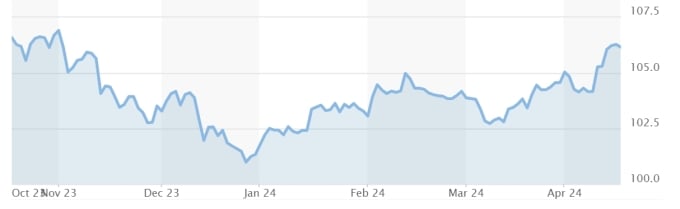
The Dollar Index's performance over the past year. Chart: Market Watch
Reuters suggests that the main reason for the USD's appreciation is the market's bet that the US Federal Reserve (Fed) will keep interest rates high for some time longer to curb inflation. The interest rate differential between the US and other economies makes assets priced in USD attractive, thereby driving the US dollar higher.
US inflation has accelerated again in recent months. The consumer price index (CPI) for March, released last week, showed prices rising by 3.5%, nearly double the Fed's target.
Immediately after this data was released, investors bet that the Fed would only cut interest rates by 50 basis points (0.5%) this year. Meanwhile, earlier this year, they had predicted the Fed would cut rates by as much as 150 basis points.
Conversely, investors also believe that other major central banks, such as those in Europe, Canada, and Sweden, will be more inclined to ease monetary policy. This view shifts from a few months ago, when many believed the Fed would be the first to cut interest rates.
"We used to be confident that the Fed would act first. But recent data is eroding that confidence. I see a clear upside potential for the USD," said Eric Leve, Chief Investment Officer at asset management firm Bailard.
The yield spread between 2-year US and German government bonds reached its highest level since 2022 last weekend, after the ECB signaled it might cut interest rates as early as June. This made US bonds more attractive to investors.
Central bank policies have also diverged significantly in recent months. The Swiss central bank cut interest rates by another 25 basis points last month, its first rate cut in nine years. The Swedish central bank signaled a rate cut in May if inflation continues to fall. The Bank of Canada also hinted at a willingness to act.
Conversely, Australia, the UK, and Norway remain hesitant to ease monetary policy. The Bank of Japan has ruled out raising interest rates to support its currency.
Eric Merlis, head of global markets at Citizens, believes the USD will continue to appreciate, given the Fed's currently tighter stance compared to the ECB. The Euro has depreciated by nearly 4% against the dollar this year.
"The USD still has room to appreciate. The US is currently the strongest economy, while Europe is still struggling with growth," he explained.
A stronger USD will complicate the fight against inflation for other economies, as their domestic currencies depreciate. In the US, multinational corporations will see a reduction in international revenue when converted to USD. Exporting companies will also face decreased competitiveness abroad due to more expensive goods.
The demand for safe haven assets is another factor that could push the USD price up. The USD is a familiar destination for investors during times of geopolitical instability.
Over the past few months, conflict in the Middle East has escalated. Last weekend, Iran attacked Israel in retaliation for an airstrike on the Iranian consulate in Syria earlier this month. On April 16, British Foreign Secretary David Cameron announced that Israel had decided to retaliate against Iran for the attack last weekend. These developments will further drive up demand for the US dollar.
The USD could be further supported by the Fed's quantitative tightening, according to Brian Liebovich, head of foreign exchange at Northern Trust. Currently, approximately $95 billion of the Fed's bond holdings mature each month, and the agency is not repurchasing them. This will reduce the money supply in the economy.
Northern Trust had previously forecast a 5% appreciation of the USD between now and the end of the year – when the US presidential election takes place. However, "market developments this week suggest that this could happen sooner than expected," the financial services firm said.
Ha Thu (according to Reuters, Bloomberg)
Source link






























![[Photo] Reception to welcome General Secretary and President To Lam and his wife on their State visit to the Philippines](https://vphoto.vietnam.vn/thumb/1200x675/vietnam/resource/IMAGE/2026/06/01/1780295488620_vna-potal-chieu-dai-chao-mung-tong-bi-thu-chu-tich-nuoc-to-lam-va-phu-nhan-tham-cap-nha-nuoc-toi-philippines-8798060-7855-jpg.webp)














































































Comment (0)