

On May 14th, a video showing three planes appearing simultaneously in the sky went viral on social media. The video was posted on Douyin by a passenger on a Spring Airlines flight.
In the description, the person stated that the plane below belonged to Chengdu Airlines, while the one low overtaking it belonged to Shandong Airlines, an airline known for its nicknames "Lightning Airlines" or "Shandong Speed."
However, the phenomenon known as "Shandong Express" of this airline doesn't stem from speed. Due to strict aviation regulations, it's almost impossible for pilots to fly faster than the speed limit.
Aerodynamic basis
The absolute reason preventing a commercial aircraft from arbitrarily increasing its speed in mid-air stems from the laws of fluid dynamics, particularly the behavior of airflow approaching the speed of sound at high altitudes.
 |
A video showing three planes appearing simultaneously in the sky, with Shandong Airlines overtaking Chengdu Airlines, has gone viral on social media. Photo: Douyin. |
Modern commercial aircraft, from compact narrow-body planes to wide-body giants, typically operate in subsonic mode, with an optimal recirculating speed range from Mach 0.78 to Mach 0.85 (78-85% of the speed of sound in air).
The actual speed of an aircraft is measured in Mach numbers, which are defined as the ratio of the object's speed to the speed of sound in the same surrounding fluid medium.
Although the aircraft itself is moving at a speed slower than the speed of sound (below Mach 1), the curved design of the upper surface of the wing forces the airflow over it to accelerate locally, generating lift according to Bernoulli's principle.
If a pilot deliberately pushes the throttle to accelerate the aircraft beyond its maximum Mach number, with the aim of overtaking or "racing" with another aircraft, extreme physical phenomena will occur.
At that point, shock waves, the invisible boundary of surging pressure and temperature, will form and create a serious disruption in the airflow. The direct consequence is boundary delamination, where the airflow no longer adheres closely to the aerodynamic surface of the wing but is torn apart behind it, creating turbulent vortices.
Besides the limitations of air resistance, commercial aircraft operating at high altitudes also face an extremely cramped operating space, which aerospace scientists call the coffin corner.
The coffin angle occurs when the aircraft moves fast enough and high enough for pressure to begin equalizing between the underside and top of the wing, causing lift to gradually disappear.
As an aircraft increases altitude, the air becomes thinner, with fewer air molecules, while the wing area remains unchanged. This forces the aircraft to fly faster to generate enough lift for the wings.
If an aircraft moves too slowly, it will crash because it no longer has enough lift to counteract the forces acting upon it, such as Earth's gravitational pull or centripetal force. When lift is less than gravity, the aircraft experiences stall – the invisible killer in the air.
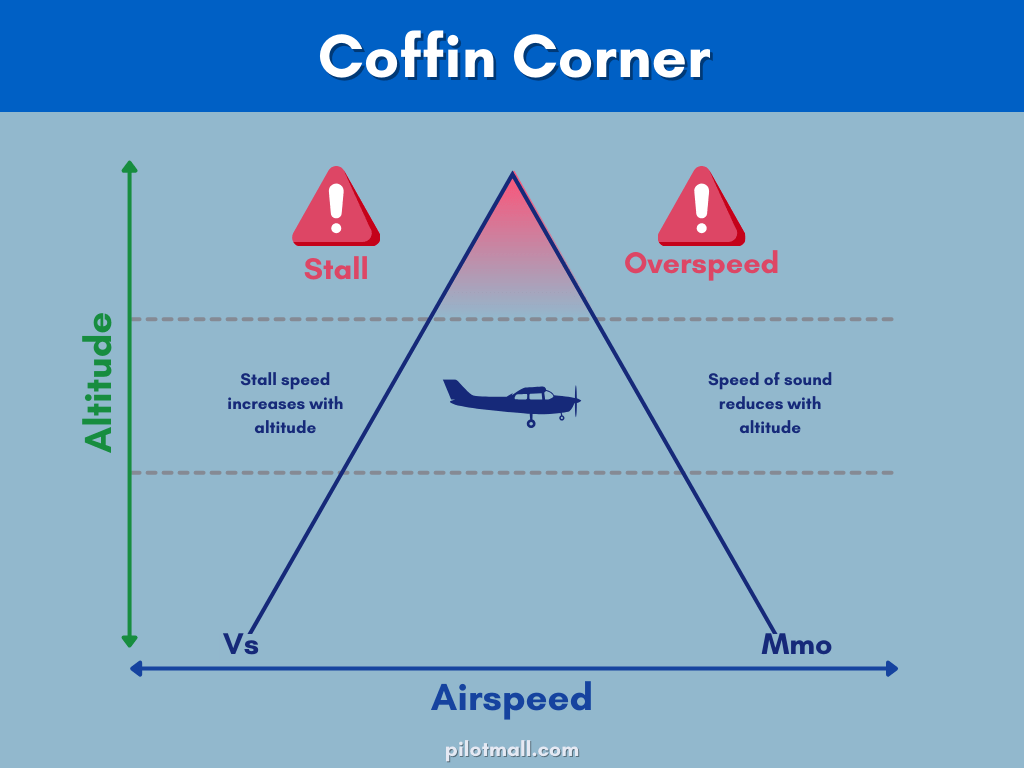 |
The illustration depicts the concept of a coffin corner. Photo: PilotMall. |
However, in the area of the coffin lid, if flying fast, the aircraft will reach subsonic Mach. The airflow over the wings reaches speeds close to or higher than the speed of sound, while the aircraft is still moving below the speed of sound.
At excessively high speeds, shock waves formed by the collision of airflow with the wing surface tend to push the nose of the aircraft toward the ground.
This makes flying near the corner of the coffin akin to being blindfolded and balancing on a tightrope. A small change in speed or altitude can lead to a loss of lift or overspeed, both of which have the potential to be catastrophic.
Economic problem
Even without safety and physical limitations, the "speed race" of commercial aircraft would still be constrained by the fundamental structure of the aviation economy.
In 1957, the first Boeing 707 took flight. It achieved a cruising speed of Mach 0.78. In 2009, Boeing launched the 787 Dreamliner. This aircraft has a cruising speed of Mach 0.85.
Two aircraft, both manufactured 52 years apart, are only 8% faster. With such remarkable advancements in science and technology, why can't airplanes fly any faster?
The reason is that the air transport industry is one of the sectors with extremely thin profit margins. Fuel costs account for the largest and most volatile proportion of an airline's total direct operating costs.
To date, Concorde is the only commercially operated aircraft to achieve supersonic speeds. It could fly at Mach 2.02, allowing travel from New York to London in approximately 3 hours and 30 minutes.
This is an impressive number, but only 14 Concordes were ever put into service, and they only served two routes for two airlines: British Airways and Air France. Concorde's first commercial flight was in 1976, and its last flight ended in 2003.
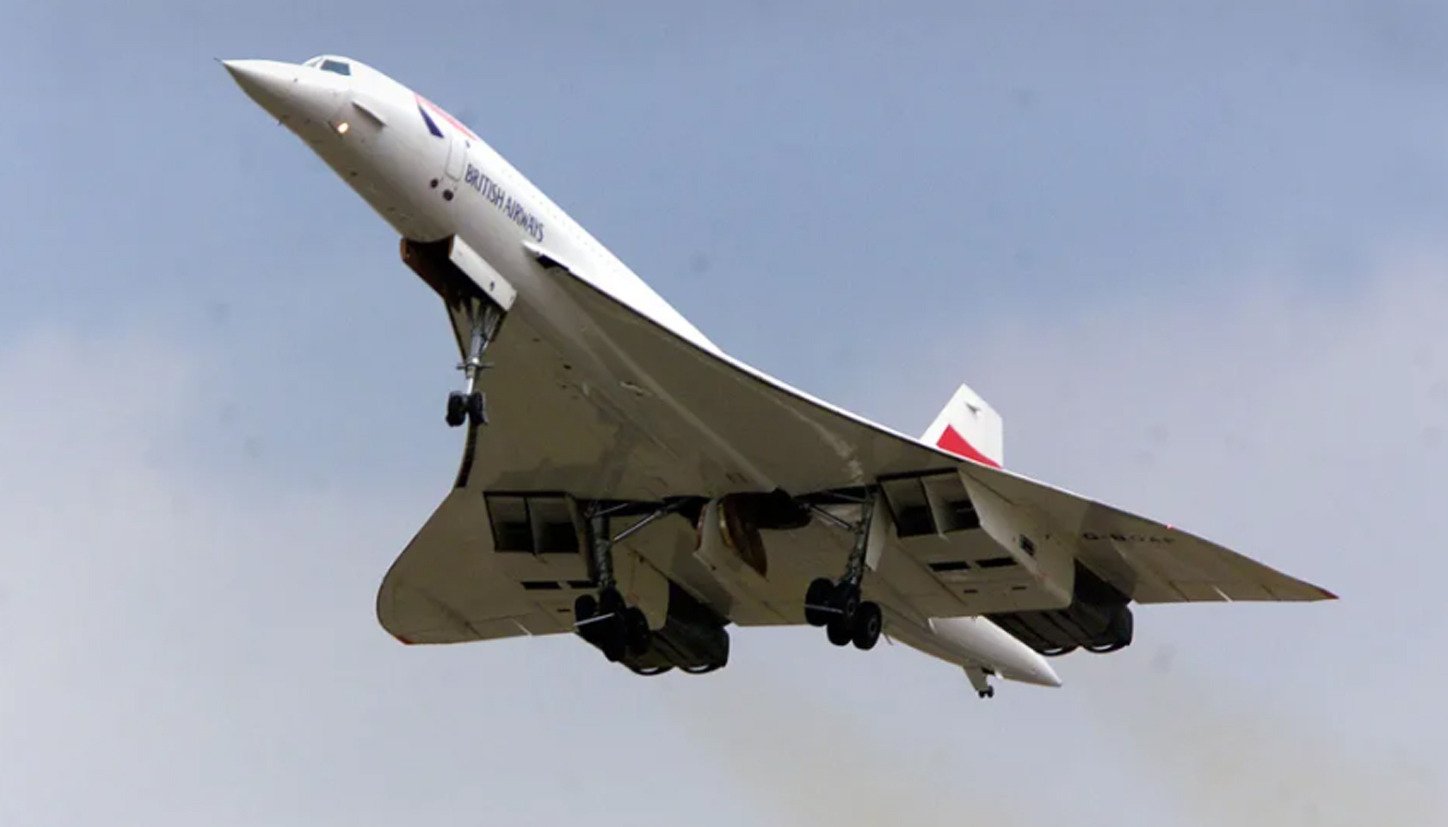 |
To date, Concorde remains the only commercially operated aircraft to achieve supersonic speeds. Photo: CNN. |
To fly supersonic, an aircraft needs to be highly aerodynamic, meaning it must have a narrow design, thus limiting the number of passengers. This meant the Concorde could only carry about 100 passengers, a modest number compared to the 330 passengers that the Boeing 787-10 can carry.
Furthermore, the high operating costs spread across a relatively small number of passengers were not a viable economic model. By the late 1990s, a one-way ticket on the Concorde cost as much as $6,000 , a price significantly higher than a regular passenger plane ticket.
Instead of speed, airlines operate based on the profit derived from operating flights. Therefore, commercial aviation technology currently focuses solely on increasing efficiency.
Take the Boeing 707 and Boeing 787 as examples. Although they have similar cruising speeds, the Boeing 787 is a much more cost-effective option.
Specifically, the Boeing 787 consumes only about 5 tons of fuel per hour and can carry approximately 140 additional passengers. For comparison, the Boeing 707 consumes about 6.8 tons of fuel per hour. Modern aircraft focus on getting the most passengers to their destination with the lowest possible fuel and operating costs.
Aircraft must fly at a speed high enough to achieve high efficiency, but drag and fuel consumption must not reduce revenue. Therefore, the flight speed of commercial aircraft today is essentially the optimal speed between efficiency and revenue.
Source: https://znews.vn/vi-sao-khong-co-chuyen-may-bay-vuot-au-dua-toc-do-post1652089.html
![[Image] Close-up view of the interchange connecting the two expressways and Long Thanh Airport.](https://vphoto.vietnam.vn/thumb/1200x675/vietnam/resource/IMAGE/2026/05/25/1779703378210_ndo_br_z7863716673926-224453a31600126cce10622af6290afd-4549-jpg.webp)


![[Image] Hanoi's urban life under the challenge of a "scorching hot" environment](https://vphoto.vietnam.vn/thumb/1200x675/vietnam/resource/IMAGE/2026/05/25/1779706979265_nang-nong-t5-2026-minh-duy-7-4636-jpg.webp)
























































































Comment (0)