

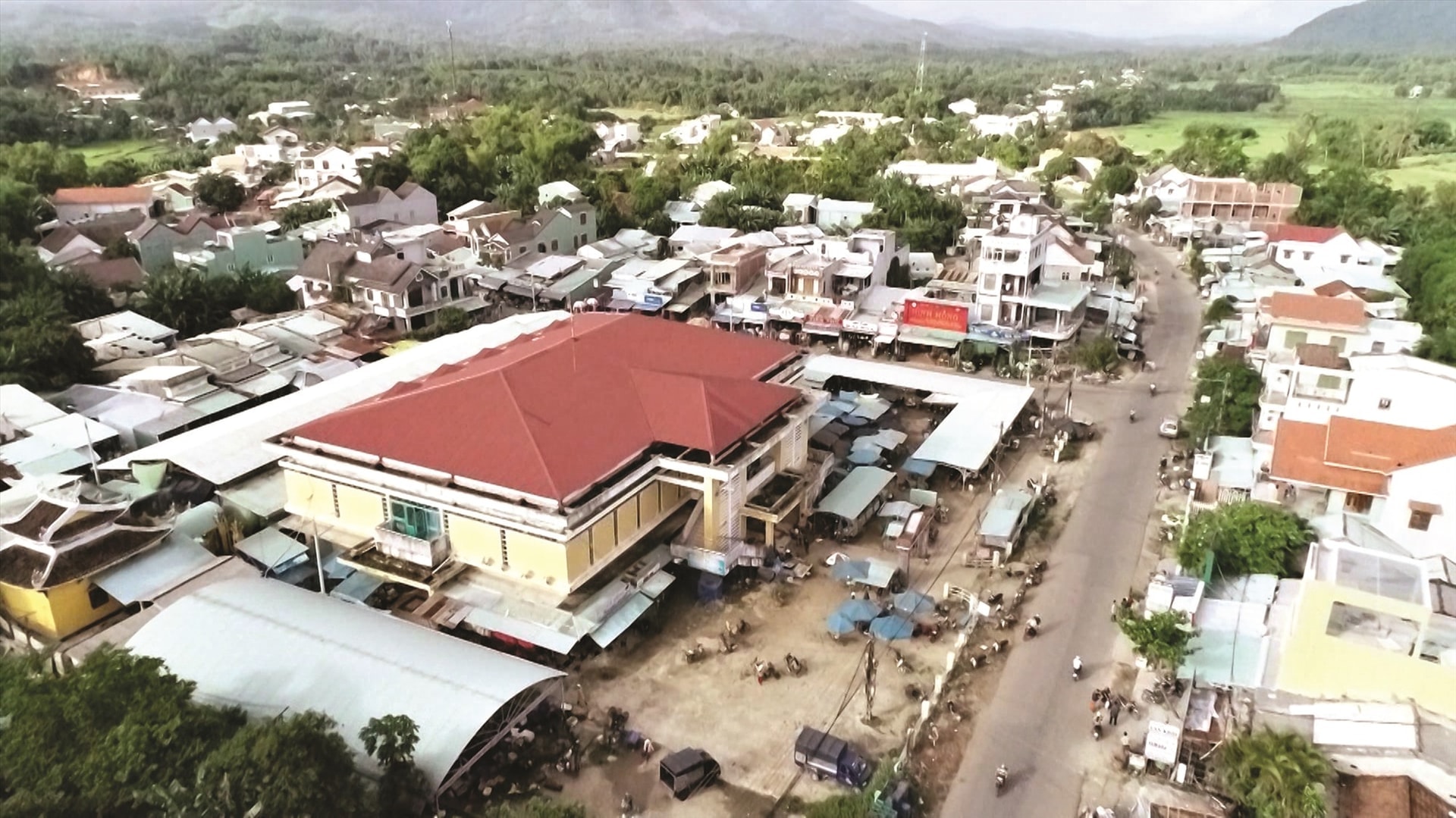
Legend behind the village's name
Viet An is a beautiful name. Among the many meanings of the word "viet" (越) combined with "an" (安) to form the name Viet An, the clearest and most easily understood meaning is peace and excellence. It is both a dream and an acknowledgment of the superiority and tranquility of our ancestors when they first set foot in this mountainous region, which hundreds of years ago was undoubtedly a remote and isolated place.
However, in the villagers' stories, the name Viet An holds a unique appeal. The story goes that at the foot of Mount Gai there was a spring well, whose water was clear, cool, and sweet all year round. At the foot of the mountain stood the house of Mr. Huong, likely a clan name rather than a title, as villages and communities hadn't yet formed since the dawn of time.
One Dragon Boat Festival, Mr. Huong went to the forest to gather leaves to dry and make tea, called "Fifth Day Tea," to drink throughout the year. When he chopped up the mixed leaves to dry, a white snake suddenly crawled into the middle of the drying tray and lay there basking in the sun, refusing to leave even after the sun set. After three days, the White Snake finally headed towards the mountains and returned home. Then, the thick, golden liquid brewed from Mr. Huong's pot of leaves seemed to possess magical powers, curing all kinds of illnesses.
One person told ten, ten told a hundred, and people from all directions came to Mr. Huong's house to ask for medicinal leaves. With the bounty of the mountains and a kind heart, Mr. Huong became a famous traditional medicine practitioner. So many people came seeking medicine that they gathered to rest on Tranh slope, waiting for their turn to receive their medicine. From there, people started selling bowls of chicken noodle soup and rice with freshwater fish. Then, with the addition of jackfruit, pomelo, and handfuls of sweet potato leaves, a market was formed.
Why it's called Viet An Market remains a mystery; even the learned elders in the village shake their heads thoughtfully, unable to offer a definitive explanation. Perhaps it's because of the acupuncture medicine? And what does the word "Viet" (meaning good, excellent) or "Viec" (meaning work, event) have to do with the uneducated villagers? Then, through the refinement of calligraphers and scholars, the name "Viec An" became Viet An, giving it a more beautiful name?
The story of the divine snake is so familiar; it seems this deity has slithered from North to South in countless tales, following the footsteps of people clearing land and establishing villages—nowhere is without its share of fantastical stories. All we know is that the soil of Mount Gai has produced many precious medicinal plants such as Solanum torvum, Polygonum multiflorum, Codonopsis pilosula, and Dioscorea opposita, which have become rare commodities today. Or perhaps the traditional medicine practitioner cleverly used this mythical story to promote his precious family remedy and save the poor?
The name unites four rural areas.
And for over 400 years, this name has been around, ever since the Nguyen and Duong families from Nghe An and Thanh Hoa provinces came here to clear the forest and establish the village, spanning sixteen generations of descendants.
Today, Viet An commune is the result of the merger of four former commune-level administrative units: Binh Lam commune, Binh Son commune, Thang Phuoc commune, and Que Tho commune. Viet An village and Viet An market were located within the former Binh Lam commune and have very close economic and cultural ties with the people of the aforementioned communes.
In the past, when the economy, culture, and society were underdeveloped, markets played a role equivalent to an economic and cultural center, thus having a significant influence on surrounding areas. Therefore, while the names of the communes Binh Lam, Que Tho, Thang Phuoc, and Binh Son are only associated with people within those communes, the name Viet An has a close relationship with the people of all four communes.
Furthermore, the Vietnamese name An is a name rich in meaning. "Peace" shares a similar meaning with the words "Bình" (in "Bình Lâm," "Bình Sơn"), "Phước" (in "Thăng Phước"), "Thọ" (in "Quế Thọ"), and "ưu tú" also evokes a similar meaning to "Quế" (in "Quế Thọ"): even after a hundred years of decay, it still retains its fragrance.
This means that the name Viet An encompasses the dreams, aspirations, and ambitions that our ancestors entrusted to the names Binh Lam, Binh Son, Thang Phuoc, and Que Tho. Thus, choosing the name Viet An for the commune means that the path of development, integration, and construction for the people of the commune today is also a journey back to their ancestral home.
Perhaps when choosing the name Viet An for the commune, the authorities at all levels pondered and reflected on the feelings and sentiments of the people. It was about listening and acknowledging. There was a connection and empathy with the entire population.
Simply put, administration is the smooth implementation (行 hành: work, policies) of national affairs from the central to the local level (政 chính: arranging work, straight and smooth procedures). This smoothness, in the simple term "administration," is the source of many good things!
Source: https://baodanang.vn/viet-an-co-xu-3329988.html

![[Photo] General Secretary and President To Lam presides over the meeting to approve the draft report on the results of the second inspection by the Politburo of the Standing Committee of the Hanoi City Party Committee.](https://vphoto.vietnam.vn/thumb/1200x675/vietnam/resource/IMAGE/2026/05/26/1779789811432_a2-bnd-4430-9620-jpg.webp)

















































































Comment (0)