

For nearly 400 years (1558-1945), Hue served as the capital of nine Nguyen lords in Dang Trong, the capital of the Tay Son dynasty, and then the capital of the unified nation under 13 Nguyen emperors.
Therefore, when people think of Hue, they immediately think of its magnificent citadels and palaces, splendid temples and shrines, majestic tombs, serene and tranquil ancient pagodas, and natural wonders sculpted by nature itself…
The ancient capital of Hue still preserves almost intact its tangible and intangible cultural heritage, which embodies many values symbolizing the intellect and soul of the Vietnamese people.
Most notably, the Complex of Monuments of the Hue Imperial City has been ranked alongside other millennia-old wonders of humanity in the UNESCO World Heritage list, and was recognized as a World Heritage Site by UNESCO on December 11, 1993.
These are the Hue Citadel, the Imperial City of Hue, and the Forbidden City of Hue, three interconnected fortresses symmetrically arranged along a vertical axis running from south to north. The system of fortifications here is a model of harmonious and seamless blending of Eastern and Western architectural styles; situated within a magnificent natural setting with many naturally occurring symbolic elements that are implicitly considered parts of the Hue Citadel – namely, Ngu Binh Mountain, the Perfume River, and Gia Vien islet.
Located in the heart of Hue, on the north bank of the Perfume River flowing from west to east, lies a complex of architectural structures symbolizing the power of the centralized Nguyen dynasty. The three citadels – the Imperial City, the Royal Citadel, and the Forbidden City – are intertwined and symmetrically arranged along a vertical axis running from south to north.
These structures are a harmonious blend of Eastern and Western architectural styles, set against a backdrop of natural beauty with Ngu Binh Mountain, the Perfume River, Gia Vien islet, and Boc Thanh islet, in a remarkably balanced combination.
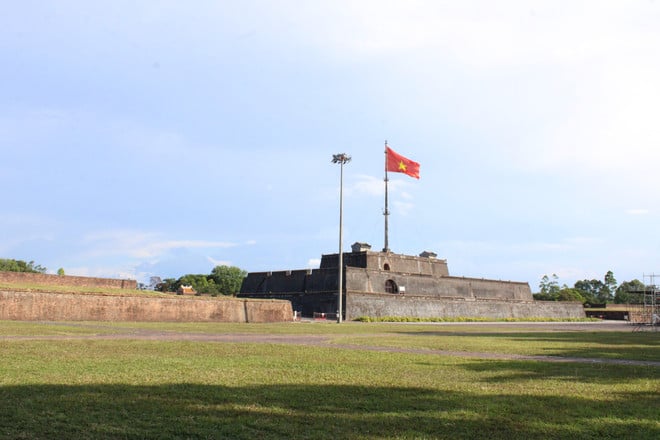
Running through all three citadels is the Sacred Way, featuring the most important architectural structures of the Hue Imperial City, including Nghinh Luong Pavilion, Phu Van Lau, Ky Dai, Ngo Mon Gate, Thai Hoa Palace, Can Chanh Palace, Can Thanh Palace, Khon Thai Palace, and Kien Trung Pavilion. On either side of this Sacred Way are hundreds of large and small architectural structures arranged symmetrically and harmoniously, blending seamlessly with the natural landscape.
Along both banks of the Perfume River are the tombs of the emperors Gia Long, Minh Mang, Thieu Tri, Tu Duc, and others, showcasing distinctive Vietnamese architecture. Each tomb has a different style, depending on the personality of each emperor, creating a rich and diverse picture.
The ancient capital of Hue is also home to famous imperial gardens such as Ngu Vien, Thu Quang, Thuong Mau, Truong Ninh, Thieu Phuong… And the architecture of these imperial gardens gradually influenced and spread to gardens in the common people, creating a distinctive garden architecture of the ancient capital.
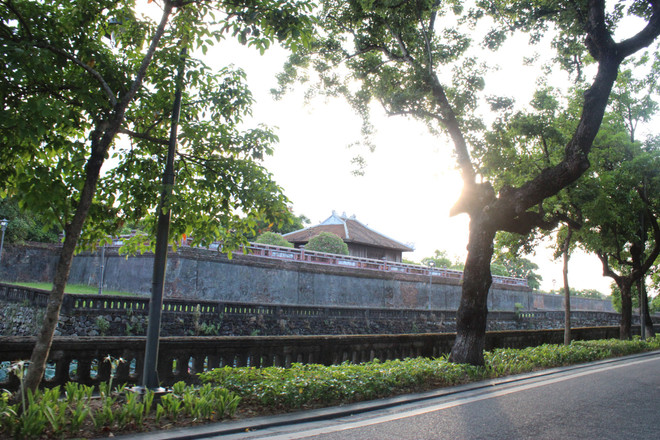
Built according to the principles of "I Ching" and "Feng Shui," Hue's garden houses are a collection of architectural systems arranged in a North-South direction. Although varying in size, each house shares a similar overall architecture, including: gates, alleys, screens, rock gardens, shallow ponds, courtyards, and traditional wooden houses. Some garden houses remain intact today, notably An Hien Garden House, Princess Ngoc Son Garden House, Lac Tinh Garden House, and Y Thao Garden House.
As the capital of the last feudal dynasty in Vietnamese history, the festivals and music in this imperial region were also incredibly rich and deeply rooted in national traditions.
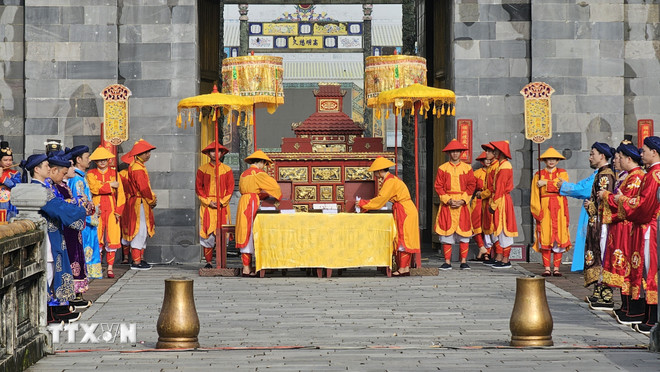
The imperial court held various ceremonies such as the Sacrifice to the Gods of the Land and Harvest, the Lunar New Year, the Dragon Boat Festival, the Longevity Festival, the Grand Court Ceremony, the Regular Court Ceremony, the Ceremony of Granting Blessings, the Ceremony of Passing on the Imperial Seal, and the Military Review. Folk traditions also offered a diverse range of festivals: the Hon Chen Temple Festival, the Fishing Festival, the Wrestling Festival, the Boat Racing Festival, and festivals at communal houses, temples, and shrines… These festivals were intertwined with a myriad of colorful folk ceremonial music.
In terms of music, Nha Nhac Cung Dinh – an elegant and sacred form of music often performed during solemn court ceremonies – reached its peak in Hue during the Nguyen dynasty. According to UNESCO, among the traditional music genres in Vietnam, Nha Nhac has achieved national stature.
Alongside ceremonial music, the entertainment music of Hue is also known worldwide as a prime example of a region's unique cultural identity—simple, pure, and unadulterated. These include Hue dances, Hue plays, and Hue songs, which have become indispensable spiritual experiences for tourists visiting the ancient capital.
To date, the ancient capital of Hue possesses 7 UNESCO-recognized World and Regional Heritage sites, including 5 unique to Hue: the Complex of Monuments of the Ancient Capital of Hue (1993), Vietnamese Court Music - Nha Nhac (2003), Nguyen Dynasty Woodblocks (2009), Nguyen Dynasty Imperial Archives (2014), and Poetry and Literature on Hue Imperial Architecture (2016); and 2 shared heritage sites with other localities: the Practice of the Mother Goddess Worship of the Three Realms (2016) and the Central Vietnamese Bai Choi Art (2017). In addition, the entire province currently has nearly 1,000 historical sites, including 3 special national-level sites, 88 national-level sites, and 90 provincial-level sites.
It is no coincidence that many researchers of Hue culture have remarked that Hue is a masterpiece of urban architecture, a city that exclusively holds priceless treasures, a strange and unique museum of Vietnam's material and spiritual culture.
Over the years, Hue city has developed many attractive programs to effectively exploit its heritage and create new experiences for the tourism industry.
In 2025, Hue plans to develop a diverse range of services with competitive advantages and high added value; mobilize investment resources for tourism development; and promote its image and affirm its brand as "Hue – Ancient Capital, New Experiences," "Hue – Destination of 8 World Heritage Sites," "Hue – Capital of Festivals," "Hue – Culinary Capital," and "Hue – Capital of Ao Dai." The city also plans to expand the development of heritage tourism associated with the Hue Imperial Citadel Complex; and promote the socialization of products and services at the Imperial Citadel and other historical sites in the area.
Source: https://www.vietnamplus.vn/co-do-hue-vung-dat-cua-nhung-di-san-van-hoa-vo-gia-post1002805.vnp


![[Image] Ho Chi Minh City simultaneously commences construction and breaks ground on 4 key projects.](/_next/image?url=https%3A%2F%2Fvphoto.vietnam.vn%2Fthumb%2F1200x675%2Fvietnam%2Fresource%2FIMAGE%2F2026%2F01%2F15%2F1768472922847_image.jpeg&w=3840&q=75)




Comment (0)