

Natural enemies reduce pest pressure.
Following the merger, by the end of April 2026, Vinh Long province will have over 121,800 hectares of coconut trees, playing a leading role in its perennial crop structure. Faced with the pressure of black-headed caterpillars and coconut beetles, Vinh Long's agriculture and environment sector is strongly shifting towards biological solutions for sustainable pest management.
According to the Department of Agriculture and Environment of Vinh Long province, the breeding and release of natural enemies such as parasitic wasps and earwigs continues to be implemented synchronously, gradually replacing chemical methods in pest control on coconut trees.
In 2025, the Provincial Department of Crop Production and Plant Protection, in coordination with the Southern Center for Crop Production and Plant Protection (Department of Crop Production and Plant Protection), bred and released 38,510 earwigs and over 170.5 million parasitic wasps that prey on black-headed caterpillars. In the first four months of 2026, they continued to release 16,100 earwigs and nearly 29.8 million parasitic wasps, focusing on key coconut-growing areas.

The black-headed caterpillar used to be a nightmare for coconut farmers because a high infestation could kill the trees. Photo: Minh Đảm.
Initial results show that the area infested with blackhead beetles has been kept at a low level. While the total area of coconut trees infested with blackhead beetles in the Vinh Long, Ben Tre, and Tra Vinh regions (before mergers) was 2,867 hectares from 2015 to 2024, by 2025, the area in the newly merged Vinh Long province had decreased to 33.4 hectares. In the first four months of 2026, the infested area was at 49.2 hectares, still within control limits and not spreading widely.
Regarding beetle infestations, the affected area remains at approximately 2,300 hectares, but the level of damage is mostly dispersed and controlled through integrated pest management measures.
According to Mr. Nguyen Thanh Binh, Head of the Crop Production and Plant Protection Sub-Department of Vinh Long province, the unit has assigned staff to closely monitor the area and track pest outbreaks, while also advising people to limit the use of chemical pesticides to protect natural predator populations.
Beyond technical solutions, communication efforts were intensified with over 60,000 leaflets providing guidance on managing blackhead caterpillars and other major pests. As a result, farmers are gradually shifting towards integrated pest management, reducing their reliance on pesticides.
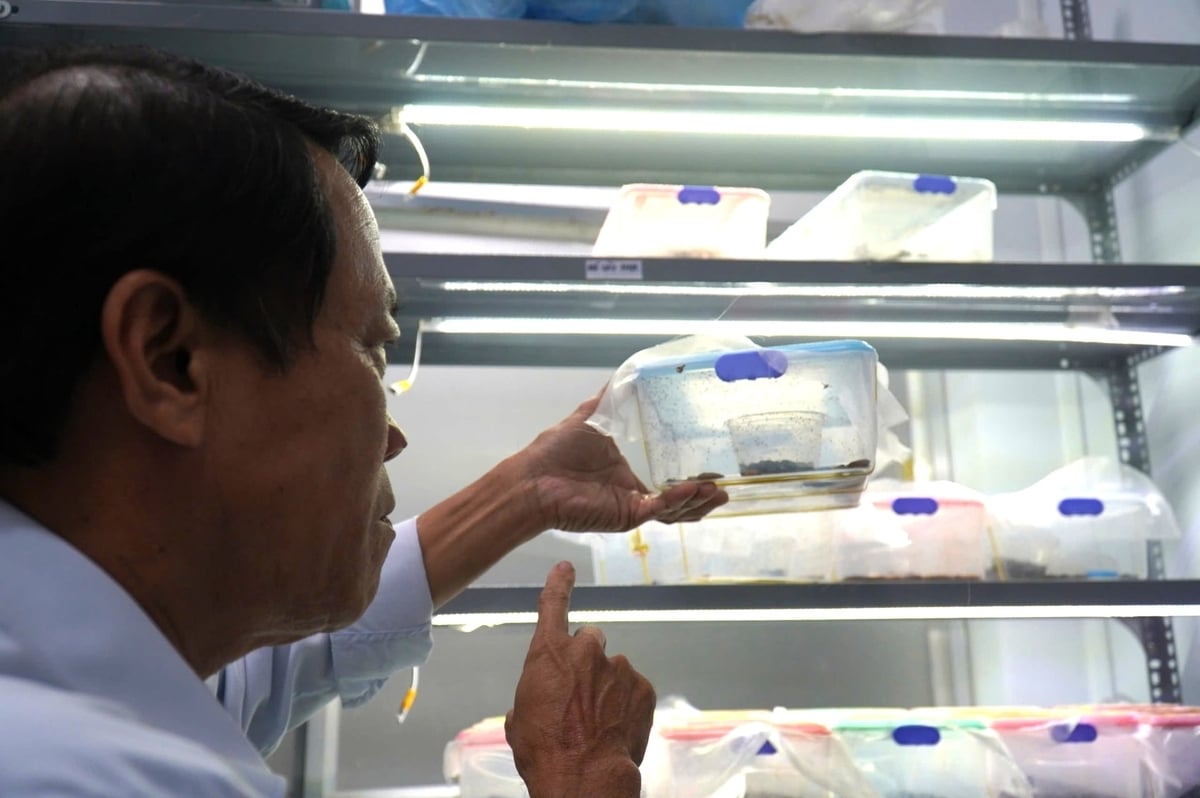
Parasitic wasps are one of the effective natural enemies for controlling blackhead caterpillars. Photo: Minh Đảm.
Hung Nhượng commune has approximately 3,924 hectares of coconut plantations, of which more than 3,500 hectares are organically grown. The local government has proactively implemented pest control measures at the grassroots level.
Mr. Bui Van Mot, Vice Chairman of the People's Committee of Hung Nhuong commune, said that the locality requires close monitoring of the blackhead pest's development, early detection, timely handling, and prevention of widespread outbreaks.
The People's Committee of the commune has assigned the Economic Department to closely monitor the area, coordinate with specialized agencies to guide the handling of outbreaks using proper techniques, and prioritize the application of biological measures, including the release of parasitic wasps.
Towards a safe and sustainable coconut-growing region.
In fact, many farmers have proactively switched to organic coconut farming methods.
Mr. Nguyen Van Khinh, a member of the Cong Bang Hung Le Cooperative (Hung Nhuong commune), said that they have stopped using chemical pesticides and switched to utilizing natural enemies to control pests.
"Previously, I used pesticides, but the effects weren't lasting. Since switching to this approach, I no longer spray pesticides but rely on natural predators to keep my garden stable," Mr. Khinh shared.
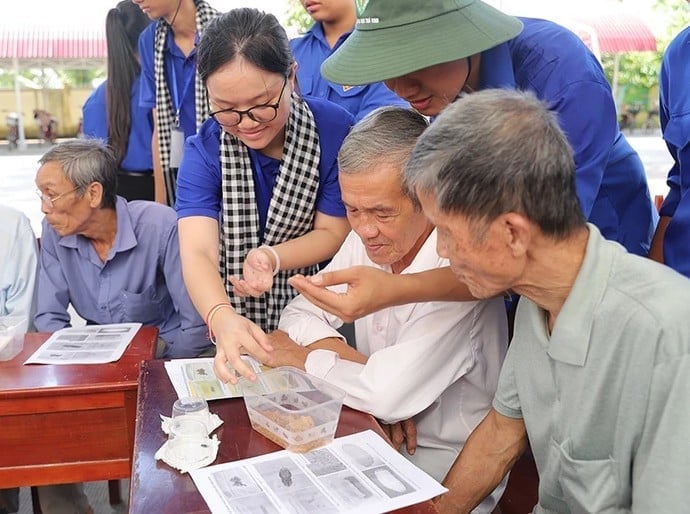
Volunteers from Tra Vinh University guide local people on how to identify and use natural predators to control black-headed caterpillars. Photo: Minh Dam.
According to Mr. Khinh, the coconut grove is protected by red-eyed bees, which are provided periodically by the partner organization, and a natural population of yellow ants in the garden. “The yellow ants are readily available, so we keep them to control pests. This reduces costs while maintaining consistent effectiveness,” he said. Thanks to the combination of cultivated and natural predators, his family's coconut grove maintains good growth and produces consistent yields.
In the coming period, the agricultural sector in Vinh Long will continue to conduct in-depth research on the biology and ecology of black-headed caterpillars and beetles, thereby improving the efficiency of breeding and releasing natural enemies.
The synchronized combination of technical solutions, local management, and changes in farmers' farming practices is contributing to the formation of a safe coconut growing area, reducing dependence on chemicals, meeting market demands, and moving towards sustainable development.
Source: https://nongnghiepmoitruong.vn/vinh-long-kiem-soat-hieu-qua-sau-dau-den-bang-thien-dich-d809575.html


![[Photo] General Secretary and President To Lam presides over a meeting on preparations for the review of one year of operation of the three-tiered government system.](https://vphoto.vietnam.vn/thumb/1200x675/vietnam/resource/IMAGE/2026/06/02/1780391821195_a1-bnd-4595-9717-jpg.webp)












![Transforming from Resolution 57: [Part 2] Businesses Lead the Way](https://vphoto.vietnam.vn/thumb/402x226/vietnam/resource/IMAGE/2026/06/02/1780399668663_5332-dsc09931-2-235637_295-235639.jpeg)

































































Comment (0)