

Traveling down the Day River from Khanh Trung to Khanh Cong and Khanh Thanh—key agricultural production areas of Yen Khanh district—the vast rice fields, ready for harvest, resemble a vibrant golden carpet. In the distance, combine harvesters, their engines roaring, busily reap the crop from each plot.
Stopping at the Phung Cong rice fields, we met Mr. Pham Van Cuong from Khanh Thanh commune who was checking the ripeness of his rice crop to calculate the harvest date. Mr. Cuong shared: "This season, my family planted more than 1 acre of rice, mainly with glutinous rice and Dai Thom 8 varieties. Thanks to good care, adherence to the planting schedule, and timely pest control with guidance from cooperative officials, we can say that this year's rice harvest is bountiful. The current price of rice is also quite high, ranging from 7,500-8,000 VND/kg of fresh rice, about 2,000 VND/kg higher than the same period last season."
According to Mr. Cuong, thanks to participating in the "3 reductions, 3 increases" model – reducing the amount of seeds, pesticides, and nitrogen fertilizer – production costs this season have also decreased significantly. With high prices and a good harvest, he earned a profit of approximately 40 million VND per hectare.
In a conversation with the Chairman of the Board of Directors of Dai Thanh Agricultural Service Cooperative (Khanh Thanh commune), Mr. Tran Van Thuy said: Although the weather at the beginning of the season was unfavorable, with prolonged rain, cold, and overcast skies, and widespread pest and disease outbreaks, thanks to decisive leadership in pest control, the cooperative's rice crop still grew and developed well, with a yield of over 2 quintals/acre. In particular, this year's winter-spring crop, the cooperative collaborated with the Provincial Department of Crop Production and Plant Protection to implement the "3 reductions, 3 increases" model on 5 hectares. This not only helped farmers reduce costs but also improved their knowledge of pest and disease identification and the rational use of pesticides, reducing environmental pollution and chemical residues in agricultural products, contributing to environmental protection and public health.
Currently, over 200 hectares of the cooperative's winter-spring rice crop are ready for harvest. With nearly 10 combine harvesters, the harvest is expected to be completed in about 5 days. The cooperative has also prepared all necessary machinery, supplies, and fertilizers to ensure full provision of all 9 service stages for farmers in the upcoming summer crop season.
During this winter-spring season, several localities have introduced technological advancements into their fields. The high production efficiency acts as a "boost," encouraging farmers to confidently expand their models towards modern, organic agriculture.
At the Khanh Hoa Agricultural Service Cooperative (Khanh Hoa commune), this season they have collaborated with farmers and businesses to implement a model of spraying pesticides using unmanned aerial vehicles (drones). Mr. Ngo Xuan Truong, Director of the Cooperative, said: "The Cooperative has introduced machinery for land preparation, harvesting, and now for pesticide spraying. In fact, this year's winter-spring rice crop has a significantly higher density of pests and diseases compared to previous years, especially pests like planthoppers and small leaf-rolling caterpillars, but the fields sprayed with drones are completely free of pests and diseases, the flag leaves are well protected, the rice panicles are uniform and plump, and the yield is guaranteed. As a result, farmers are even more enthusiastic about adopting this new technology." For the 2023-2024 winter-spring crop, the entire province planted 39,549.4 hectares of rice (reaching 101.4% of the plan).
As of June 5th, localities had harvested over 21,000 hectares (reaching 54% of the total area). Some districts have basically completed the harvest, such as Nho Quan and Yen Mo.
According to the general assessment of localities, although this production season faced many difficulties, with the close and coordinated guidance of the government at all levels and the agricultural sector, and the efforts of farmers, we still achieved a comprehensively successful harvest, not only maintaining productivity but also increasing the quality and price of rice.
According to Comrade Nguyen Ngoc Tuan, Deputy Head of the Provincial Department of Crop Production and Plant Protection: This year's winter-spring crop faced complex weather and climate conditions at the beginning of the season. From January to March, there were 8 cold spells and intensified cold fronts affecting the growth, development, and care of late spring rice crops. The growth of rice crops in this season was 5-7 days slower than in the 2022-2023 winter-spring crop. In March, the gloomy weather, drizzle, and high humidity created favorable conditions for pests and diseases to develop, especially rice blast, which caused localized damage to susceptible rice varieties such as TBR 225, LT2, Bac Thom No. 7, Dai Thom 8, BC 15, and glutinous rice...
In April and May, alternating sunny and rainy weather continued to cause significant damage from rice leaf rollers and various types of planthoppers. The total area affected by rice leaf rollers this season reached over 33,000 hectares (1.9 times higher than the same period last year), of which over 26,000 hectares were severely affected (twice the area of the 2022-2023 Winter-Spring crop). Regarding planthoppers, the density of the first, second, and third generations was higher than in the 2022-2023 Winter-Spring crop.
However, thanks to effective planning and forecasting; timely advice to the Provincial People's Committee to issue documents on focusing on caring for and preventing pests and diseases to protect production; mobilizing the involvement and decisive, thorough direction of localities; and close coordination of relevant units to guide farmers in implementing effective control measures, the pest and disease situation has been basically brought under control. More than 39,000 hectares of rice in the province are still growing and developing well, with average yields increasing compared to last year's winter-spring crop, reaching 66.81 quintals/hectare.
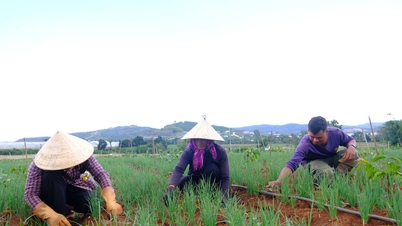
Besides a bountiful harvest and high prices, this rice crop also witnessed many innovations in production methods. Notably, many farmers and cooperatives boldly invested in purchasing advanced machinery and high-tech equipment for production, such as rice transplanters and pesticide sprayers. The total area using tray seedlings and machine transplanting reached over 2,000 hectares, while the area producing specialty, high-quality rice using organic methods and new varieties and advanced techniques was over 1,350 hectares.
In many localities, linkages continue to be formed between cooperatives and companies/businesses in supplying input materials and purchasing output products, creating a rice value chain. In addition, this season, the Provincial Department of Crop Production and Plant Protection also implemented training to guide farmers in expanding the application of Integrated Pest Management (IPM/IPHM) models and Improved Rice Cultivation Systems (SRI), thereby helping to reduce input costs such as seeds and fertilizers, bringing high efficiency and productivity, reducing emissions, and protecting the environment.
Currently, given the complex weather patterns, the agricultural sector is focusing on guiding and urging localities to mobilize maximum machinery and manpower to harvest the winter-spring rice crop quickly and efficiently, with the motto "better to harvest while the rice is still green than to let it wither in the field," and preparing the land for planting the next summer crop as soon as the harvest is completed. The success of the winter-spring crop is a solid foundation and driving force for the new production season.
Text and photos: Nguyen Luu
Source














































































Comment (0)