

Asia is the world's largest producer and consumer of rice, playing a crucial role in global food security.
However, the region's rice industry is facing increasing pressure from climate change, natural disasters, degradation of arable land, and especially the volatile prices of fertilizers and inputs due to geopolitical tensions, supply chain disruptions, and escalating energy costs.
In response to these changes, leading rice-producing countries in Asia are proactively restructuring their input supply chains and accelerating the "greening" of production.
This is not just a solution to short-term shocks, but also a strategic step to enhance resilience and build sustainable agriculture in the long term.
Diversification and greening
According to Qingfeng Zhang, Senior Director of the Agriculture, Food, Natural Resources and Rural Development Office of the Asian Development Bank, the Asia-Pacific region is not currently facing a direct risk of food shortages, but is experiencing a “systemic shock” spreading from energy to fertilizers, logistics and production costs.
Against this backdrop, leading rice-producing nations in Asia are implementing diverse approaches to restructure the supply of fertilizers and other inputs for rice production, thereby enhancing their ability to respond to market fluctuations and laying the groundwork for a greener, more sustainable agricultural transition.
China, the world's largest fertilizer consumer, has expanded its potassium imports from Canada, Russia, Belarus, Jordan, and Israel, while encouraging businesses to invest in overseas mineral deposits and sign long-term contracts to stabilize supply.
Simultaneously, China is promoting a program to "zero increase in the use of chemical fertilizers," applying precision fertilization, digitizing nutrient management, and reusing agricultural by-products in a circular economy model.
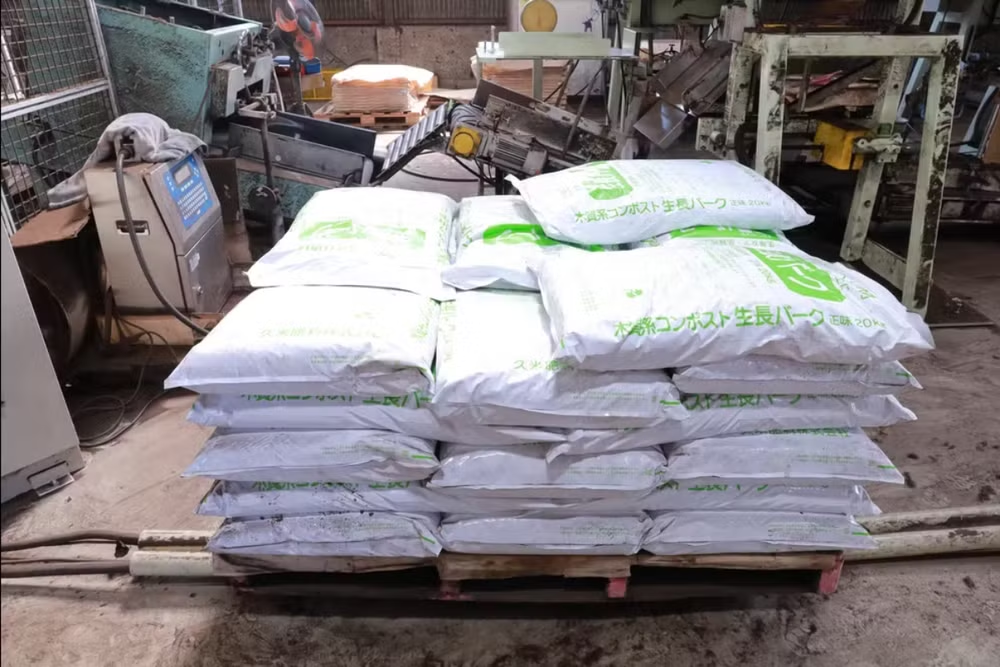
India, the world's second-largest consumer of fertilizers with over 45 million hectares of rice paddies, has expanded imports of urea, DAP, and potassium from Russia, Canada, Algeria, Indonesia, and Australia, while also reviving domestic urea plants. Simultaneously, the Indian Farmers Fertilizer Cooperatives (IFFCO) is developing nano-urea and nano-DAP, combining them with biofertilizers and natural farming programs to reduce the amount of chemical fertilizers used in the fields.
As one of the world's leading rice exporters, Thailand is diversifying its fertilizer import sources, increasing strategic reserves, and encouraging farmers to use fertilizers based on soil analysis results. The country is also promoting organic farming, using bio-based products and organic fertilizers to enhance the value of rice grains and meet high-end market standards.
Pakistan leverages its domestic urea production from natural gas, but continues to expand imports of DAP fertilizer, potassium, and raw materials from Saudi Arabia, Morocco, and China to ensure supply. Simultaneously, Pakistan promotes balanced nutrient management, increased use of organic fertilizers, and input-saving farming practices to improve soil fertility.
In Vietnam, companies such as the Petrochemical Fertilizer and Chemical Corporation, Ca Mau Petrochemical Fertilizer Joint Stock Company, and Binh Dien Fertilizer Joint Stock Company have proactively met most of the domestic urea demand, while continuing to diversify imports of DAP, SA, and potassium fertilizers from Russia, the Middle East, China, Canada, and North Africa.
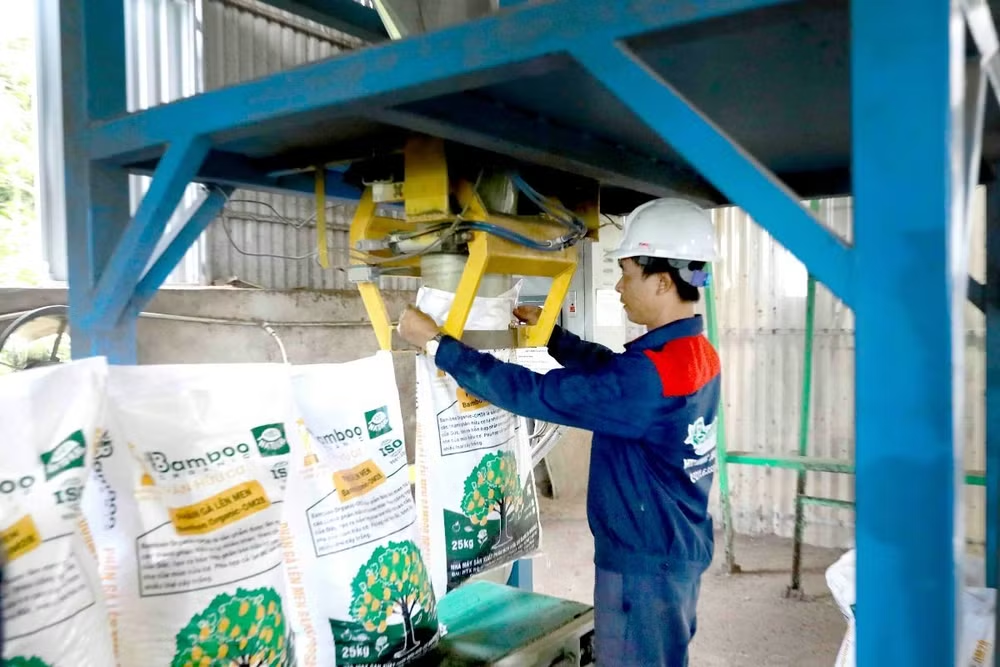
Simultaneously, Vietnam is implementing a project to sustainably develop 1 million hectares of high-quality, low-emission rice in the Mekong Delta, encouraging the use of smart fertilizers, organic fertilizers, and biological products.
Through the central role of the state-owned fertilizer corporation Pupuk Indonesia, Indonesia is diversifying its input sources while controlling prices and distribution to stabilize rice production costs. In addition, the country is promoting the development of biofertilizers, organic fertilizers, and low-carbon agriculture programs to reduce emissions and improve soil health.
According to Mr. Khuat Dong Ngoc, Director-General of the United Nations Food and Agriculture Organization (FAO), future agriculture must aim for the goal of "producing more with less input."
The aforementioned reality in major rice-producing countries in Asia shows that diversifying fertilizer sources and promoting biological solutions is not only a way to respond to geopolitical fluctuations, but also a foundation for the transition to green and sustainable agriculture.
From a commercial perspective, this trend also helps improve the quality of agricultural products, meeting increasingly stringent standards on carbon emissions, chemical residues, and traceability in major export markets.
According to the World Bank, agricultural systems that are better adapted to climate change and reduce environmental impact will have an increasing competitive advantage in global agricultural trade.
Obstacles to overcome
Although the shift is becoming increasingly evident, this process still faces many challenges. The initial investment costs for fertilizer-saving technologies, smart irrigation systems, and biological inputs remain high, especially for smallholder farmers.
Furthermore, many farmers are still accustomed to farming methods that rely primarily on chemical fertilizers and do not fully trust the short-term effectiveness of biological products. In addition, the research infrastructure, standards, quality control systems, and distribution networks for biological products in many countries are still not synchronized, making scaling up difficult.
According to the World Bank, the transition to green agriculture can only succeed if it is accompanied by long-term investment in infrastructure, technology transfer, farmer training, and financial mechanisms to reduce initial transition costs.
The inevitable direction of Asian rice
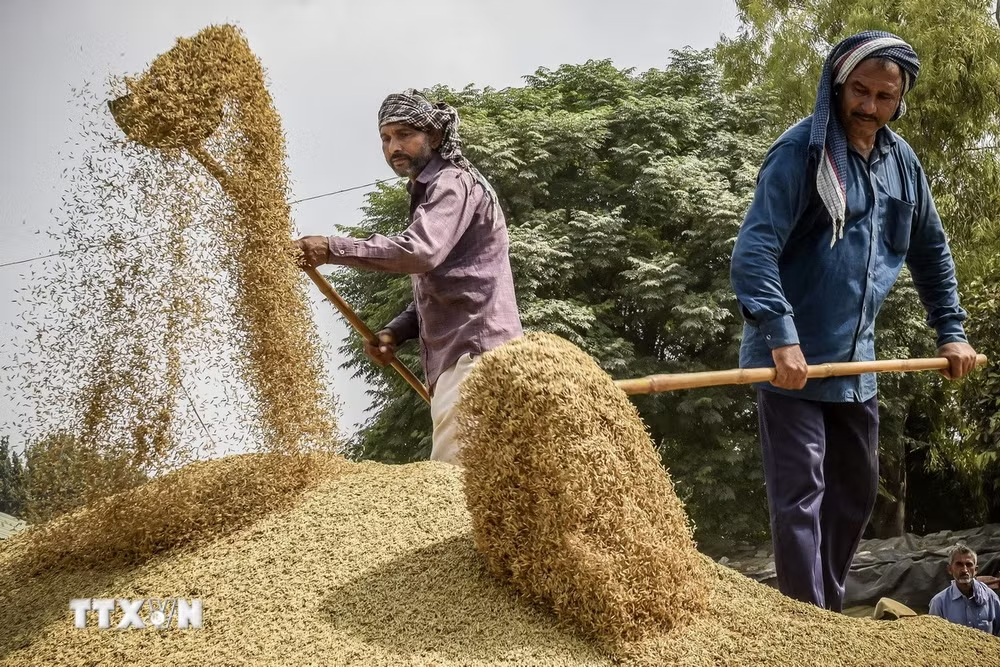
From India with nano-fertilizers, Vietnam with its high-quality, low-emission rice farming model, to China with circular agriculture, Asia's leading rice-producing nations are gradually shifting from a growth model heavily reliant on chemical inputs to a greener, more efficient, and more resilient production method in the face of global climate, market, and geopolitical fluctuations.
According to Maximo Torero, chief economist of the FAO, fertilizers are one of the most sensitive links in the global food system, because a sharp increase in gas prices or disruption to logistics can immediately escalate agricultural production costs and have a ripple effect on food prices.
Therefore, diversifying fertilizer sources and developing bio-products is not only a solution to short-term shocks, but is becoming a long-term strategy to strengthen food security, enhance competitiveness, and move towards a more sustainable agriculture.
Lesson 1: Pressure for innovative, self-reliant thinking, strongly promoting green transformation.
Lesson 2: Indonesia leverages its influence amidst global upheaval.
Lesson 4: Long-term planning for better resilience
Final article: Responding to the risk of disruption to the fertilizer supply chain.
Source: https://www.vietnamplus.vn/tai-cau-truc-dau-vao-cho-hat-gao-chau-a-post1113992.vnp
![[Photo] First session of the 14th Congress of the Vietnam Trade Union](https://vphoto.vietnam.vn/thumb/1200x675/vietnam/resource/IMAGE/2026/06/03/1780465947883_ndo_br_img-3852-jpg.webp)
![[Photo] General Secretary and President To Lam presides over a meeting with the Central Organizing Committee.](https://vphoto.vietnam.vn/thumb/1200x675/vietnam/resource/IMAGE/2026/06/03/1780482764658_a1-bnd-4741-3342-jpg.webp)

![[Photo] Secretary of the National Assembly Party Committee, Chairman of the National Assembly presides over the meeting of the Standing Committee and Executive Committee of the National Assembly Party Committee.](https://vphoto.vietnam.vn/thumb/1200x675/vietnam/resource/IMAGE/2026/06/03/1780480353201_ndo_br_bnd-2585-jpg.webp)















































![[Video] Sunset at Lap An Lagoon – Where the sun sets over the fishing nets](https://vphoto.vietnam.vn/thumb/1200x675/vietnam/resource/IMAGE/2026/05/31/1780192137701_beach-landscape-sea-water-nature-grass-745871-pxhere-com.jpeg)


























Comment (0)