

Three players, three different footballing cultures, three very different types of talent. But they share one thing in common: they are not just outstanding players, they are icons who have shaped the emotions of generations of viewers. While they were on the field, football was not simply a competition of winning and losing. It was a memory, a belief, something that made people look forward to each match with a feeling of almost familiarity: the great figures are still there, a part of their youth is still on the pitch.
Significantly, their departure – if the 2026 World Cup truly is their last – will not only leave a void in the lineups of Portugal, Argentina, or Croatia. It will also leave a void in the spiritual lives of many fans, especially middle-aged viewers. This is the generation that followed Ronaldo during his golden era at Real Madrid, witnessed Modrić become the heart of the Royal team's midfield, and followed Messi through almost his entire peak journey with Argentina, from the days of doubt to lifting the 2022 World Cup trophy.
For them, watching Ronaldo, Messi, or Modrić play is not just about watching a football match. It's also a way to reflect on themselves, to look back at a bygone era, when El Clasico matches were a global tradition, when every touch of the ball by Messi in an Argentina shirt brought both hope and anxiety, when Modrić's presence in midfield was enough to make people believe the game was still under control. These players, in a sense, belong more than just to football. They belong to the collective memory of an entire generation.
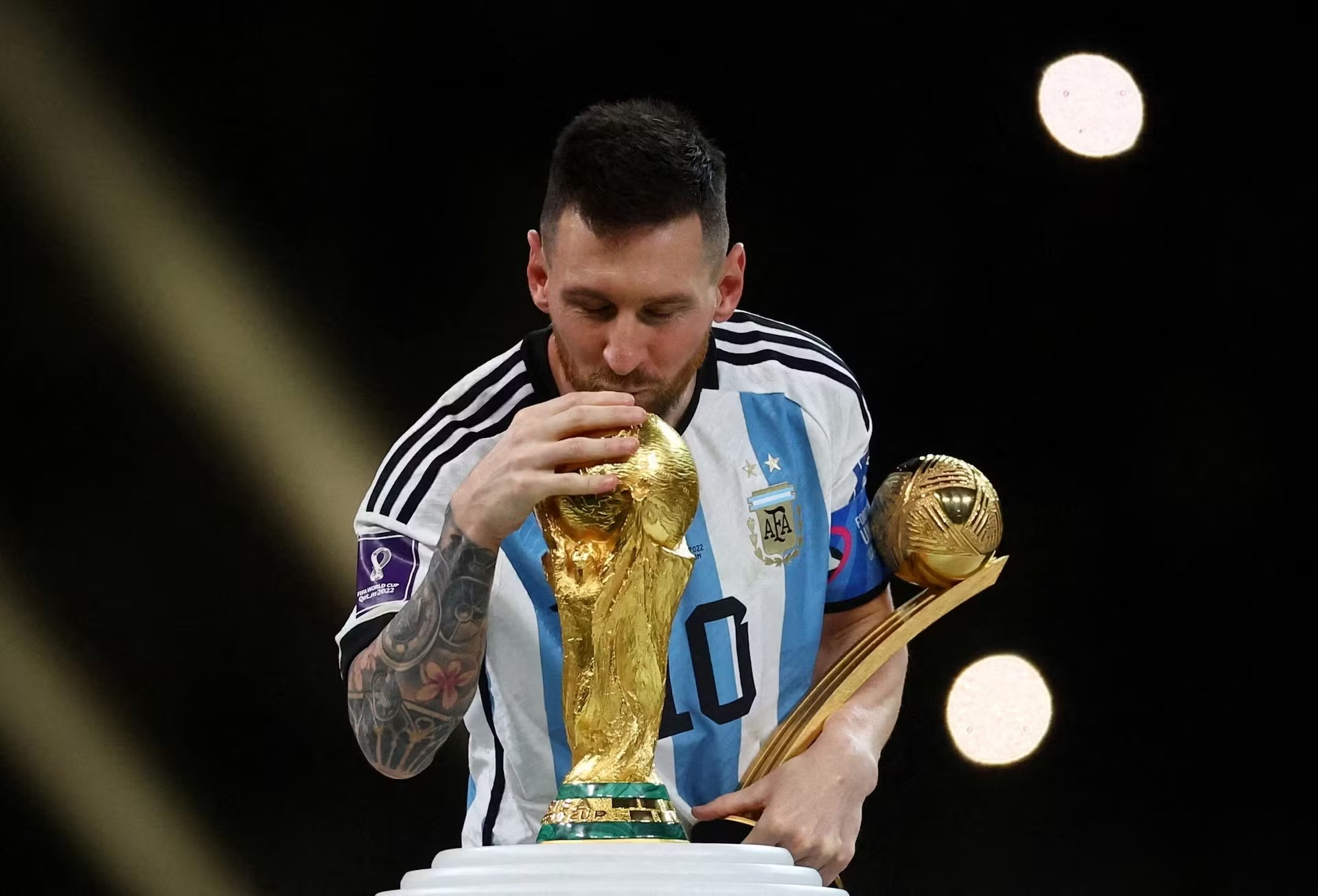
Ronaldo: From a symbol of victory to a legacy of willpower.
Cristiano Ronaldo is the kind of player built on discipline, ambition, and an unwavering will to overcome limitations. During his peak at Real Madrid, he embodied performance, scoring goals with cold precision. For older fans, Ronaldo is also part of the era when Real Madrid played a style of football characterized by speed, power, and immense pressure on opponents. He turned goal-scoring into something almost instinctive and made winning titles his raison d'être.
At the national team level, Ronaldo is the same: a cornerstone. Portugal has had many talented young players over the years, but Ronaldo remains a name that every opponent must be wary of before a match begins. He is no longer a player operating with the intensity of his twenties, but what remains intact is his instinct to decide the fate of a match in the shortest moments. A well-placed shot, a leap, a finish in the penalty area – these are still the pieces that can change the entire course of the game.
But perhaps Ronaldo's greatest value in the final stages of his career lies not simply in the number of goals he scored, but in the energy he instilled in the entire team. When a player has passed almost all of his peak but still retains the same ambition as when he first started, he must be seen as a living lesson in perseverance. For Portugal, Ronaldo was more than just a striker. He was a guarantee that no matter how difficult the match, there is always a chance if someone like Ronaldo is on the field.
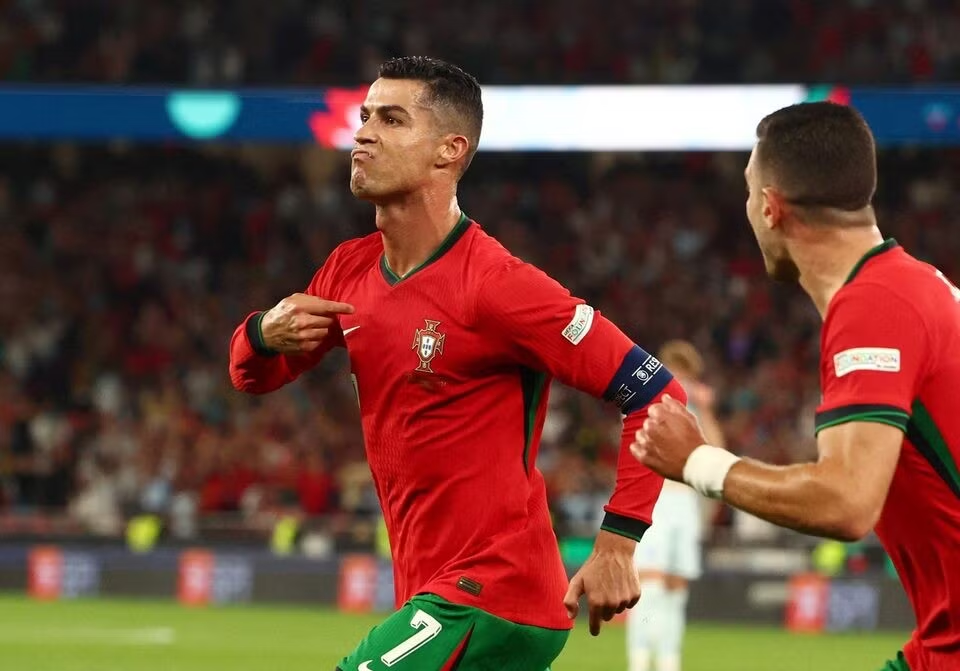
Messi: From a chance encounter in childhood to a childlike desire to play football.
If Ronaldo represents willpower and discipline, then Messi represents something very different: the purity of football. For many, Messi has long since entered the pantheon of legends. He has achieved almost every great glory a player can attain. But what makes Messi special is not just his vast collection of titles. It's also the feeling that he has never truly lost the primal joy of the ball.
The 2026 World Cup, if it's Messi's last major tournament, will therefore have a very special significance. It's not just a farewell to an Argentinian icon, but also a farewell to a type of player that is increasingly rare in modern football: someone who still plays as if they are doing what they love most in life. At this age, Messi no longer needs to prove who he is. He has been doing that for a long time. Now, if he continues to play, perhaps what he seeks is no longer titles, but the feeling of touching the ball, of leading the game, of living in the familiar rhythm of the sport that has been with him since childhood.
This brings to mind Messi's own story: a story that is both simple and miraculous. As a child, Messi wasn't the kind of player destined for fame. He came to football by chance. There are anecdotes that say during a primary school game, when another boy was absent, Messi's grandmother asked the coach to let little Leo play as a substitute. And from that seemingly ordinary moment, an extraordinary journey began.
That story is incredibly evocative because it shows that Messi never came to football through a glamorous arrangement. He came to it like a child given an opportunity, and from that opportunity, he transformed his passion into a life. Perhaps that's why, even today, having reached every peak, Messi still makes people feel that he plays football primarily out of love. Titles come to him as a natural consequence of talent and hard work. But it is his passion for the ball that remains intact. Messi no longer plays football to chase a goal. He plays football because he still wants to play.
For Argentina, Messi is the soul of a generation. But for many middle-aged fans, he's also a part of their entire journey as supporters. From the days when Messi was a skinny boy in the national team jersey, to being compared to every other legend, and finally lifting the World Cup trophy, his journey is like a multi-chapter film. And if 2026 truly is his last, fans will not only see a star depart, but will also see a part of their youth come to an end.
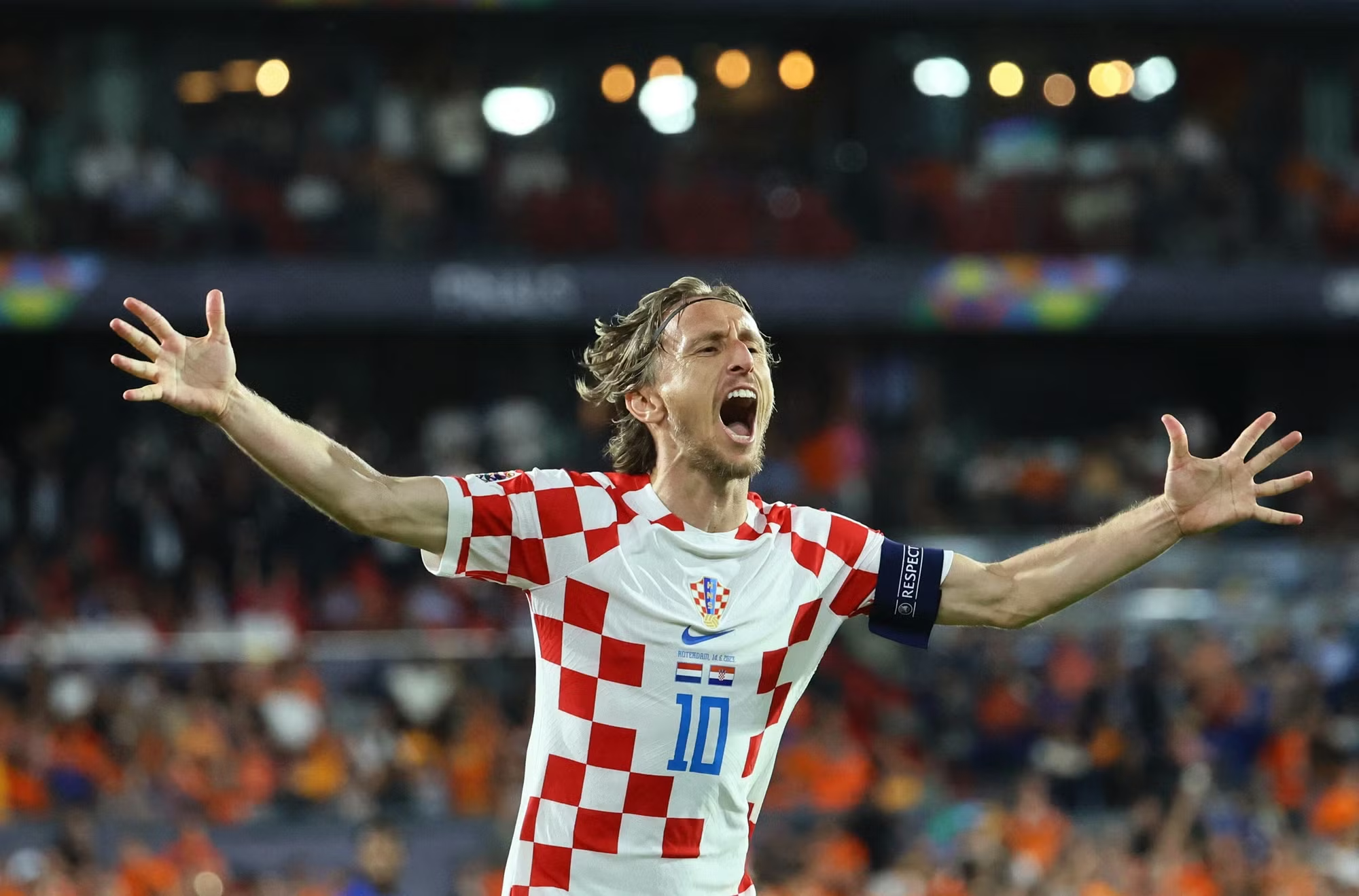
Modrić: The quiet mind of a footballing genius.
While Ronaldo and Messi often appear as the central figures in every debate, Luka Modrić is a quieter kind of icon. He doesn't create media hype or make grand pronouncements. But in top-level football, sometimes it's the quietest players who leave the deepest impression.
Modrić is the kind of midfielder every team wants but is hard to find: intelligent, calm, sophisticated, and especially adept at reading the game. In the Real Madrid shirt, he, along with other stars, created a golden era for the club, and for long-time fans, Modrić is more than just a good player. He embodies stability, the ability to maintain tempo, and the capacity to salvage the system when the game becomes chaotic.
In the Croatian national team, Modrić's value is even greater. A country with a relatively small population and not a dense array of attacking stars, yet capable of consistently causing problems for the big teams, largely thanks to minds like Modrić. He transforms experience into an advantage and composure into a weapon. If 2026 is the last time we see him at the World Cup, it will be a farewell to a midfielder that modern football desperately needs but is increasingly rare.
The final chapter of monuments
What makes the 2026 World Cup special isn't just the question of who will win, but who will be there to make the tournament a part of history. Ronaldo, Messi, and Modrić aren't simply three aging players nearing the end of their careers. They are figures associated with an era where world football was told through iconic individuals.
Their departure, if it truly happens, will leave a void in each country's national team. But more broadly, it will leave a void for those who grew up with them. People can talk about tactics, speed, strength, or statistics. But football, ultimately, is a sport of emotion. And that emotion often comes from seeing a familiar face appear once again, as if the memory remains intact.
For the middle-aged generation, names like Ronaldo, Messi, and Modrić are not just favorite players. They represent milestones in history. They represent periods of life spent watching football, classic matches, and breathtaking moments of suspense. Ronaldo evokes memories of Real Madrid's fiery Champions League nights. Modrić brings back a different Real Madrid: calmer, more intelligent, yet still elegant and confident. Messi evokes the captivating contrast between genius and pressure, between expectations and reality, between setbacks and ultimate perfection in the Argentina jersey.
The world of football today is not lacking in talented stars, but finding those who can be compared to these three legends is not easy. Therefore, if the 2026 World Cup truly marks the final chapter for these three veterans, it will be a very special one. Not only because football will lose three great names, but also because fans will have to accept watching the beautiful game without these icons on the field. It's a rare kind of farewell: a farewell not to a tournament, but to an entire era.
Luka Modrić is one of the rare players to break the nearly decade-long dominance of Lionel Messi and Cristiano Ronaldo in the Ballon d'Or. Even after these two legends left Barcelona and Real Madrid, the Croatian midfielder remained a crucial and irreplaceable element in the "Los Blancos" squad. At the World Cup, while his former teammate CR7 never played in a final, Modrić led Croatia all the way to the final match at the Luzhniki Stadium in Moscow in the summer of 2018.
Source: https://cand.vn/world-cup-2026-khi-bong-da-buoc-sang-mot-trang-moi-post811762.html
![[Photo] Reception to welcome General Secretary and President To Lam and his wife on their State visit to the Philippines](https://vphoto.vietnam.vn/thumb/1200x675/vietnam/resource/IMAGE/2026/06/01/1780295488620_vna-potal-chieu-dai-chao-mung-tong-bi-thu-chu-tich-nuoc-to-lam-va-phu-nhan-tham-cap-nha-nuoc-toi-philippines-8798060-7855-jpg.webp)


![[Photo] General Secretary and President To Lam and the President of the Philippines hold talks.](https://vphoto.vietnam.vn/thumb/1200x675/vietnam/resource/IMAGE/2026/06/01/1780286997787_anh-man-hinh-2026-06-01-luc-11-09-43.png)

































































Comment (0)