

A ticket is more than just a ticket.
For a football fan, witnessing their national team play in the World Cup is an almost sacred experience. It's not simply a football match, but a once-in-a-lifetime moment: standing amidst a sea of people, singing the national anthem, and watching their country's flag fly high on the biggest stage on the planet.
But that dream is becoming more of a luxury than ever before.
According to published analyses, World Cup ticket prices have sparked a strong backlash, to the point that a group of US lawmakers have called on FIFA to lower the fees. For some knockout matches, especially the semi-finals, the most expensive tickets can cost up to $3,295. That's no longer the price of a single football match. For many, it's the equivalent of several months' wages.

A Mexican fan might have to spend about 3.6 months' average salary to buy a ticket to the semi-finals with a good seat. For Brazilians, that cost is equivalent to more than 2.5 months' income. Even in developed countries like France or the United States, that price is still enough to deter many people.
And that's just the ticket price.
World Cup and its hidden costs
The harsher reality lies in the underlying costs: airfare, hotels, food, transportation, service fees, and unnamed expenses. When all of these are added together, a World Cup trip can become a serious financial investment, even a heavy burden of debt for ordinary fans.
Hotel prices in host cities across North America are reportedly about 35% higher than the same period last year. Meanwhile, rising aviation fuel costs and pressure on air supply are also contributing to higher airfares.
It's worth noting that the World Cup was originally built on a popular spirit. Football is appealing because it belongs to everyone: from children playing barefoot in the street, to workers stopping by cafes after work to watch the game, to fans traveling halfway around the world to follow their team. But as ticket costs rise, the question inevitably arises: Who is the World Cup serving?
When "football festival" becomes a luxury product.
Modern mega-sports events are increasingly operating according to commercial logic. Tickets are tiered, prices fluctuate according to demand, premium experience packages are expanded, and hotels and airlines take advantage of peak season to raise prices.
All of that is fine in a market economy . But with football, the issue lies in emotion.

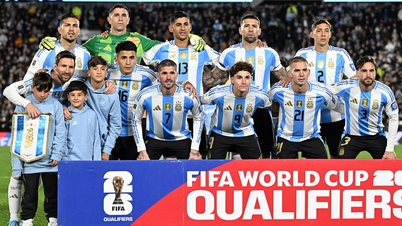
The most beautiful World Cup isn't just about the stars shining, but also about the vibrant atmosphere in the stands. The whole world can tell at a glance which section of the stands belongs to Argentina, Mexico, Brazil, or the Netherlands, England, France… These fans are the ones who create the soul of the tournament.
If the stands are increasingly filled with high-spending crowds, while die-hard fans are pushed aside by the price, the World Cup may still be spectacular, still generate record revenue, and still be broadcast globally, but it will lose a part of its essence: the chaos, passion, and popular appeal that makes football so captivating.
The World Cup needs stands that belong to the people.
Football is never just about VIP stands or thousand-dollar tickets. Football thrives on people willing to travel thousands of kilometers, wearing worn-out jerseys, singing until their voices are hoarse, and crying over a goal in injury time.
An overly expensive World Cup might still be a revenue success, but it raises big questions about identity. As the biggest football event on the planet becomes increasingly out of reach for the average fan, it's not just an economic issue; it's a cultural one.
The World Cup shouldn't become a lavish museum where people come to spend money rather than live for football. It should be a world square, where people from all walks of life can meet in the same simple belief: football belongs to everyone.
And perhaps, the 2026 World Cup is the time to ask a serious question: will the football festival still have room for so many players?
Source: https://danviet.vn/world-cup-2026-khi-bong-da-tro-nen-xa-xi-d1430640.html
![[Photo] Ba Lang An Lighthouse - the "eye of the sea" amidst the "rock museum" of Quang Ngai province.](https://vphoto.vietnam.vn/thumb/1200x675/vietnam/resource/IMAGE/2026/05/29/1780038698840_anh-man-hinh-2026-05-29-luc-14-10-42.png)

![[Image] Pleasant weather helps students enter the 10th grade entrance exam with confidence.](https://vphoto.vietnam.vn/thumb/1200x675/vietnam/resource/IMAGE/2026/05/29/1780034401612_ngay-1-thi-lop-10-minh-duy-8-5009-jpg.webp)





































































Comment (0)