

 |
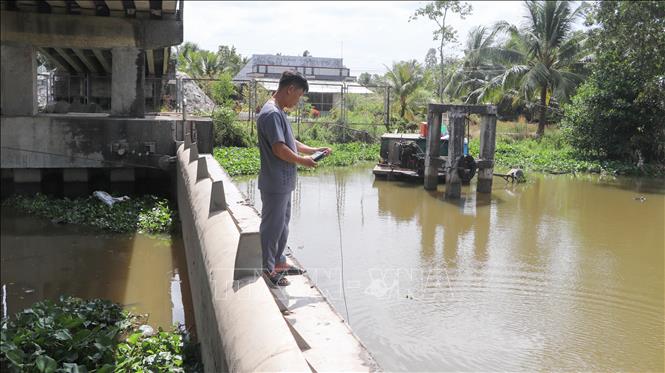
| Monitoring salinity levels in the Mekong Delta. Photo: VNA |
Regarding the trend of saltwater intrusion in the Mekong Delta region from May 1st to 10th, the National Center for Hydro-Meteorological Forecasting stated that saltwater intrusion in the area is expected to gradually decrease towards the end of the week. The highest salinity levels at monitoring stations will be approximately the same as or lower than the highest salinity levels recorded in May 2024, according to VNA.
The depth of the 4‰ salinity boundary extends 30-50km along the Vam Co Dong and Vam Co Tay rivers; 30-37km along the Cua Tieu and Cua Dai rivers; 35-40km along the Ham Luong river; 30-35km along the Co Chien river; 25-35km along the Hau river; and 25-30km along the Cai Lon river.
Salinity intrusion in the Mekong Delta estuaries is trending downwards. Salinity intrusion in the Vam Co and Cai Lon rivers only increased significantly on May 1-5, then gradually decreased.
Salinity intrusion deep into rivers and canals will affect the daily lives and production of people in the area. Local authorities need to take advantage of low tides to store freshwater for agriculture and daily life, and at the same time, limit irrigation to minimize production losses.
Experts advise people to plant seasonal crops that can tolerate high salinity levels, switch to suitable crop varieties, and implement careful care measures to minimize damage caused by drought and saltwater intrusion.
For areas planted with high - value fruit trees that are sensitive to salinity, farmers need to check the salinity level before irrigating.
Besides storing and conserving water, people need to install desalination systems to ensure the best quality water for domestic use and irrigation. Desalination systems are considered a way to directly utilize existing saltwater resources. Through filtration, the system removes dissolved salts from the water, providing water with a suitable level of sweetness. Importantly, the filtered water can be used for direct drinking or for irrigating crops that have low salt tolerance.
For aquaculture farmers, it is necessary to monitor the salinity of the farming environment to determine the appropriate start and end times for farming, taking into account the current level of saltwater intrusion.
( According to thesaigontimes.vn )
Source: https://baoapbac.vn/xa-hoi/202505/xam-nhap-man-o-dong-bang-song-cuu-long-dang-giam-1041417/

![[Image] Central Party Office summarizes work in 2025](/_next/image?url=https%3A%2F%2Fvphoto.vietnam.vn%2Fthumb%2F1200x675%2Fvietnam%2Fresource%2FIMAGE%2F2025%2F12%2F18%2F1766065572073_vptw-hoi-nghi-tong-ket-89-1204-jpg.webp&w=3840&q=75)






































































Comment (0)