

Whenever I hear breaking news about auctions of Vietnamese artifacts in France, Germany, or the United States, I feel a sense of anticipation.
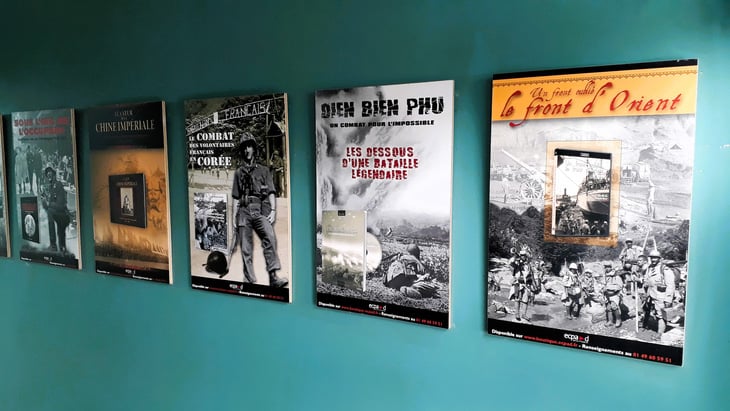
This poster showcases ECPAD's documents and publications on the war.
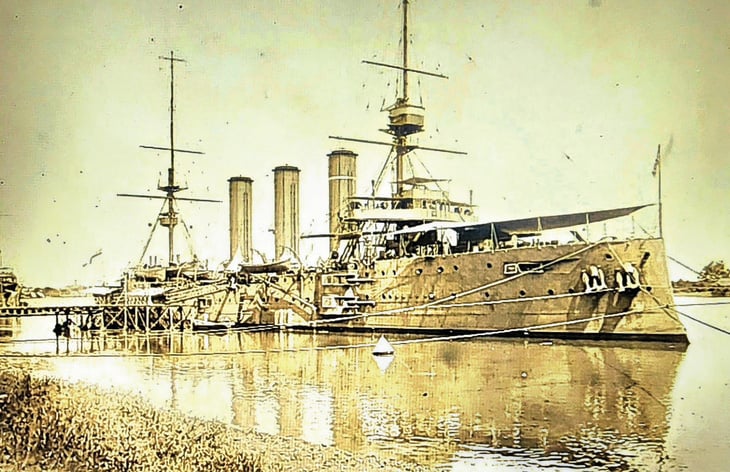
Australian warships docked in Saigon from 1913 (Victoria State Library, Australia)
The three Fansipan peaks in Paris
The French capital, the City of Lights, is full of captivating sights, but if you love Vietnamese history, you can't miss the Vietnamese and Indochinese archives preserved there. First is the French National Library (BNF), housed in two enormous buildings designed like two large books opening onto the banks of the Seine River. At the BNF in 2017, I saw and touched for the first time the urban design plans of modern Saigon – nearly two centuries ago. There was a hand-drawn sketch of the city center streets from 1865, still retaining the rough pencil strokes on croquis paper. Next was a large-format A0 print on contemporary paper, a black and white woodblock print depicting a 3D perspective of the Saigon urban plan from 1880. Wow! Seeing and examining every detail of the original plans was incredibly exciting and emotionally impactful, far more so than a virtual computer map. The Indochina National Museum (BNF) houses a series of hand-drawn or machine-printed maps of Saigon, Cholon, the three regions of Central, Southern, and Northern Vietnam, and all of Indochina, spanning various periods from the late 19th century to approximately 1954. According to bibliographic data, the BNF and its affiliated libraries currently hold 120 maps and 523 photographs specifically about Indochina. In the early 1970s, Dr. Huynh Phan Tong, while working on his dissertation on the history of Vietnamese journalism, discovered that the BNF held approximately 25,000 books and over 1,000 newspaper titles related to Indochina. More recently, doctoral candidate Cao Vy, while working on his dissertation about books published in Southern Vietnam, found over 5,000 books from the period 1922-1944 at the BNF. Dr. Nguyen Giang Huong, a BNF expert in document authentication, estimates that there are tens of thousands of types of documents covering "everything" about Vietnam and Indochina. She told me that those statistics were incomplete, because the BNF still has many documents that have not been fully analyzed and processed. Indeed, a mountain of documents, like Fansipan itself, lies right in the heart of glamorous Paris, waiting to be conquered and explored by those who love Vietnamese history. Paris also has other vast archives that are frequent destinations for Vietnamese studies scholars both domestically and internationally. In 2018, Dr. Olivier Tessier, director of the Far East Institute of Archaeology (EFEO) office in Ho Chi Minh City, introduced me to the school's library near the Trocadero Metro station. As a student, I had heard my professors speak of the EFEO as a legendary castle – a gathering place for many French and Vietnamese scholars with outstanding research works on Indochina, from the beginning of the 20th century to the present. Now, stepping into this "castle," I witnessed thousands of books, newspapers, and documents about Indochina and Asia before and after 1975, all very well preserved. Among these, I found some elementary Vietnamese textbooks compiled by Petrus Trương Vĩnh Ký in the 1880s, and documents on the history of the Thượng Thơ Palace from 1864 – right at the time when there was a debate about whether or not to demolish this historical building (59-61 Lý Tự Trọng Street, District 1, Ho Chi Minh City). In the autumn of 2022, while visiting Paris, my Vietnamese studies friends pointed out a new mountain to me: the Library of the Paris Missionary Society (MEP). Having heard about it for a long time, I went inside and was able to admire another Fansipan-like collection with over 15,000 books, 200 magazines, and 800 paintings related to many East Asian countries. Of these, Vietnam alone had over 1,000 works in both Hán Nôm and Quốc ngữ scripts. To my surprise, I was shown the original handwritten copy of Bishop Pigneau de Behaine's Anamitico Latinum dictionary, completed around 1773, which was kept in pristine condition. This document was a large notebook, larger than A4 size, with neatly written lines in Chinese ink, containing four types of characters: Latin, Nom, Han, and Vietnamese using the Latin script – later known as the national script. I also held a similar handwritten copy of the Annam Chronicle. Looking at the writing from four centuries ago, I couldn't help but feel moved, thinking of the anonymous "souls of yesteryear" who helped missionaries record Vietnamese culture and create the modern writing system for future generations.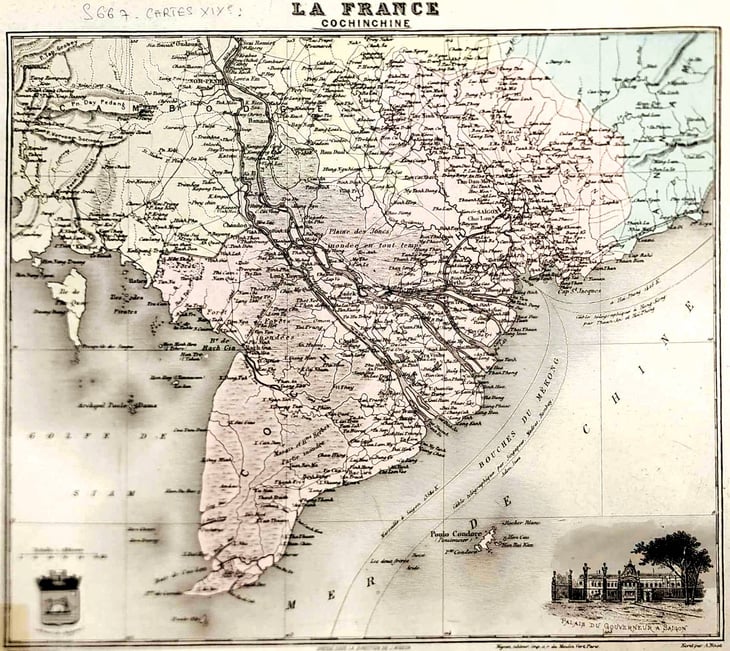
Map of Cochinchine (Southern Vietnam) from the 1870s. The Saigon city logo is in the lower left corner, and the Governor's Palace is in the upper right corner. The map is housed at the Institute of Southeast Asian Studies in Singapore, photographed in November 2023.
Crossing the ocean, encountering a "sea of documents"
Having returned to Paris many times in recent years, I've had the opportunity to visit the Military Museums, Guimet, Cernuschi, and Jacques Chirac, which house many historical artifacts and works of art from Vietnam. French universities also have a wealth of resources on Vietnam and Southeast Asia. At the library of the Paris School of Architecture, I was shown over 120 master's theses researching the planning and architecture of Saigon and Hanoi , with a wealth of historical and contemporary data. A quick glance filled me with both joy and envy, secretly hoping that these theses would one day be shared online. Visiting the French Army's Film and Photography Archive (ECPAD), located in an ancient Vauban-style fortress, my French friends guided me through a magnificent collection of photographs. Thousands of old photographs, still pasted in old paper folders, had, wonderfully, been digitized and uploaded to computers. Through the lenses of officer photographers, the houses and daily life of Saigon and Indochina from 1945 to 1955 are depicted in a diverse and vibrant way.Open Sesame...
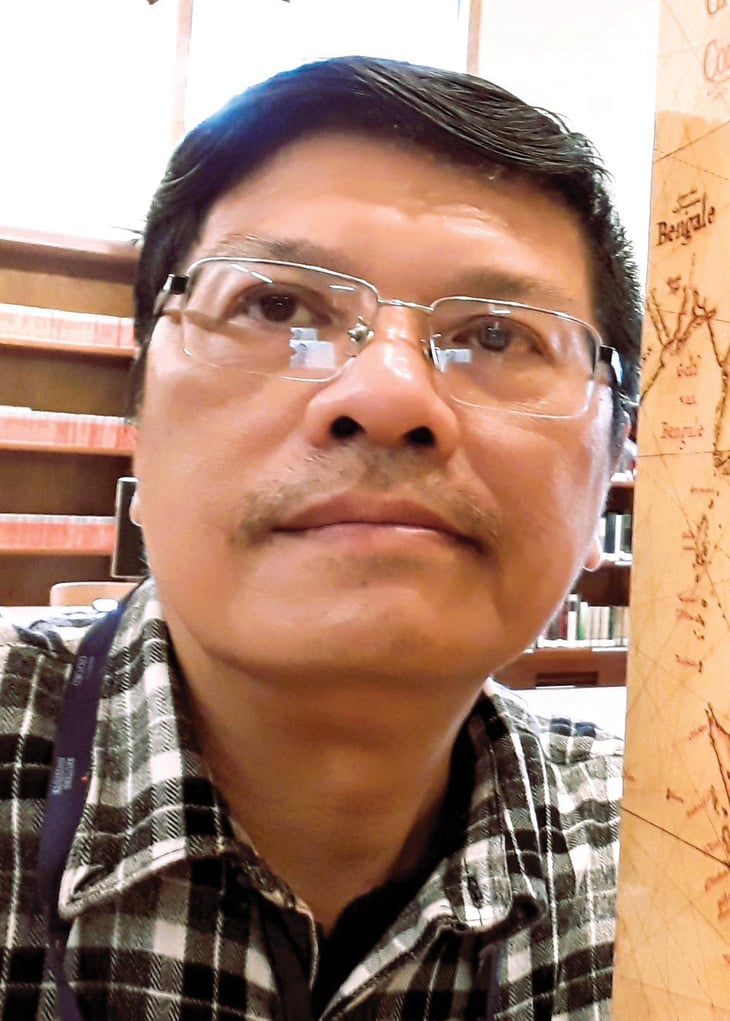
Author Phuc Tien
We must go in search of hidden treasures.
Where else can we find the "mountains of documents" and "seas of documents" about Vietnam? I understand they are present in the archives, libraries, and universities of China, Japan, England, the Netherlands, Portugal, and Spain – countries that have had diplomatic relations with the entire Southeast Asian region since very early times. In particular, the solemn archives of the Vatican also contain many rare and valuable documents and artifacts related to Vietnam from the 15th century. Besides exploiting foreign archives, we cannot forget or allow the resources within our own country to be wasted. Currently, many historical documents and artifacts of Vietnam from various periods are still hidden in archives, libraries, museums, universities, and especially among the people. These are all invaluable treasures that need to be cherished, supplemented, and widely promoted to the public and researchers through various means. Phuc Tien - Tuoitre.vn
![[Image] Hanoi's urban life under the challenge of a "scorching hot" environment](https://vphoto.vietnam.vn/thumb/1200x675/vietnam/resource/IMAGE/2026/05/25/1779706979265_nang-nong-t5-2026-minh-duy-7-4636-jpg.webp)






















































Comment (0)