

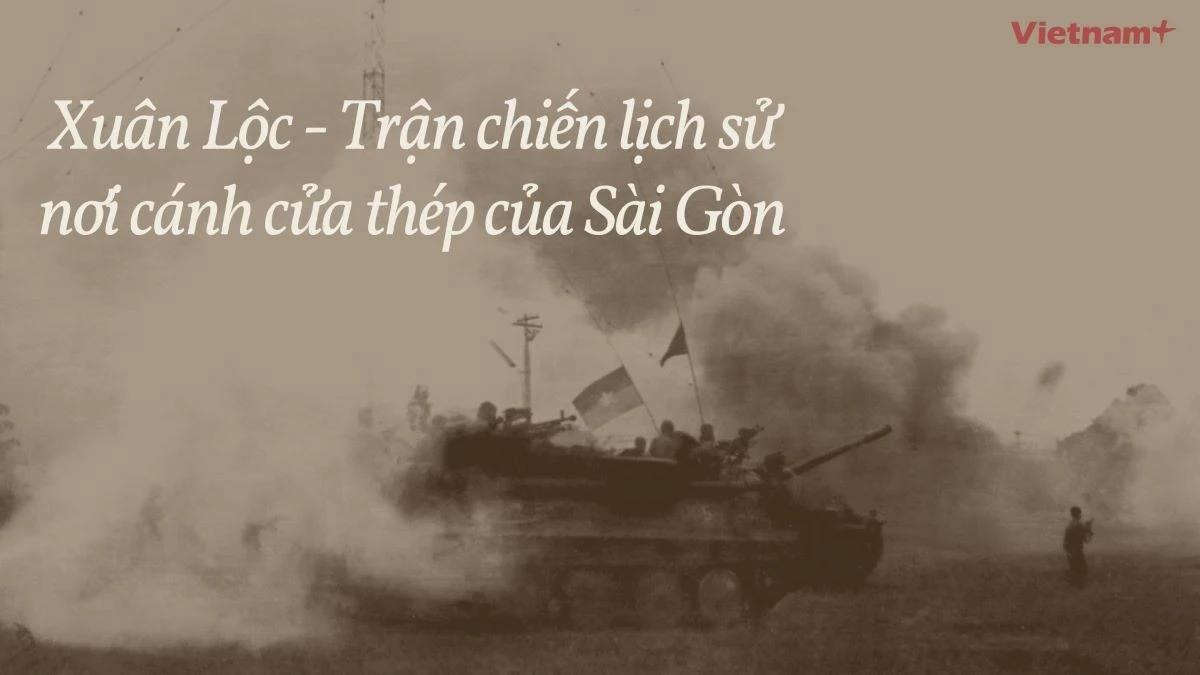
One of the key milestones in our army's historic Ho Chi Minh Campaign, which contributed to the Great Victory of Spring 1975, was the victory at Xuan Loc, which took place from April 9-21, 1975.
This was a particularly important and fiercely contested campaign because the enemy reinforced their defenses and urged their soldiers to fight to the death. However, after unsuccessful attacks, we used a clever tactic to break through the "steel gate" of Xuan Loc, opening the way for the Ho Chi Minh Campaign.
The Xuan Loc Campaign is considered a prime example of the art of using stratagem to defeat the enemy in the treasury of modern Vietnamese military history. This victory created a strategic advantage and a strategic location not only for the 4th Corps but also for the 2nd Corps advancing from the North, providing a foothold and a springboard for the Central Committee and the Regional Command to launch the Ho Chi Minh Campaign.
Xuan Loc opens its "steel gate" wide.
During the Spring Offensive of 1975, following the decisive blow at Buon Ma Thuot, we quickly liberated the Central Highlands, Hue, Da Nang , and most of the central coastal provinces, creating an isolation and threatening Saigon-Gia Dinh and the remaining areas of the Eastern and Southwestern regions under the control of the Saigon government.
To halt the advance of the Liberation Army, the US and the Saigon government concentrated their remaining forces to establish a defensive line stretching from Phan Rang through Xuan Loc to Tay Ninh; in which, Xuan Loc was the key point - the "steel gate" protecting Saigon-Gia Dinh from the East.
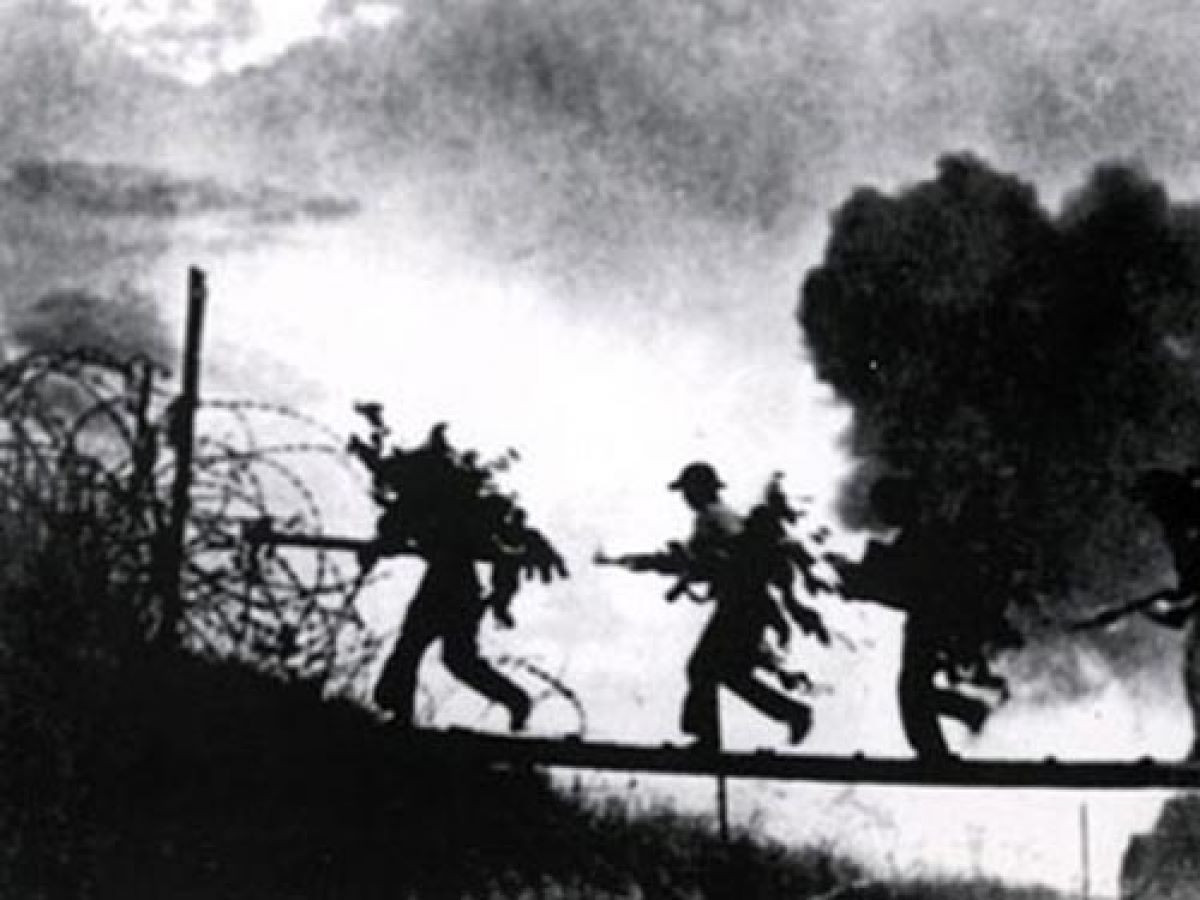
Liberation Army troops advanced to capture the headquarters of the puppet 18th Division during the Xuan Loc Campaign in April 1975. (Archival photo)
Xuan Loc was a town in Long Khanh province (now Long Khanh city, Dong Nai province), located about 80 km east of Saigon, strategically situated along important transportation routes such as National Highway 1A leading to Saigon, National Highway 20 connecting Saigon with Da Lat, and National Highway 15 connecting Saigon with Ba Ria-Vung Tau.
The Chief of Staff of the U.S. Army, General Frederick C. Weyand, personally inspected Xuan Loc and emphasized: "Xuan Loc must be held; losing Xuan Loc means losing Saigon."
To turn Xuan Loc into a "steel gate," the enemy concentrated an infantry division, a commando regiment, a tank and armored vehicle regiment, four artillery battalions, and a force that had been prepared for special support.
On our side, recognizing the importance of the Xuan Loc gateway, on April 2, 1975, in accordance with the guiding principles of the Politburo and the Central Military Commission, the Regional Command decided to launch an offensive to liberate Xuan Loc, aiming to destroy the 18th Division in the outer perimeter, thwart the enemy's long-range defense plan, break the enemy's consolidated defense of Saigon, cut off transportation, and isolate Saigon. The task of attacking Xuan Loc was assigned to the 4th Corps.
At 5:40 AM on April 9, 1975, the 4th Army Corps launched an attack on Xuan Loc. On the first day of fighting, our troops captured half of the town and the entire administrative area of the sub-district.
In the following days, the fighting in Xuan Loc-Long Khanh intensified. Faced with this difficult situation, we studied the course of the battle and decided to reorganize our forces, changing our tactics from direct attack to a siege and isolation strategy aimed at weakening the enemy forces within the town; and destroying the enemy's newly arrived reinforcements that were still unestablished in the outer perimeter.
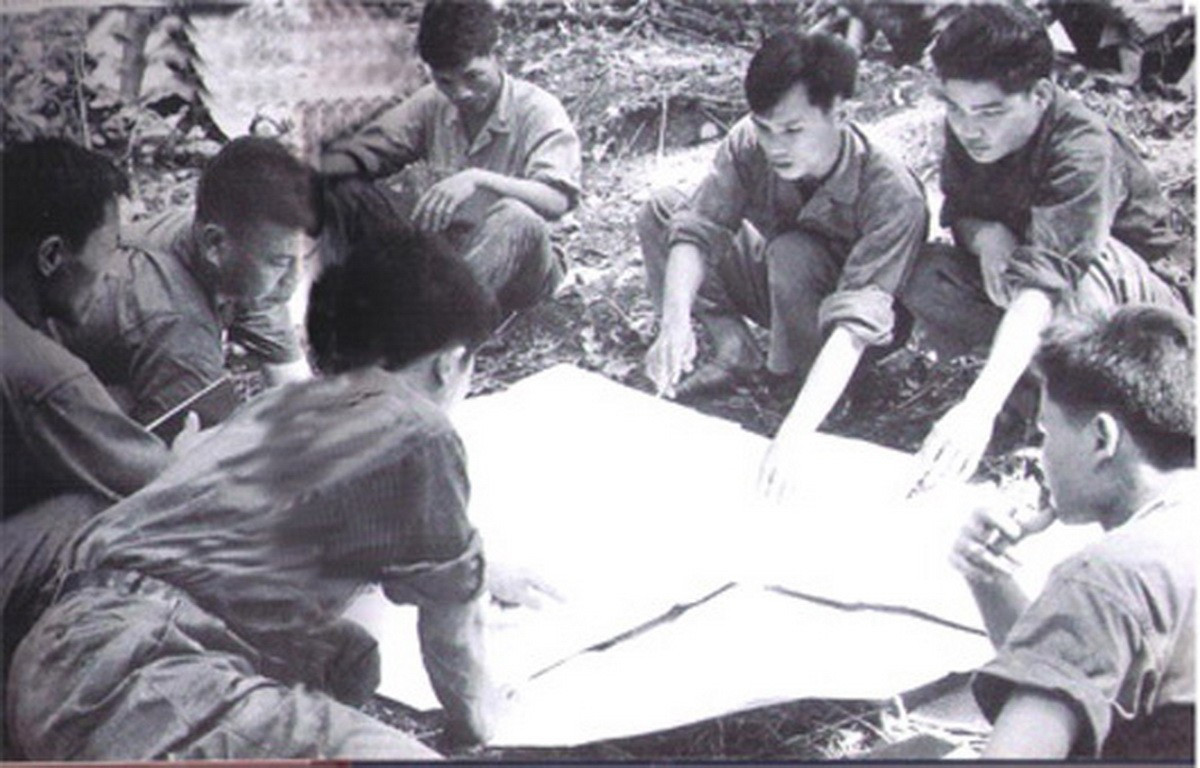
The commander of the 3rd Regiment (304th Division) discusses battle plans during the Xuan Loc Campaign. (archival photo)
We organized the attack to capture the Dau Giay and Nui Thi intersections, cut off National Highway 1, and intercepted reinforcements from Bien Hoa and Trang Bom, cutting Xuan Loc off from Bien Hoa.
At dawn on April 15, 1975, our troops began shelling Bien Hoa airport. In the Xuan Loc area, the 7th Division and the 341st Division continuously engaged the enemy, defeating the remaining two combat groups (43rd and 48th) of the 18th Division and destroying a portion of the paratroopers.
Realizing they could not defend Xuan Loc, the enemy retreated on April 20th, pursued and annihilated by our troops. On April 21st, Xuan Loc town and the entire Long Khanh province were liberated.
After the "steel gate" of Xuan Loc was broken down, a series of major political events unfolded in quick succession on the Saigon political scene.
On the very night that Xuan Loc was liberated, Nguyen Van Thieu had to resign as President of the Republic of Vietnam, and Tran Van Huong took over amidst growing panic throughout Saigon due to the rapidly accelerating American evacuation campaign.
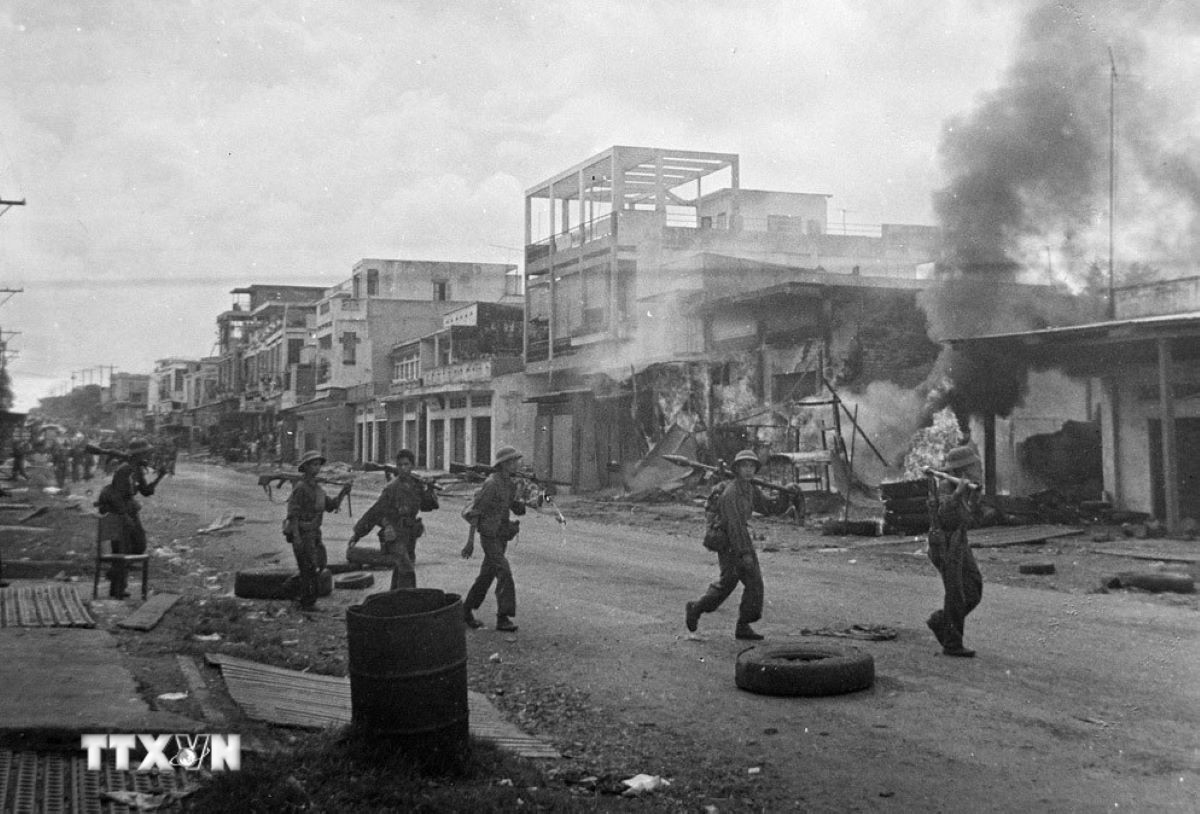
Soldiers of the 341st Division (4th Corps) attacked and liberated Xuan Loc town, shattering the strongest defense line east of Saigon, on April 21, 1975. (Photo: VNA)
The very next day, April 22nd, the Party Committee and the Command of the Ho Chi Minh Campaign approved and officially ratified the plan for the offensive to liberate Saigon-Gia Dinh.
Then, on April 23rd, across the ocean, at Tulane University in New Orleans, U.S. President Gerald Ford declared: The war is over for Americans.
"The victory at Xuan Loc shook the entire enemy defense system around Saigon, further demoralizing the enemy troops. News of the victory thrilled the people throughout the country." (Excerpt from the memoir "General Headquarters during the Spring of Total Victory" by General Vo Nguyen Giap)
Memories from those involved
With the momentum of a "raging attack like a waterfall," after 12 days and nights of incredibly heroic fighting by our army and people, the "steel gate" of Xuan Loc was flung open, paving the way for our troops to advance and liberate Saigon, unifying the country.
Fifty years have passed, but the memories of the Battle of Xuan Loc remain vivid for many veterans.
Having been involved in the pivotal Battle of Xuan Loc in 1975, where he served as a captain and deputy commander of the 266th Regiment of the 341st Division, Mr. Le Tien Hat still preserves many precious mementos related to the liberation of Xuan Loc. During the most brilliant period of his youth, he dedicated his entire energy and enthusiasm to serving in the 341st Division of the 4th Army Corps.
According to his account, Xuan Loc was considered one of the most strategically important gateways. Based on an understanding of the actual battlefield situation, on April 2, 1975, the Regional Command, under the thorough guidance of the Politburo and the Central Military Commission, decided to launch an offensive campaign to liberate Xuan Loc. The strategic objective of the campaign was to destroy the 18th Division stationed in the outer perimeter, disrupt the enemy's long-range defenses, and simultaneously collapse the defensive positions aimed at consolidating Saigon. Furthermore, the campaign played a crucial role in cutting off strategic transportation routes and isolating the enemy's central area in Saigon.
The atmosphere of preparation for the Battle of Xuan Loc throughout the entire corps was extremely urgent and serious. At Regiment 266, where he served, everyone understood that capturing this stronghold was the decisive step towards advancing into Saigon and achieving ultimate victory. Everyone strived and was determined to contribute, however small, to the campaign. In particular, a soldier around 15-16 years old, like Dam Duy Thien, drew an extremely detailed battle map, perfectly suited to the actual situation, helping the commanders effectively manage the battle.
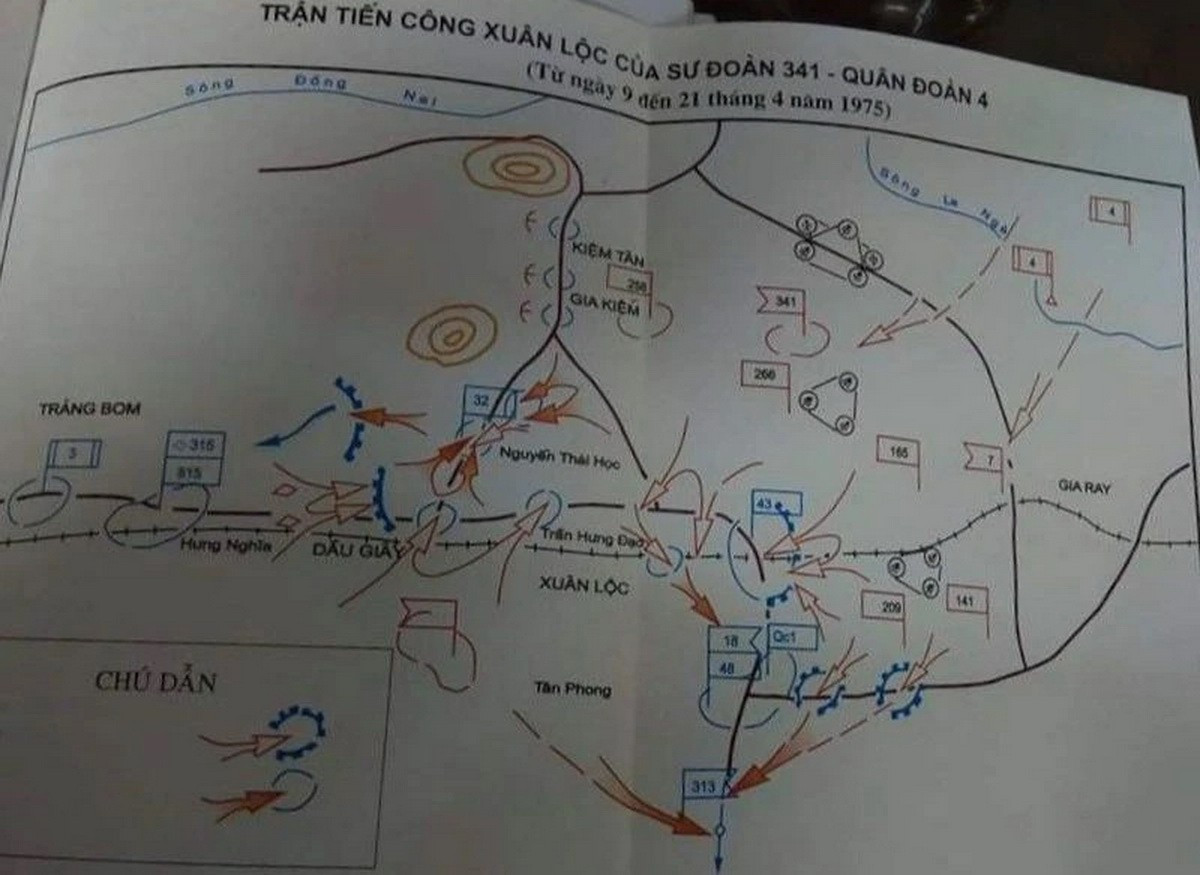
The map of the Battle of Xuan Loc was completed by veteran Dam Duy Thien.
Like Mr. Hat, veteran Dam Duy Thien - the man who drew the battle map of Xuan Loc - still vividly remembers those historic April days on the Southern battlefield.
At the age of 16, Dam Duy Thien set aside his dream of becoming a doctor to defend his country. When he joined the 266th Regiment, he was the youngest member of the unit. Having a talent for painting, he was assigned by his superiors to draw battle maps.
Mr. Thien recalled that during the Battle of Xuan Loc, upon arriving in a new area, he received a lot of information about the enemy from scouts. He had to try his best to gather, observe, and use his memory to connect all the data. At that time, he had to immediately write down everything the commander said. In addition, when units and departments went on reconnaissance missions, he also needed to grasp the information and accurately represent it on the map.
In the early days of the Battle of Xuan Loc, although our troops captured several targets in the town, they had not yet completely annihilated the enemy forces. Given this situation, the attack tactics had to change, requiring the battle map to be adapted flexibly to the new plan from higher command.
Thanks to accurate map drawings and a courageous and resilient spirit, after 12 days and nights (from April 9th to April 20th, 1975), our army launched a precise attack, shattering the "choke point" of Saigon.
Veteran Dang Dinh Long (born in 1942 in Duc Ninh commune, Dong Hoi city, Quang Binh province) recalled: “For me, the most profound memory is the moment when I and my comrades directly defeated the enemy's defensive line in Xuan Loc and approached Trang Bom to advance into Saigon. The fierce battle to break through the enemy's steel defense line lasted for 12 consecutive days and nights.”
Given the strategic location of Xuan Loc-Long Khanh, liberating Saigon required liberating Xuan Loc-Long Khanh. Therefore, the Xuan Loc battlefield became an extremely fierce battleground.
On April 9, 1975, Mr. Long and his comrades were ordered to launch a simultaneous attack from multiple directions on the "steel gate" of Xuan Loc. After 12 days and nights of fierce fighting, with every house and street corner contested, the enemy's defenses at Xuan Loc gradually weakened.
After breaking through the Xuan Loc defense line, on the night of April 26, 1975, Long's unit launched an attack on Trang Bom with great momentum. The troops advanced to capture Bien Hoa airport, and together with other units, crossed the Dong Nai River and entered Saigon.
During this fierce battle, Mr. Long was wounded for the second time when 15 M79 shrapnel fragments lodged in his body. While wounded, he had to crawl nearly 1 km, enduring the pain while continuing his reconnaissance duties right next to the American-backed South Vietnamese reconnaissance squad.
“For us soldiers at that time, we were always ready to face danger and accept death, determined to fight to the end. When we entered Saigon and witnessed the South Vietnamese soldiers abandoning their weapons and fleeing in disarray, and the people pouring into the streets to welcome the troops, we felt incredibly proud and moved. Those are feelings we can never forget,” Mr. Long said emotionally.
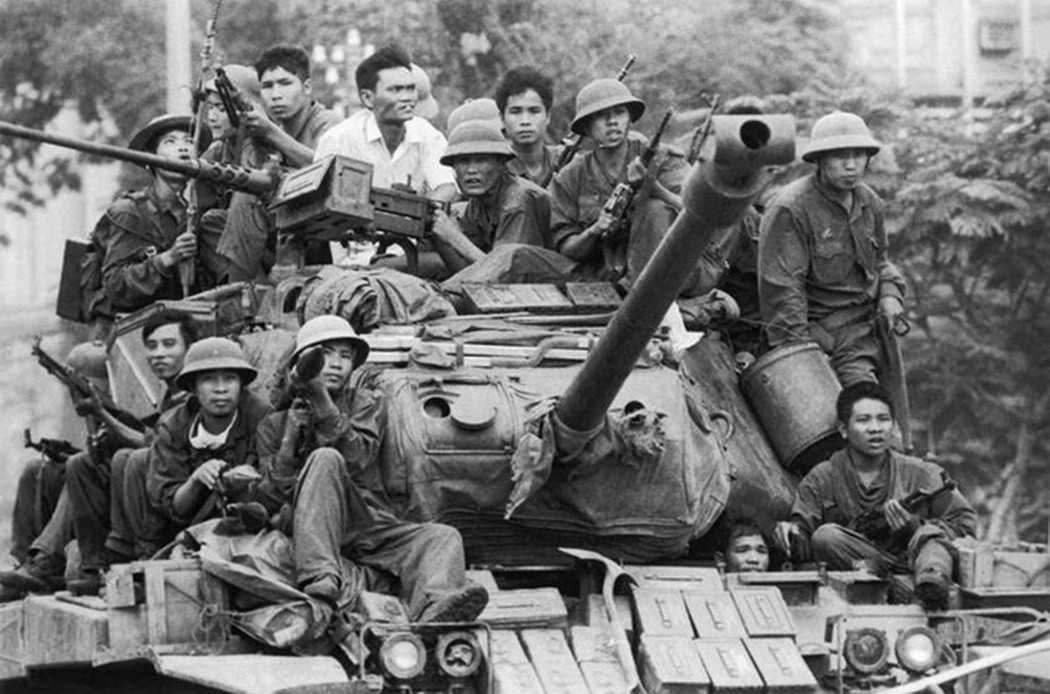
Breaking through the "steel gate" of Xuan Loc, opening the way to Saigon. (Archival photo)
Mr. Pham Quang Than (a former soldier of the 341st Division, 4th Corps; currently the Chairman of the Veterans Association of Long Khanh City, Dong Nai Province) fondly recalled: “On April 9, 1975, all units received orders to advance and liberate Xuan Loc-Long Khanh. At that time, together with the people, the army units liberated wherever they went, the offensive momentum was like a whirlwind. The main army units advanced into Xuan Loc and Long Khanh, and wherever they went, they were welcomed by the people, who supplied them with food and provisions.”
For Mr. Tran Van Phu, a former soldier of the Long Khanh Military Engineering Workshop, memories of the historic battle remain vivid. He recalls that on the morning of April 9, 1975, the main army units began a simultaneous attack from multiple directions on the "steel gate" of Xuan Loc.
At that time, local army units also advanced, fighting from within; the people rose up, supporting and supplying the army forces, taking over control of each area as they fought.
"Given the strategic location of Xuan Loc-Long Khanh, the enemy determined that losing Xuan Loc meant losing Saigon. For our forces, we understood that liberating Saigon required liberating Xuan Loc-Long Khanh. Therefore, the Xuan Loc-Long Khanh battlefield became an extremely fierce battleground, with the enemy using a large amount of modern weapons and putting up fierce resistance," Mr. Pham Quang Than shared.
Realizing that Xuan Loc was only valuable when resupplied from Bien Hoa, the Campaign Command decided to change tactics, cutting off the enemy's advance from Dau Giay and capturing Thi Mountain, aiming to isolate Xuan Loc from enemy reinforcements from the west. After 12 days and nights of all-out attack, while simultaneously cutting off enemy reinforcements, our forces routed the enemy in many places.
"With an overwhelming offensive momentum, our troops seized control of the battlefield. Locally, our army units, along with the local people, attacked from within, causing the enemy officers and soldiers to flee in disarray, seeking ways to escape," recalled Mr. Tran Van Phu.
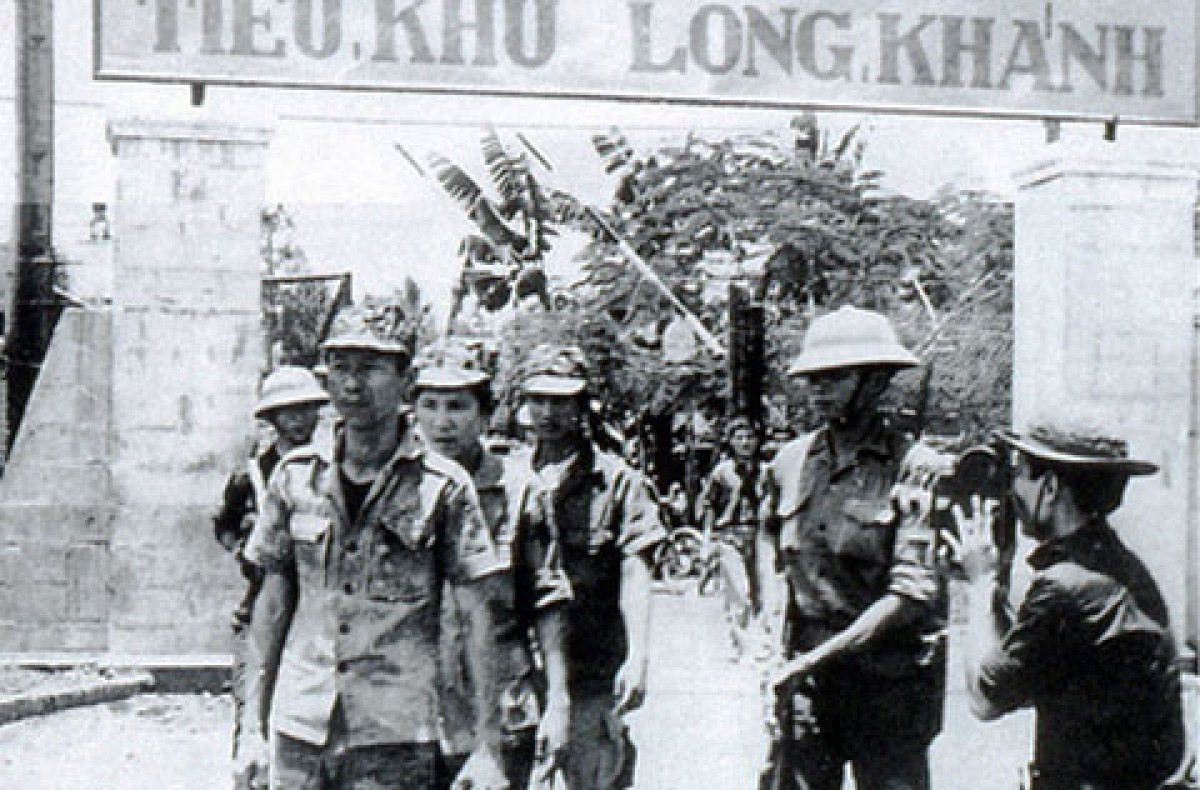
Capturing enemy prisoners in the Long Khánh sub-district. (Archival photo)
Historical significance and valuable lessons learned.
The victory of the Xuan Loc campaign not only affirmed the correct and creative line of the Party in leading and directing the revolutionary war, but also consolidated and promoted the political and spiritual factors of our entire army and people, creating a combined strength to achieve the final victory - the historic Ho Chi Minh Campaign.
The victory in the Xuan Loc campaign created a favorable staging area, serving as a springboard for the attack of the Eastern Front - one of the five main mobile spearheads of the campaign named after our beloved President Ho Chi Minh - advancing to liberate Saigon-Gia Dinh.
With the Eastern Front opened, the army advanced towards Saigon with unwavering momentum. The breach of the "steel gate" of Xuan Loc opened the way for our army to launch the historic Ho Chi Minh Campaign, liberating Saigon, storming the last stronghold of the US-puppet regime, contributing to the victory of the historic Ho Chi Minh Campaign, and bringing to a successful end the glorious resistance war against the US for national salvation of the Vietnamese people.
The victory at Xuan Loc also yielded many valuable lessons. These included understanding the strategic intentions of the Central Party Committee, making timely and accurate decisions; knowing how to organize and utilize local forces, maximizing the combined strength of people's war; timely, sensitive, and flexible leadership and command; and developing a strategic offensive, seizing opportunities to achieve victory.
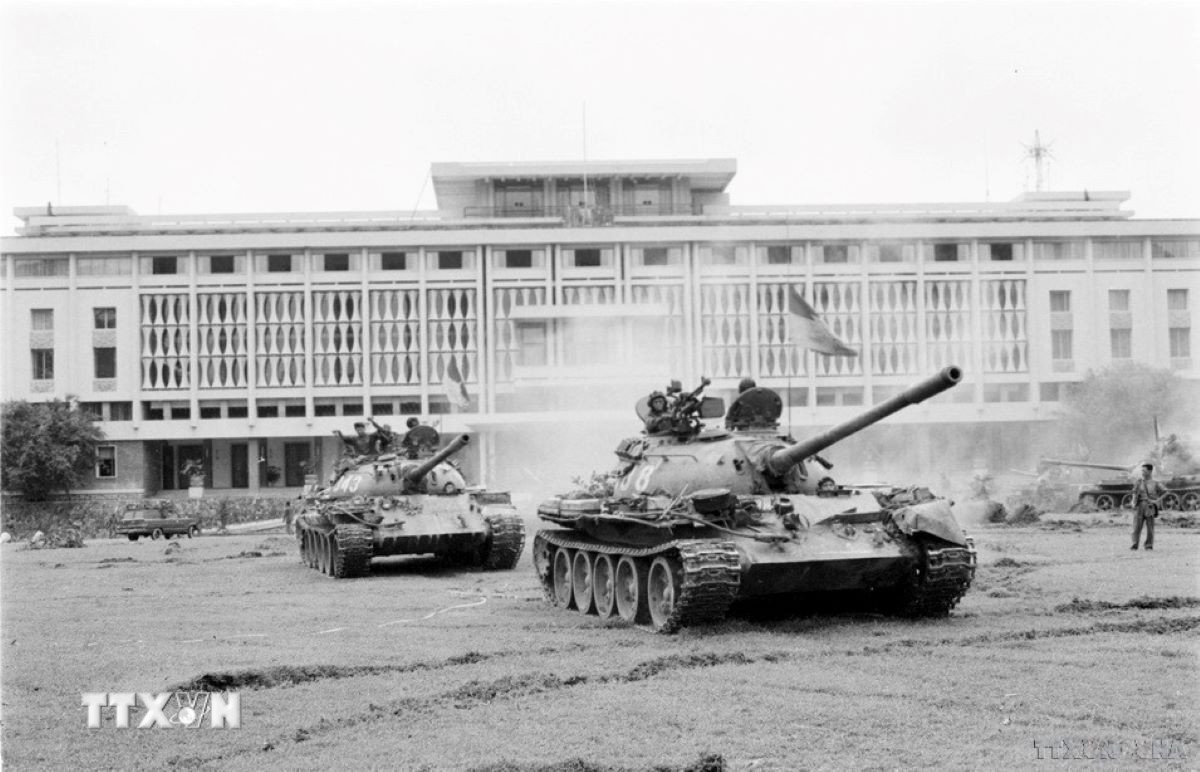
On the morning of April 30, 1975, from all directions, hundreds of tanks, armored vehicles, and infantry simultaneously advanced towards the Presidential Palace of the Saigon puppet regime, liberating Saigon. (Photo: Hua Kiem/VNA)
Those lessons learned and spiritual values remain intact in the cause of building and defending the Fatherland today.
Currently, hostile forces have not abandoned their plot of "peaceful evolution" and inciting riots and overthrow, and are using the pretexts of "democracy" and "human rights" to try to change the political regime in Vietnam...
In this situation, to firmly protect the socialist Fatherland of Vietnam and the achievements of the Xuan Loc victory in particular, of the Spring 1975 General Offensive and Uprising, and of the national liberation revolutionary cause in general, it requires the entire Party, the entire people, and the entire army to constantly uphold the spirit of revolutionary vigilance, build political and spiritual factors, build a solid foundation of people's support, build a national defense system based on the entire population, a national defense posture linked with a people's security posture, build provinces and cities into solid defense zones, and proactively defend the country even before it is in danger.
(Vietnam+)
Source: https://www.vietnamplus.vn/xuan-loc-tran-chien-lich-su-noi-canh-cua-thep-cua-sai-gon-post1022561.vnp


![[Photo] Prime Minister Pham Minh Chinh attends the Conference on the Implementation of Tasks for 2026 of the Industry and Trade Sector](/_next/image?url=https%3A%2F%2Fvphoto.vietnam.vn%2Fthumb%2F1200x675%2Fvietnam%2Fresource%2FIMAGE%2F2025%2F12%2F19%2F1766159500458_ndo_br_shared31-jpg.webp&w=3840&q=75)
































































































Comment (0)