

This situation urgently necessitates a comprehensive restructuring, shifting from "high-volume export" to processing, improving quality, and enhancing competitiveness within the global value chain.
Growth in quantity, but a drop in value.
In recent years, coffee exports have continued to be a bright spot for Vietnam's agricultural sector. In the first four months of 2026 alone, export volume reached approximately 810,000 tons, a 15.8% increase compared to the same period. However, export value only reached US$3.69 billion, a 7% decrease – a paradox reflecting the significant dependence on fluctuations in world prices.
According to the Vietnam Coffee and Cocoa Association, the average export price has fallen sharply to only about 4,556 USD/ton, significantly lower than the same period last year. This is not a temporary phenomenon but a trend that has repeated itself for many years: Production has increased but the value has not kept pace.

According to Do Ha Nam, Vice President of the Vietnam Coffee and Cocoa Association, the direct cause stems from the oversupply situation in the global market. World coffee production has been continuously increasing, especially Robusta – Vietnam's main product. When supply exceeds demand, price drops are inevitable, severely impacting countries that export raw materials.
The Ministry of Agriculture and Environment notes that Vietnam currently primarily exports green coffee beans, accounting for over 85% of total exports. The low added value makes the industry vulnerable to market fluctuations. Furthermore, besides being dependent on price, the market structure also reveals several weaknesses. Despite expanding to many countries, exports remain heavily concentrated in traditional markets such as Europe. This makes the industry susceptible to impacts when these markets tighten standards or experience a decline in demand.
From a business perspective, Pham Thang, Director of Cat Que Production and Trading Co., Ltd., believes that another limitation is that Vietnamese coffee brands have not yet been clearly positioned in the international market. Despite being a leading exporter of Robusta coffee, the product still primarily serves as raw material for foreign roasting companies, failing to establish its own distinct image.
Many experts also believe that coffee exports are hampered by production issues; most coffee farms are fragmented, and loose supply chain linkages reduce efficiency. Farmers mainly produce on a small scale, lacking connections with processing and exporting businesses, leading to difficulties in controlling consistent quality.
Adding value and greening production – the way forward for the coffee industry.
Faced with increasing challenges, the need to shift the development model of the coffee industry is becoming urgent. The focus is no longer on expanding acreage or increasing production, but on enhancing added value and achieving sustainable development.
According to economic experts, the fundamental solution is to promote deep processing. Currently, the proportion of processed coffee (roasted, ground, instant) in Vietnam is still modest compared to its potential. Meanwhile, processed products can bring in higher value, ranging from several hundred to thousands of USD per ton. Do Ha Nam, Vice President of the Vietnam Coffee and Cocoa Association, stated: "If we only export green coffee beans, we will always be at a low position in the value chain. To change this, we must invest heavily in deep processing and brand building."
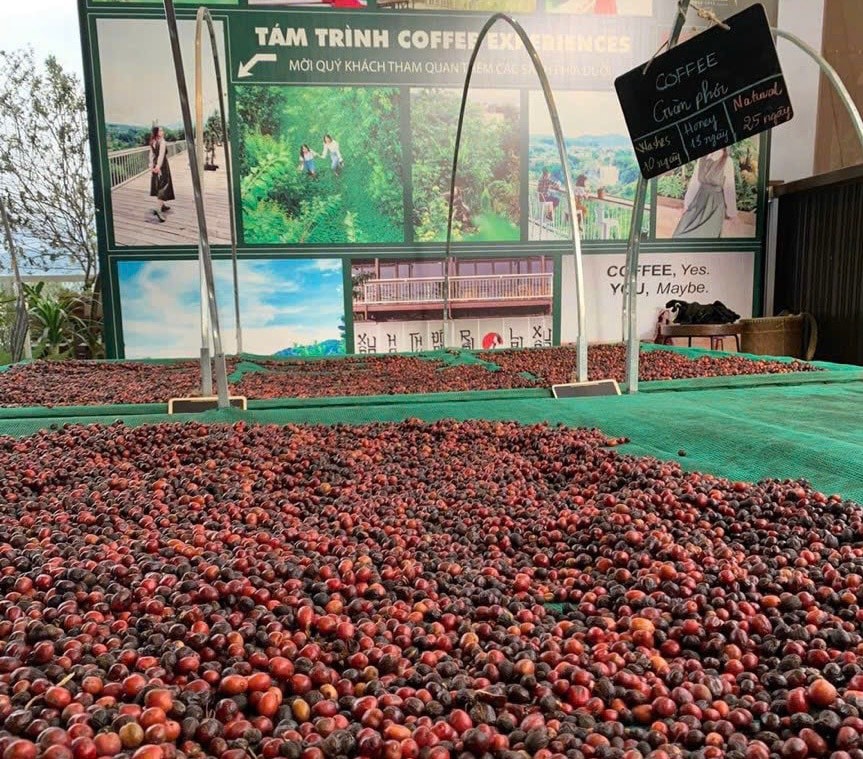
Simultaneously, the development of specialty coffee is also considered a strategic direction. This segment not only brings high value but also helps to position the Vietnamese coffee brand in the international market. Besides the value factor, "greening" production is becoming a mandatory requirement. Major markets, especially Europe, are increasingly tightening standards on environmental protection, traceability, and sustainable development. Failure to meet these standards clearly risks losing market share.
In light of the aforementioned issues, the Ministry of Agriculture and Environment stated that, in recent years, the Ministry has closely followed the planning of coffee growing areas and acreage, and that the coffee industry needs to shift strongly towards sustainable production, reducing emissions, and using resources efficiently. This is not only a requirement of the market but also a condition for long-term development.
To achieve this, a coordinated effort is needed from the government, businesses, and farmers. The government needs to improve mechanisms and policies to support green credit and encourage investment in processing and technology. Businesses must play a leading role in the supply chain, building sustainable links with raw material areas. Meanwhile, farmers need to change their production mindset, focusing on quality rather than just quantity. Furthermore, building a national brand for Vietnamese coffee is also an urgent task. With a strong brand, products will not only fetch higher prices but also establish a sustainable position in the international market.
The Vietnamese coffee industry is at a critical juncture. Production growth figures alone are no longer sufficient to reflect the industry's true strength. In the context of increasingly fierce global competition, only by enhancing value, developing sustainably, and building a strong brand can Vietnamese coffee escape the "raw export trap" and rise to a position it deserves in the world market.
Source: https://hanoimoi.vn/xuat-khau-ca-phe-viet-nam-tang-truong-thieu-ben-vung-ap-luc-tai-cau-truc-748764.html

![[Photo] National Assembly Chairman Tran Thanh Man working with the Standing Committee of the Law and Justice Committee](https://vphoto.vietnam.vn/thumb/1200x675/vietnam/resource/IMAGE/2026/05/21/1779378929214_ndo_br_1-4610-jpg.webp)
![[Photo] General Secretary and President To Lam presides over a working session with the Central Policy and Strategy Committee on the development of the materials industry.](https://vphoto.vietnam.vn/thumb/1200x675/vietnam/resource/IMAGE/2026/05/21/1779359935432_a3-bnd-3129-1412-jpg.webp)




































































Comment (0)