

Despite achieving new export records, the lack of a strong rice brand has become a major obstacle for Vietnam's rice industry.
It's difficult to maintain export records.
Surpassing the impressive figures of 2023, rice exports in 2024 reached approximately 9 million tons for the first time, generating nearly $5.8 billion in revenue, representing a 10.6% increase in volume but a significant 23% increase in value. The average export price of rice in 2024 also increased by 16.7% compared to 2023. This is an incredibly impressive breakthrough after 35 years since Vietnam began exporting rice. As a result, rice farmers are enjoying good income and profits.
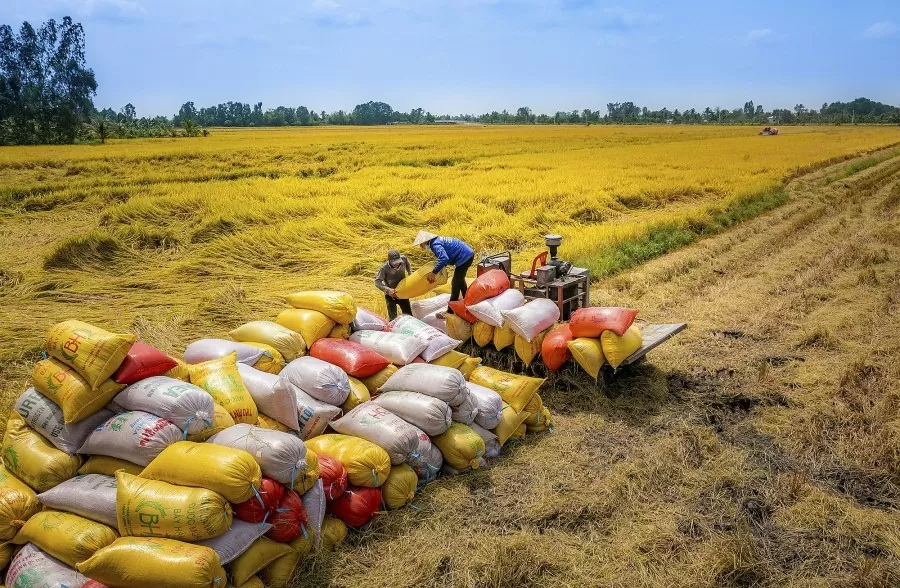 |
| In 2024, Vietnam ranked third in the world for rice exports. |
In terms of markets, Vietnamese rice has reached approximately 150 countries and territories worldwide. The largest importing markets are the Philippines, Indonesia, Malaysia, Ivory Coast, and Ghana; among them, the Philippines continues to be Vietnam's largest rice importer, and Vietnam is also the leading rice supplier to this country.
However, the good news for the rice industry was short-lived, as the continuous drop in rice prices at the beginning of 2025 caused anxiety and insecurity among farmers. This situation once again raises the issue of the urgent need for long-term solutions to ensure the sustainable development of the rice industry…
According to the latest information from the Vietnam Food Association (VFA), the price of 5% broken rice from Vietnam continues to fall by another $4/ton, to $413/ton. The price of 25% broken rice also decreased by $3/ton to $387/ton. However, the price of 100% broken rice increased by $8/ton, to $330/ton. According to the VFA, the export price of Vietnamese rice has been continuously declining since the last month of 2024.
According to the Department of Agriculture and Rural Development of An Giang province, the current price of Nang Hoa 9 rice is 9,200 VND/kg; the price of IR 50404 rice (fresh) fluctuates between 5,500 - 5,700 VND/kg; OM 5451 rice fluctuates between 5,800 - 6,000 VND/kg; OM 18 rice (fresh) fluctuates between 7,600 - 7,800 VND/kg; Dai Thom 8 rice (fresh) fluctuates between 7,600 - 7,800 VND/kg; OM 380 rice is at 6,600 - 6,700 VND/kg; and Japanese rice is at 7,800 - 8,000 VND/kg;...
Currently, the market price of paddy rice is around 7,000 VND/kg for varieties like Dai Thom 8 or Jasmine, compared to 9,000 VND/kg or even higher at the same time last year. Lower-priced varieties range from over 5,000 to under 7,000 VND/kg (depending on the type), a decrease of 1,000 - 2,000 VND/kg compared to the same period last year.
Export rice prices have fallen sharply due to several factors, including major rice-importing countries studying cost-saving policies to avoid importing high-priced rice, and some even declaring they will not buy rice in 2025. According to business forecasts, the record rice export prices and export figures of Vietnam in 2024 are unlikely to be maintained in 2025.
The long-term story of Vietnamese rice
The winter-spring rice crop is the largest rice crop of the year. From before Tet (Lunar New Year) to after Tet 2025, the Mekong Delta region will harvest the winter-spring rice crop, meaning a large quantity of fresh rice will be harvested, and consequently, the supply of rice to the market will be more abundant.
Industry experts believe that the recent drop in rice prices just before Tet (Lunar New Year) is a wake-up call regarding the sustainability of rice production and consumption. Given Vietnam's record rice exports, comprehensive policies are needed to protect rice farmers. Solving the price problem is not only an economic issue but also a social responsibility, ensuring stable livelihoods for millions of farmers in the Mekong Delta.
Agricultural expert Hoang Trong Thuy noted that although Vietnam's rice export volume consistently reaches impressive figures, averaging 7-8 million tons per year, the added value of Vietnamese rice remains very limited. Vietnamese rice is still mainly exported in its raw form. The lack of a strong rice brand has become a major obstacle to export activities.
To address this situation, we need to focus on reorganizing production, especially according to the "Sustainable Development Plan for 1 Million Hectares of High-Quality, Low-Emission Rice Cultivation Linked to Green Growth in the Mekong Delta by 2030". Only by producing regionally, standardizing varieties, and applying strict management processes can we create high-quality rice products that meet the increasingly stringent demands of the market.
Sharing this view, from a local perspective, Mr. Tran Thai Nghiem - Deputy Director of the Department of Agriculture and Rural Development of Can Tho City - stated that farmers, cooperatives, and businesses need to cooperate for the long term. In particular, the project "Sustainable Development of 1 Million Hectares of High-Quality, Low-Emission Rice Cultivation Associated with Green Growth in the Mekong Delta by 2030" is a sustainable approach.
According to Mr. Le Minh Hoan, Minister of Agriculture and Rural Development, the struggle to find enough rice for each meal used to be a constant worry, but now Vietnam has become one of the leading rice exporting countries in terms of both volume and quality. Vietnamese rice has been honored among the best rice in the world. This is a source of national pride and honor. Rice has enhanced the image and status of the nation, contributing to positioning our country on the world agricultural map.
The year 2025 is expected to be challenging for the rice industry. However, many businesses remain quite optimistic because the market has now diversified, expanding its market share in the high-end segment not only in the EU but also in Japan, China, and the Middle East.
Furthermore, focusing on exporting high-quality rice not only helps affirm the position of Vietnamese rice but also provides a basis for businesses to proactively negotiate selling prices commensurate with value, reducing price pressure from the food reserve market.
However, to ensure that Vietnamese rice not only increases in value but also doubles or triples it, industry experts believe that building a rice brand is a top priority. In addition, it is necessary to develop the value chain, from production to consumption, and focus on high-end markets.
Learning from the successes of neighboring countries like Thailand and Cambodia, along with shifting the mindset from agricultural production to agricultural economics and developing distinctive, high-quality products that meet the stringent requirements of the international market, will be the way for rice farmers to escape the curse of "eternal poverty from rice farming" and "bumper harvests leading to low prices," while simultaneously contributing to enhancing the image of Vietnamese rice in the international market.
In his press conference before the New Year, Minister of Agriculture and Rural Development Le Minh Hoan began his remarks with a short video of the song "Rock Rice" by singer Phuong My Chi. Combining rock music, a genre traditionally associated with Western music, with the Vietnamese element of rice grains has opened up a fresh perspective on the image of a global citizen. The English compound word "glocal," combining global and local, is a very insightful concept: global connection combined with local understanding and appreciation of local resources. We integrate globally, distilling the best aspects of the world to revitalize traditional values. And we confidently and proudly introduce and promote these traditional values to the world, proactively building the image and positioning of the Vietnamese brand. Is this also the case when building agricultural product brands? We need to be agile to integrate, but to integrate and integrate well, we first need to build a solid foundation, carefully selecting unique values, cherishing the simple, familiar things that have been rooted for generations. |
Source: https://congthuong.vn/xuat-khau-gao-va-cau-chuyen-duong-dai-371926.html

![[Photo] Solemn bathing ceremony and Buddha procession in Hue](https://vphoto.vietnam.vn/thumb/1200x675/vietnam/resource/IMAGE/2026/05/31/1780228263543_1-jpg.webp)

![[Photo] The General Secretary, President and his wife begin their state visit to the Philippines.](https://vphoto.vietnam.vn/thumb/1200x675/vietnam/resource/IMAGE/2026/05/31/1780230559452_anh-man-hinh-2026-05-31-luc-19-28-11.png)
![[Image] Hanoi Police officially crowned champions of V-League 2025/2026](https://vphoto.vietnam.vn/thumb/1200x675/vietnam/resource/IMAGE/2026/05/31/1780244769054_ndo_br_039d561b692be875b13a-jpg.webp)
![[Photo] Admire the coral "masterpiece" amidst the million-year-old heritage of Dak Lak province.](https://vphoto.vietnam.vn/thumb/1200x675/vietnam/resource/IMAGE/2026/05/31/1780221235105_anh-man-hinh-2026-05-31-luc-16-53-27.png)











![[Video] Sunset at Lap An Lagoon – Where the sun sets over the fishing nets](https://vphoto.vietnam.vn/thumb/340x192/vietnam/resource/IMAGE/2026/05/31/1780192137701_beach-landscape-sea-water-nature-grass-745871-pxhere-com.jpeg)






































![[Photo] Admire the coral "masterpiece" amidst the million-year-old heritage of Dak Lak province.](https://vphoto.vietnam.vn/thumb/402x226/vietnam/resource/IMAGE/2026/05/31/1780221235105_anh-man-hinh-2026-05-31-luc-16-53-27.png)































Comment (0)