

Astronomers have discovered some of the most massive celestial objects in the universe, from planets to superclusters of galaxies.
Largest planet: ROXs 42Bb
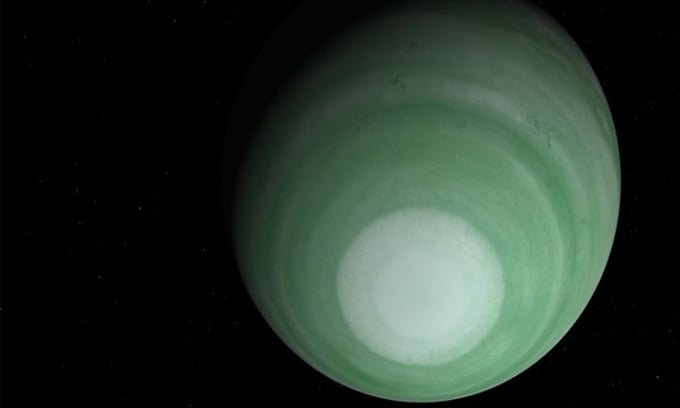
Simulation of the planet ROXs 42 Bb. Image: NASA
Jupiter, a planet 11 times larger than Earth in radius, is the largest planet in the Solar System. ROXs 42Bb is the largest planet found in the universe. It has nine times the mass and 1.12 times the radius of Jupiter. The distance between ROXs 42Bb and Earth is 440 light-years. Because it is outside the Solar System, it belongs to the group of exoplanets.
Thayne Currie, an astronomer at the University of Toronto, first identified ROXs in 2013. It is a giant gas planet similar to Jupiter. While Earth and Jupiter take 365 days and 12 years, respectively, to orbit the Sun, ROXs 42 Bb completes one orbit around its host star in 1968.3 years.
Biggest star: UY Scuti
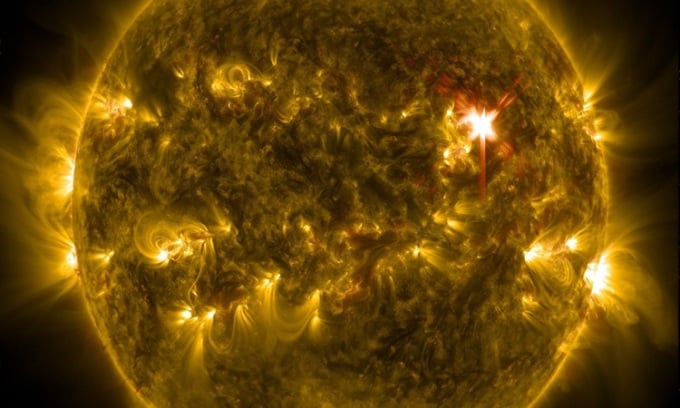
Simulation of the star UY Scuti. Photo: Pixabay/Pexels
More than a million Earths could fit inside the Sun, but the largest star in the universe is UY Scuti, so massive that it could contain 5 billion stars with a volume equivalent to the Sun. If UY Scuti were located at the center of the Solar System, its outer layer, the photosphere, would extend beyond Jupiter's orbit. This supergiant star, 9,500 light-years from Earth, was first described in 1860 by a group of astronomers from the Bonn Observatory in Germany. Even 160 years after its discovery, astronomers have yet to find a star larger than it.
UY Scuti is classified as a variable star because it undergoes fluctuations in brightness every 740 days. Scientists speculate that it is currently in the phase of exhausting its core hydrogen fuel and expanding into a red supergiant. This means it may be on track for a supernova explosion, marking the end of its existence. However, researchers do not yet know the exact time UY Scuti will explode.
the largest star system
The largest orbital system in the universe consists of only one planet (2MASS J2126) orbiting the star TYC 9486-927-1. Seven years ago, astronomers didn't even know the star and planet had any connection. Both were considered free-floating celestial bodies, separated by 1 trillion kilometers in space.
However, in 2016, an international team of researchers identified the enormous orbit of 2MASS J2126 and discovered the planet orbiting TYC 9486-927-1. The distance between Earth and this unique star system is 104 light-years. 2MASS J2126's orbit is 140 times wider than Pluto's orbit in our solar system. Aside from its extremely wide orbit and great distance from its host star, 2MASS J2126 takes nearly 900,000 Earth years to complete one orbit.
Largest galaxy: IC 1101
A galaxy is a collection of many star systems. Some reports suggest the universe contains approximately 2 trillion galaxies. These massive celestial bodies contain billions of stars and many other objects within them. For example, the Milky Way is estimated to contain 100 billion stars and nearly 100 million black holes.
However, that number pales in comparison to IC 1101, the largest galaxy in the universe in terms of scale. IC 1101 is 50 times larger and 2,000 times more massive than the Milky Way. Astronomers estimate it is home to 100 trillion stars, spanning 6 million light-years. In contrast, the Milky Way is only about 100,000 light-years in diameter. Some experts speculate that IC 1101 may have formed from the collision and merger of multiple galaxies.
Largest black hole: TON 618
The largest black hole in the universe is estimated to have a mass 66 billion times that of the Sun. This supermassive black hole powers a quasar (an extremely bright celestial object) called TON 618, which has a luminosity equivalent to 140 trillion Suns. Located 18.2 billion years from Earth, TON 618 was first discovered in 1957.
The largest stellar nursery: The Tarantula Nebula
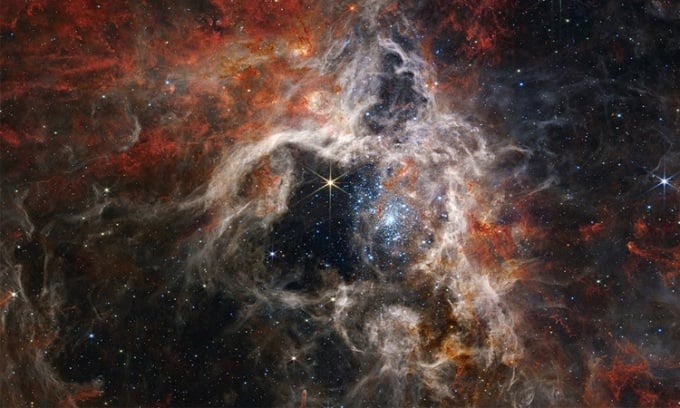
Tarantula Nebula. Image: NASA
Nebulae are giant clouds of gas and dust in the universe where new stars form due to the influence of gravity, changes in temperature and pressure, and thermonuclear reactions. The Tarantula Nebula, also known as 30 Doradus, is among the largest and brightest of the known nebulae, according to NASA. It covers an area spanning 1,800 light-years in the universe and is located 170,000 light-years from Earth. The Tarantula Nebula was discovered in the early 1750s by the French astronomer Nicolas-Louis de Lacaille. However, telescopes at the time were not advanced enough to detect individual stars and other structures within the nebula. It wasn't until more than 200 years later, when astronomers took high-resolution images of the Tarantula, that they realized its enormous size.
The largest galaxy cluster: El Gordo
In 2012, NASA's Chandra X-ray Observatory identified a massive galaxy cluster called ACT-CLJ0102-4915. When astronomers performed calculations to determine its mass, the results were incredibly surprising. ACT-CLJ0102-4915's mass was estimated to be 3 quadrillion times that of the Sun. This is the largest galaxy cluster ever discovered and has been nicknamed El Gordo, meaning "the fat guy."
Astronomers speculate that it may have formed from two massive galaxy clusters colliding in space at speeds of millions of kilometers per hour. El Gordo also contains the longest observable galaxy, La Flaca.
The largest entity in the universe: Hercules' Great Wall - Corona Borealis
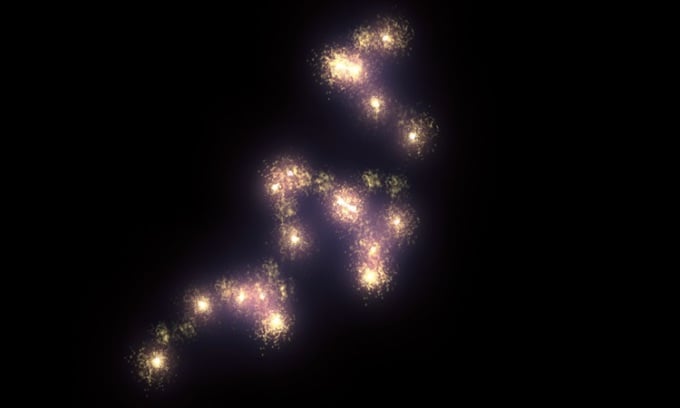
The Great Wall of Hercules - Corona Borealis. Photo: Pablo Carlos Budassi/Wikimedia Commons
Spanning 6-18 billion light-years, the Great Wall of Hercules is believed to be the largest observable entity in the universe. It is a cluster of galaxies bound together by gravity. The size of this supercluster is so immense that light takes approximately 10 billion years to travel its entire length. The Great Wall of Hercules was discovered in 2013 while mapping gamma-ray bursts, the most energetic form of light.
An Khang (According to Interesting Engineering )
Source link
![[Photo] Ba Lang An Lighthouse - the "eye of the sea" amidst the "rock museum" of Quang Ngai province.](https://vphoto.vietnam.vn/thumb/1200x675/vietnam/resource/IMAGE/2026/05/29/1780038698840_anh-man-hinh-2026-05-29-luc-14-10-42.png)


![[Image] Pleasant weather helps students enter the 10th grade entrance exam with confidence.](https://vphoto.vietnam.vn/thumb/1200x675/vietnam/resource/IMAGE/2026/05/29/1780034401612_ngay-1-thi-lop-10-minh-duy-8-5009-jpg.webp)







![[GALLERY] The million-dollar 007 blockbuster is causing a sensation on Steam, is it worth buying?](https://vphoto.vietnam.vn/thumb/402x226/vietnam/resource/IMAGE/2026/05/29/1780064112088_ta-2-png.webp)






















































































Comment (0)