

As scams become faster and more sophisticated.
According to statistics shared at the Digital Trust in Finance 2026 (DTF 2026) forum, Vietnamese people lost over 8 trillion VND due to online scams in 2025. However, the worrying aspect is not just the amount of losses; experts believe the major challenge is that AI is causing an unprecedented increase in the speed of creating scam scenarios, while significantly reducing the "barrier to entry" for cybercriminals.
Previously, carrying out a large-scale scam required perpetrators to spend a lot of time developing scenarios, gathering data, writing content, and contacting victims. Now, many of these steps can be automated at very low cost.
Mr. Nguyen Manh Tuong, Co-founder, Co-Chairman of the Board of Directors and CEO of MoMo, stated: "AI is making fraud 'faster, cheaper, and more sophisticated,' and completely changing the way perpetrators carry out online fraud campaigns."
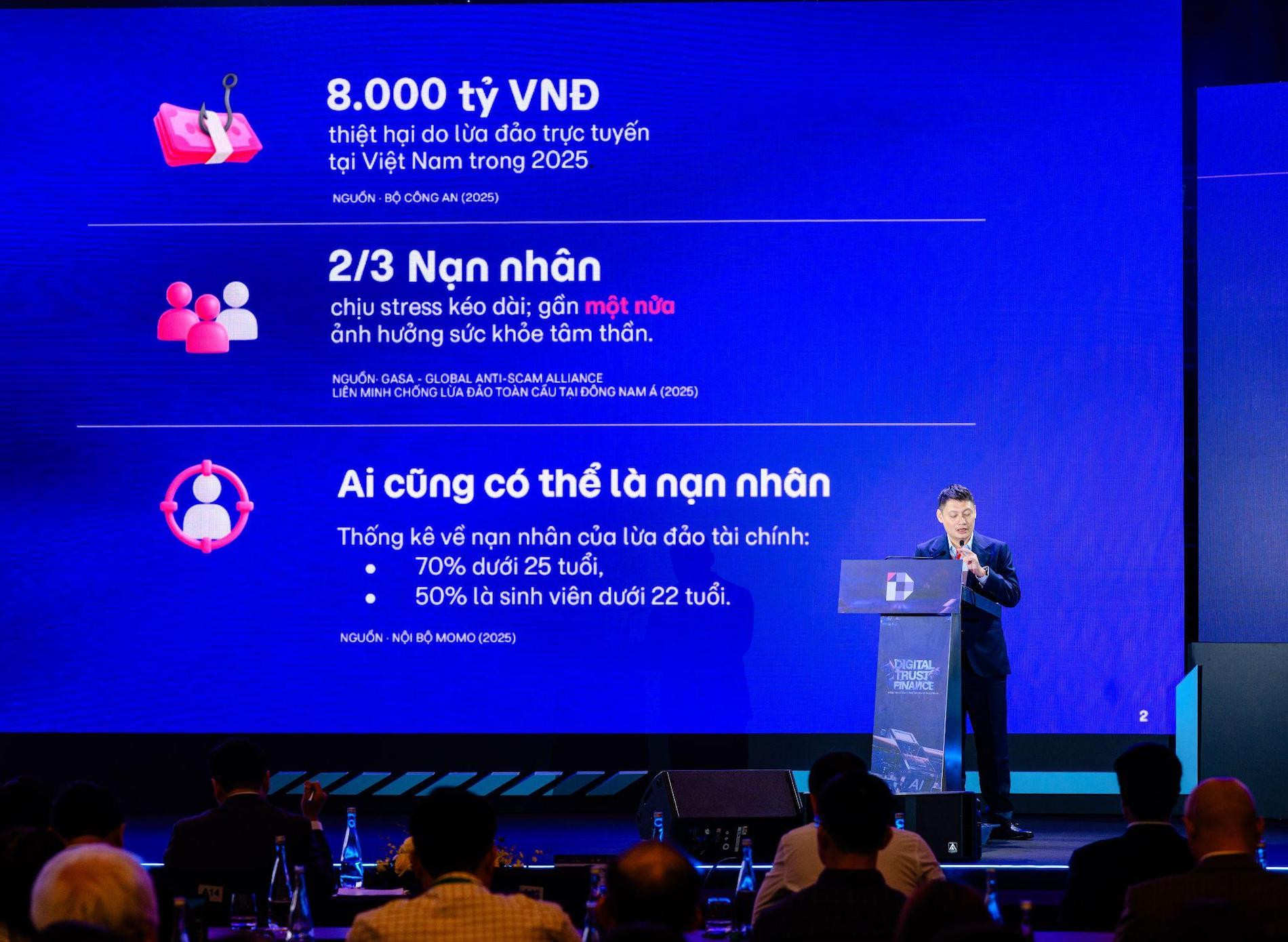
Instead of the mass dissemination methods of the past, scam scenarios can now be created at a much faster pace and with a higher degree of personalization. From online behavior and consumer habits to social media relationships, a wealth of publicly available data can be used to construct targeted approaches that are highly specific to each user.
On underground forums today, there is an increasing number of "phishing-as-a-service" models – where phishing toolkits are offered as subscriptions similar to SaaS software. Users can rent ready-made fake websites, mass email systems, dashboards to monitor stolen data, and even accompanying technical support services.
The Wall Street Journal, citing data from Microsoft, Barracuda Networks, Netcraft, and the FBI, shows that many phishing platforms are now "packaged" with user-friendly interfaces, pre-built templates, and the ability to deploy in minutes. This allows even teams with less technical skill to quickly participate in large-scale phishing campaigns.
The anti-fraud model also needs to "accelerate".
Based on the above experience, Mr. Nguyen Manh Tuong believes that the digital finance industry cannot continue to rely entirely on the traditional mindset of "detecting transactions and then blocking them." Instead, MoMo must shift its thinking from "blocking bad actors" to "partnering with good actors."
Each transaction on the MoMo platform is processed in 100-300 milliseconds. In a period shorter than the blink of an eye, the AI system simultaneously analyzes more than 1,000 different risk signals. These signals include login devices, geographical location, transaction history, account usage frequency, recipient characteristics, and many other unusual signs in transaction behavior.

If an account suddenly generates a large transaction to a cluster of accounts previously linked to suspicious activity, or exhibits characteristics similar to previously documented scam patterns, the system can immediately assess the risk level and issue a warning.
Initial results show that this approach is yielding positive results. On the MoMo platform, for every 1,000 users who receive a warning from the system, 995 stop the transaction. As a result, approximately 44 billion VND is saved each day from potential fraud risks.
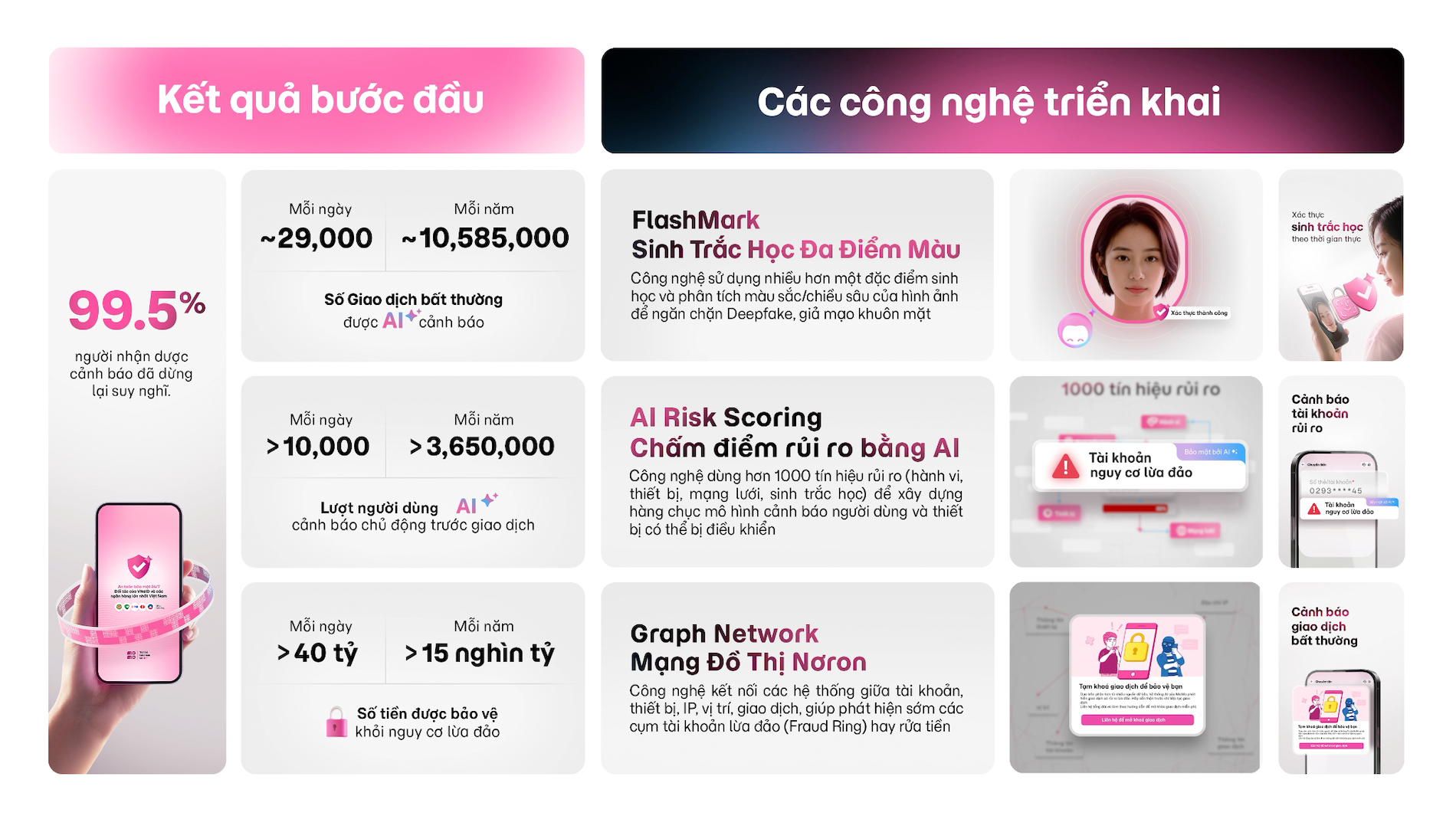
On the other hand, every newly discovered fraudulent account, every new phishing scenario reported by a user, or every newly verified unusual transaction can immediately become data for the system to update its risk identification models.
Thanks to this, the valuable lessons learned by individual users have been transformed by MoMo into shared knowledge for the entire system. This mindset shapes the strategy of building a "common shield": not leaving users to face risks alone, but transforming the power of community data into a digital immune system capable of self-learning and continuously improving over time.
(Source: MoMo)
Source: https://vietnamnet.vn/ai-doc-vi-kich-ban-canh-bao-nguoi-dung-truoc-bay-lua-dao-2520887.html
![[Image] Nearly 125,000 Hanoi students completed the Literature exam for the 10th grade entrance exam.](https://vphoto.vietnam.vn/thumb/1200x675/vietnam/resource/IMAGE/2026/05/30/1780117233041_ndo_br_thiet-ke-chua-co-ten-2-png.webp)































































































Comment (0)