

In fact, rambutan still contains natural sugars, so it can raise blood glucose levels. However, the extent of the impact depends on the amount consumed, the ripeness, and how it's combined with other foods in a meal. If eaten in moderation, rambutan can still be part of a healthy diet without significantly affecting blood sugar, according to the American website Eating Well .
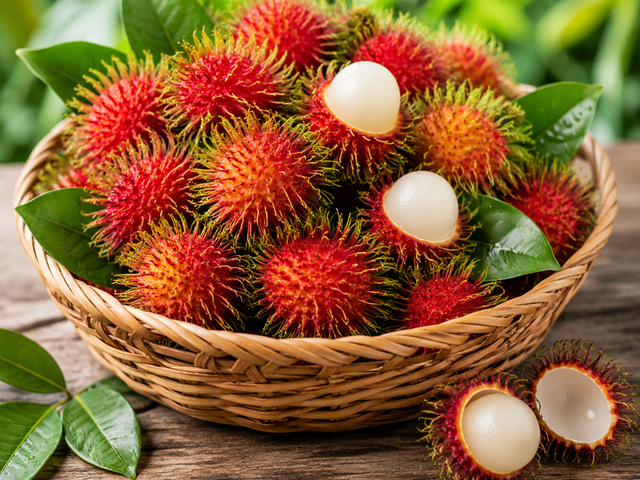
Rambutan is a fruit rich in vitamin C, copper, potassium, manganese, and magnesium.
PHOTO: N. Quy created using AI
While rambutan can cause a spike in blood sugar after eating, the increase is usually not as significant as with foods containing refined sugar, such as soft drinks, sweets, or bubble tea.
Rambutan has a glycemic index ranging from 42 to 59, depending on the variety and ripeness. Therefore, it is considered a fruit with a low to medium glycemic index. However, the glycemic index is not the only factor determining the increase in blood sugar after eating. The amount consumed is also important.
Despite having a relatively low glycemic index, rambutan still contains a significant amount of natural sugar. Eating too much in a short period of time can lead to a sharp increase in total sugar intake.
Furthermore, the fiber in rambutan only slows down sugar absorption to a certain extent. If consumed in excessive amounts, sugar levels can still exceed the body's ability to control, especially in people with insulin resistance or diabetes.
The ripeness of the fruit also affects blood sugar levels. The riper and sweeter the rambutan, the higher its sugar content. Therefore, eating a lot of ripe rambutan can cause blood glucose to rise more quickly. In addition, eating rambutan on an empty stomach allows for faster sugar absorption compared to eating it after a main meal.
Why shouldn't you delay cancer screening?
People with diabetes can eat rambutan in moderation.
People with diabetes don't necessarily have to completely avoid rambutan. Many current nutritional guidelines suggest that people with diabetes can still eat rambutan, but in moderation.
If you want to eat rambutan while still controlling your blood sugar, you should pay attention to how you eat it. Eating rambutan after a main meal will help slow down the rate of sugar absorption compared to eating it on an empty stomach.
You shouldn't eat too much rambutan at once, especially on an empty stomach. Combining rambutan with protein-rich foods or healthy fats, such as plain yogurt, nuts, or eggs, can also help slow glucose absorption. After eating the sweet fruit, light exercise like walking can also help the body use glucose more efficiently, according to Eating Well .
Source: https://thanhnien.vn/an-chom-chom-co-lam-tang-duong-huyet-khong-185260519200851276.htm
![[Image] Hanoi's urban life under the challenge of a "scorching hot" environment](https://vphoto.vietnam.vn/thumb/1200x675/vietnam/resource/IMAGE/2026/05/25/1779706979265_nang-nong-t5-2026-minh-duy-7-4636-jpg.webp)


![[Image] Close-up view of the interchange connecting the two expressways and Long Thanh Airport.](https://vphoto.vietnam.vn/thumb/1200x675/vietnam/resource/IMAGE/2026/05/25/1779703378210_ndo_br_z7863716673926-224453a31600126cce10622af6290afd-4549-jpg.webp)























































































Comment (0)