


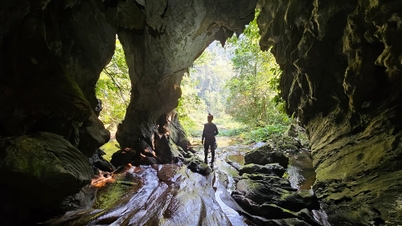
The author inserted numerous logos but lost copyright because someone else used artificial intelligence to remove them - Photo: DINH VAN THANG - Provided by Chan Troi Goc Be Travel
Many photos taken by Mr. Thang have been reposted on travel websites. Some people repost them for interaction, others for advertising, or to include links to sell tour packages. Some suspect the photos are "collected from elsewhere," but most people don't credit the photographer.
When asked about copyright, they were challenged: "Go file a complaint with the United Nations!"
Mr. Thang complained about many people using his photos without permission in a group about tourism in Ha Giang. Immediately, he received hundreds of negative and insulting comments. Many people searched to see if he had a business license and if he had any past controversies in order to attack him online.
A user named Tran Hoai Thuong commented: "Photos posted on community groups, without watermarks or logos, and not originally owned... clearly stating the source as 'collected' shows a sense of respect. Hoai Thuong also advised him to learn from this experience and not engage in 'half-hearted copyright practices' because photos posted on groups are for everyone to see!"
Others attacked him, calling him narrow-minded and envious, and even tried to find the company's registered business address!
Thang messaged a TikTok account named MinhHieu.20, who challenged him, "Send a petition to the United Nations!" before blocking him.
According to Mr. Thang, using photos to promote groups about Ha Giang, Tuyen Quang, or local tourism in general should still require permission from the photographer. He is willing to share images and even send the original image and video files via Google Drive to others, but the fact that his images were used and he was also accused of wrongdoing has made him very upset.
"We travel extensively, exploring various angles to capture beautiful images. While helping to spread positive images of Ha Giang is commendable, many companies in Hanoi brazenly use our photos for advertising and tour sales, directly competing with travel agencies in Ha Giang," Thang said.
When we asked him about reporting the issue to the relevant authorities, the Tuyen Quang Tourism Association, or the Vietnam Creative and Copyright Association, Mr. Thang shook his head.
According to him, this is the nth time he has reported copyright infringement, and each time he has been attacked in return without any way to resolve the issue. Not only his photos, but even the content of his articles and tour advertisements have been copied, with only the contact information changed for advertising and selling tours.
Pham Thai Duong's travel agency (Tuyen Quang) frequently encounters this situation. "Sometimes customers ask, 'Is this person on the same team?', and all I can do is smile awkwardly," Duong said.
According to Mr. Duong, many people are underestimating the efforts of others. They use the excuse of spreading the beauty of Ha Giang to legitimize the appropriation of other people's intellectual property. There are few who truly want to spread the beauty of Ha Giang, but many who focus on selling tours, attracting customers, and creating content.
Mr. Duong believes that people working in tourism, such as photographers, travel extensively, have many products, and always use their own content. However, those working in other fields like tourism marketing, tour sales, or content creation elsewhere are the ones who often "use" content for free online.
The responsibility of social networks
Mr. Tran Ngoc Linh, a tour guide in Sa Pa (Lao Cai), said he has been subjected to rampant copyright infringement. To protect himself, he added many logos and watermarks to his photos, but the thieves used artificial intelligence to remove all the logos in an instant.
Mr. Linh said that he had also looked into copyright regulations, but he didn't know where to send a complaint. At most, he could find the phone number of the person who took the photos and ask them to remove them. Some people removed them, but others challenged him, laughed, and blocked his phone number.
Photographer Tran Linh (Hanoi) specializes in landscape and travel photography. He also works in the field of photo tours (photography tourism), and he says he comforts himself by saying, "I'm contributing beautiful images to life," because so many of his photos have been stolen.
According to Dr. Vu Van Tinh, advisor at Salus Law Firm (Hanoi), copyright is formed immediately after photography without the need for any registration or recognition by a third party. Copyright includes both moral rights and property rights.
Moral rights include the right to name the work, the right to be credited as the author, the right to publish the work to the public, and the right to protect the integrity of the work. Property rights are those rights related to economic interests, allowing the author or copyright owner the exclusive right to exploit or permit others to exploit the work.
"Copying someone else's photo and reposting it on a tourism promotion website or fan page without the author's consent constitutes a violation of both of the author's rights protected by law," said Dr. Tinh.
He stated that the case not considered a copyright infringement under Article 25 of the Intellectual Property Law is copying for scientific research and personal study, not for commercial purposes.
According to him, the promulgation of Decree 174/2026 and the basic legal regulations on copyright have better protected the rights of authors. However, law enforcement needs to be substantive and timely. Furthermore, there are still some loopholes due to the unique characteristics of cyberspace. This is the responsibility of cross-border platforms regarding copyright protection.
He suggested that a legal mechanism is needed to require cross-border platforms to proactively monitor copyright infringements.
"First and foremost, we need to establish a 'Notice & Staydown' mechanism requiring major platforms (Facebook, TikTok, YouTube) to adopt 'fingerprinting' technology so that once a file has been requested to be removed, subsequent copies will be automatically blocked from uploading," Mr. Tinh said.
According to Article 95.1 (d) of Decree 174, any person using social networks to perform the act of "Providing or sharing journalistic, literary, artistic, or published works without the consent of the intellectual property rights holder..." will be fined between 20 and 30 million VND.
Therefore, all photographs of tourist landscapes are considered works of art. Posting them on social media without the author's or intellectual property rights holder's consent (the person authorized by the author) may be subject to the penalties mentioned above.
"When an author learns that their work has been infringed upon, they can first send a warning letter to the infringing party and request immediate removal. If they refuse to remove it, they can file a complaint with the director of the Department of Culture in the author's place of residence or send it to the Copyright Office under the Ministry of Culture, Sports and Tourism requesting action against the copyright infringement," said Dr. Vu Van Tinh.
Over 1,000 websites found to be infringing copyright have been blocked.

Authorities inspect products suspected of infringing on trademarks protected in Vietnam - Photo: Customs Department
Deputy Prime Minister Ho Quoc Dung chaired a conference on June 2nd to review the implementation of the Prime Minister's directive on focusing on decisively implementing solutions to combat, prevent, and handle acts of intellectual property infringement.
At the conference, Mr. Dung assessed that the results achieved were only the initial steps. Compared to the requirements set forth, the work of protecting and enforcing intellectual property rights still has many shortcomings and limitations that need to be addressed. He requested that ministries, sectors, and localities continue to launch new intensive campaigns, comprehensively review the situation, and focus on more decisively combating acts of intellectual property infringement.
"The entire system strives to increase the number of detected and handled intellectual property violations by at least 20% compared to 2025 across all stages, from inspection, examination, and administrative handling to investigation, prosecution, and criminal trial," he demanded, adding that this is not only a domestic requirement but also a basis for Vietnam to demonstrate to international partners its determination and tangible effectiveness in protecting intellectual property rights.
According to the report, the Ministry of Public Security has detected, investigated, and verified 148 cases with signs of intellectual property infringement; handled 128 cases, including initiating criminal proceedings in 44 cases.
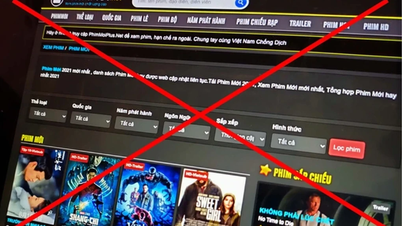
In particular, the police force has dismantled many serious online infringement rings, including websites broadcasting illegal football matches such as CakhiaTV and RakhoiTV. The total value of seized infringing goods exceeded 28 billion VND. The police force also played a core role in blocking more than 1,000 websites that violated copyright and industrial property rights.
The Ministry of Industry and Trade, along with local authorities, directed market management forces to intensify inspections, controls, and enforcement actions. As a result, 1,520 violations of industrial property rights, mainly trademark counterfeiting, were processed.
Notably, compared to May 2025, the number of cases processed increased by 370.6%, 4.7 times higher; the amount of fines increased by 314.8%; and the value of confiscated goods processed increased by 827.5%, far exceeding the assigned minimum target of 20% increase.
Source: https://tuoitre.vn/anh-du-lich-xai-chua-la-pham-luat-20260603082351499.htm
![[Photo] First session of the 14th Congress of the Vietnam Trade Union](https://vphoto.vietnam.vn/thumb/1200x675/vietnam/resource/IMAGE/2026/06/03/1780465947883_ndo_br_img-3852-jpg.webp)
![[Photo] Secretary of the National Assembly Party Committee, Chairman of the National Assembly presides over the meeting of the Standing Committee and Executive Committee of the National Assembly Party Committee.](https://vphoto.vietnam.vn/thumb/1200x675/vietnam/resource/IMAGE/2026/06/03/1780480353201_ndo_br_bnd-2585-jpg.webp)
![[Photo] General Secretary and President To Lam presides over a meeting with the Central Organizing Committee.](https://vphoto.vietnam.vn/thumb/1200x675/vietnam/resource/IMAGE/2026/06/03/1780482764658_a1-bnd-4741-3342-jpg.webp)



































![[Video] Sunset at Lap An Lagoon – Where the sun sets over the fishing nets](https://vphoto.vietnam.vn/thumb/1200x675/vietnam/resource/IMAGE/2026/05/31/1780192137701_beach-landscape-sea-water-nature-grass-745871-pxhere-com.jpeg)



























Comment (0)