

Earthquake lights appear in many different forms, but researchers have yet to find a precise explanation for the mechanisms that create them.
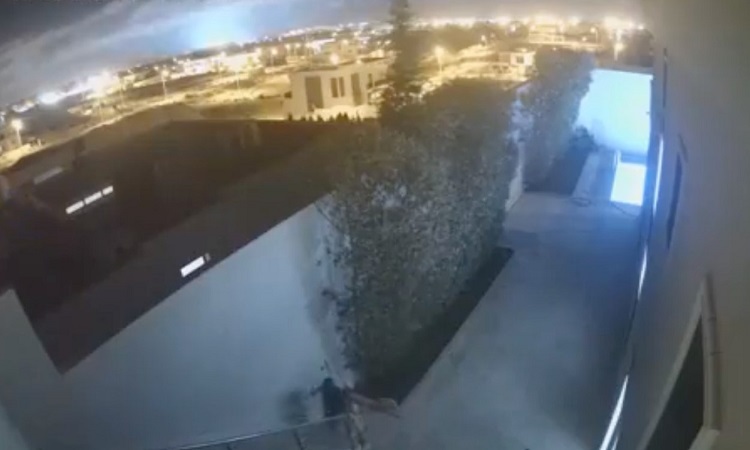
A flash of light in the Moroccan sky is believed to be the light of an earthquake. Video : New York Times/Twitter
Earthquake lights, like those seen in many videos before the 6.8 magnitude earthquake in Morocco on September 8th, have been known for centuries, dating back to ancient Greece. These flashing, multicolored lights have long puzzled scientists , and they remain divided on what causes them. However, they are "clearly real," according to John Derr, a retired geophysicist formerly of the U.S. Geological Survey. He is a co-author of several scientific papers on earthquake lights (EQLs).
"The occurrence of EQLs depends on the darkness and many other favorable factors," Derr explained. He noted that recent video from Morocco resembles earthquake lights captured by security cameras during the 2007 Pisco earthquake in Peru. Juan Antonio Lira Cacho, a physics professor at the National University of San Marcos in Peru and an expert in studying the phenomenon, commented that the widespread use of mobile phones and security cameras has made studying earthquake lights easier.
Earthquake lights can take several different forms. Sometimes, they look like ordinary lightning or as a luminous band in the atmosphere similar to the aurora borealis. Other times, they resemble glowing spheres hovering in mid-air. Earthquake lights can also appear as small, flickering flames creeping along the ground. A video filmed in China shortly before the 2008 Sichuan earthquake captured these bright clouds floating in the sky.
To better understand earthquake lights, Derr and colleagues collected data on 65 earthquakes in the US and Europe since 1600. They shared their research in a 2014 paper in the journal Seismological Research Letters. The research team found that 80% of the EQLs they surveyed occurred in earthquakes with a magnitude greater than 5.0. In most cases, the phenomenon was observed shortly before or during the seismic event. EQLs could be located as far as 600 km from the epicenter.
Earthquakes, especially strong ones, are more likely to occur along or near areas where tectonic plates intersect. However, a 2014 study found that the vast majority of earthquakes associated with EQLs occur within tectonic plates rather than at the boundary. Furthermore, EQLs almost certainly occur above or near rift valleys, where the Earth's crust is pushed apart in some places, creating elongated lowlands between two higher landmasses.
Friedemann Freund, an assistant professor at San Jose State University who previously worked at NASA's Ames Research Center, proposed a hypothesis about earthquake light. According to Freund, when impurities in the crystals of rocks experience mechanical stress, such as the buildup of tectonic stress before and during a major earthquake, they instantly break apart and generate electricity. Rocks are insulators, and when subjected to mechanical stress, they become semiconductors. "Before an earthquake, enormous masses of rock—hundreds of thousands of cubic kilometers of rock in the Earth's crust—are under pressure. This pressure causes mineral particles to move relative to each other. The process is like flipping a battery, producing electrical charges that move extremely fast, up to 200 meters per second," Freund explained.
Other theories about the cause of earthquake lights include static electricity generated by rock fracturing and radon emissions. Currently, seismologists still disagree on the mechanism behind earthquake lights. Scientists are trying to unravel the mystery of this phenomenon. Freund hopes that in the future, earthquake lights, combined with other factors, can be used to predict major earthquakes.
An Khang (According to CNN )
Source link
































































































Comment (0)