

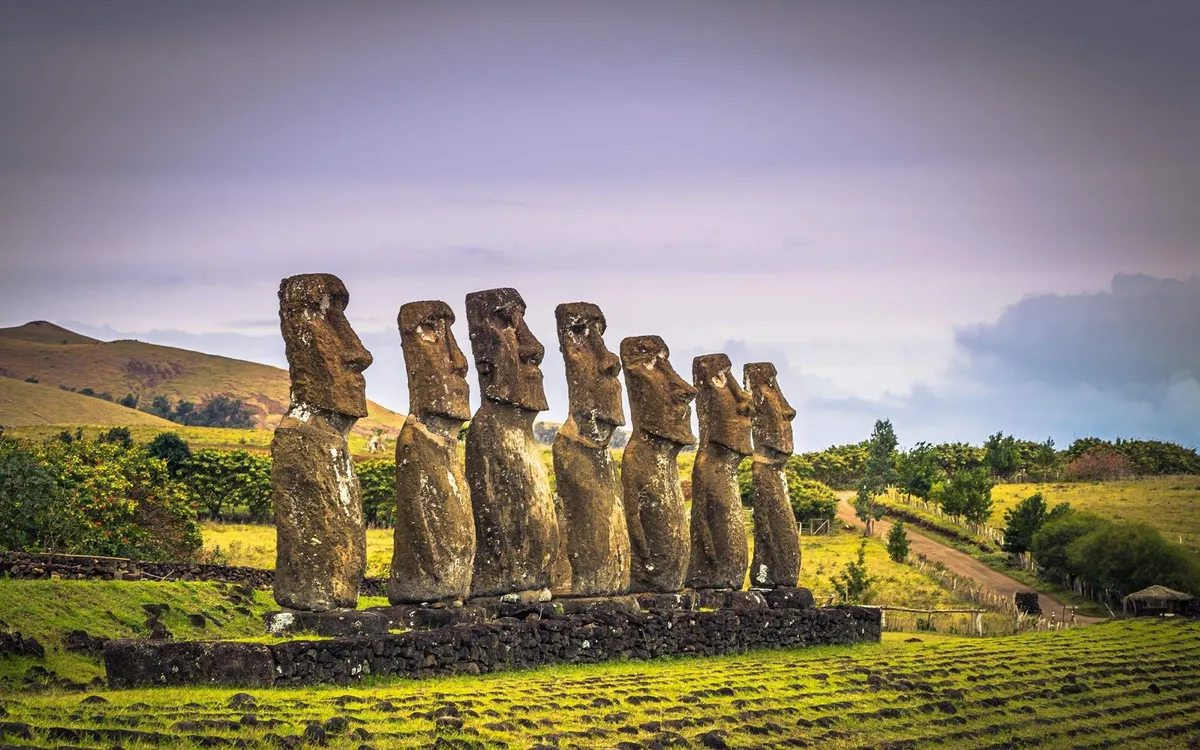
In recent years, Easter Island (Rapa Nui) has welcomed over 100,000 visitors annually. Many are drawn to the ancient stone statues (moai), of which approximately 1,000 are scattered across the island. Layers of the island's history – including the stories of the statues and the Polynesians who arrived approximately 1,000 years ago – remain shrouded in mystery.
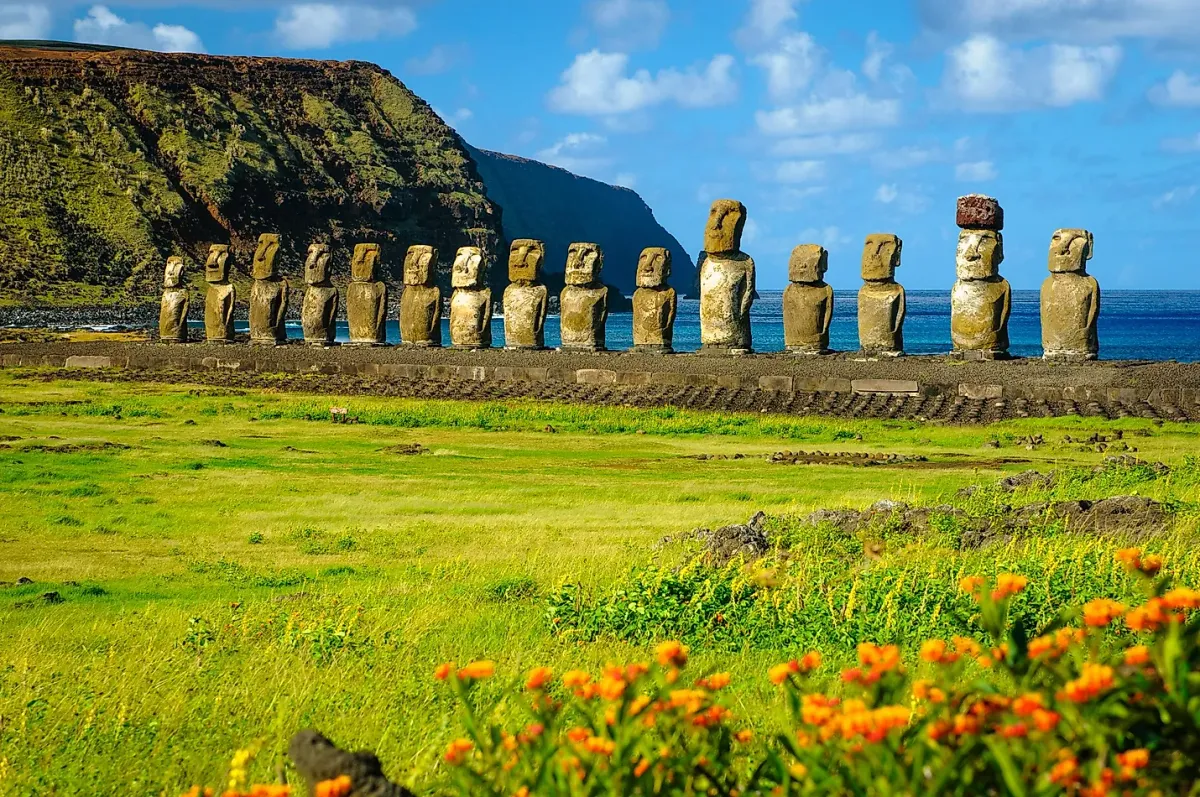
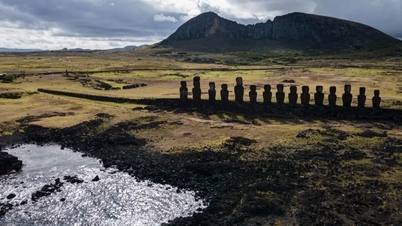
Moai statues on Easter Island
The small island and life is not easy.
Rapa Nui rises only 500 meters above sea level at its highest point, is flat, has few valleys, and is subject to strong winds and erratic rainfall. Freshwater levels are always critical: crater lakes exist, but streams are rare because the porous rock allows rainwater to seep down very quickly. Archaeological findings show the island was once covered with palm forests, but these disappeared after centuries of deforestation, coupled with the destruction caused by the invasive Polynesian rat.
The sea surrounding the island is poor in nutrients, with few coral reefs and no lagoons to provide abundant seafood. The Rapa Nui people rely on drought-resistant sweet potatoes, yams, taro, and sugarcane grown in rocky fields; their protein comes only from coastal fish, caught using traditional nets, traps, or fishing methods.
Given such harsh natural conditions, the fact that they created around 1,000 moai statues – each weighing tens of tons – is both absurd and magnificent.
Who were those ancient artisans, and why did they erect those colossal statues? How did they transport blocks of stone weighing nearly 14 tons? What happened to their civilization?... To this day, there are no complete answers.

How the ancient people moved the moai statues across the island remains a mystery to modern science .
Works of will
It is believed that after being carved at the quarries, the moai statues "walk"—or more accurately, "rock back and forth"—from the quarry to their final location. The community works together to push and balance the statues as they move forward. The way they place the heavy "hats" made of red scoria (pukao) on the statues' heads is also a mystery that researchers have only recently solved. A study published in PLOS One in January 2019 suggests that the placement of the moai is related to the island's freshwater resources.
At the foot of each moai is an ahu, a stone platform facing the sea. On the surface, they resemble religious structures, but research indicates that the ahu is closely linked to community life: a place for dividing water resources, organizing rituals, and maintaining solidarity—a vital element in a small and deprived society.
When Europeans arrived in the 18th century, the island was almost completely devoid of trees; one theory suggests that all the trees had been cut down to facilitate the transport of moai from the quarries to the coast.
Today, the island is lush but barren, its fertile grass covering dormant volcanic craters. Wild horses still roam freely along the rocky coastline. Though breathtakingly beautiful, Easter Island faces numerous challenges: rocks used for fishing weights cause severe erosion, garbage is dumped in hidden pits, and rising sea levels are gradually encroaching on the island's shoreline. Nearly half of its inhabitants identify themselves as indigenous Rapa Nui people. Many live in poverty and receive very little support from the Chilean government .
The gap between their daily lives and that of tourists—who often retreat to luxurious resorts deep in the valley—has created much tension and conflict. Nevertheless, Easter Island continues to attract visitors.

The colorful life of the Rapa Nui people
When millennia-old mysteries shed light on the age of climate change.
The secrets of the moai statues tell the story of an ancient community, while also reflecting the present day – an era where freshwater has become a scarce resource in many parts of the world .
Rapa Nui once had forests. Then the forests disappeared. They once had richer habitats. Then the ecosystem declined. The absolute dependence on natural resources—and the consequences when those resources are depleted—makes the island's history resemble a microcosm of Earth.
But surprisingly, many new studies show that the Rapa Nui people did not collapse as pessimistic theories suggested. They survived thanks to social cohesion, wise resource management, and the moai, "freshwater markers," which reminded the community of what was most vital for survival.
The moai statues on Easter Island are an archaeological mystery that we may never fully unravel. But that's not so important: just like when standing before a pyramid or any ancient wonder, the greatest value lies in the experience of their beauty and mystique.
Source: https://vtv.vn/dao-phuc-sinh-va-nhung-bi-an-chua-co-loi-giai-100251211111304587.htm


![[Photo] Prime Minister Pham Minh Chinh holds a phone call with the CEO of Russia's Rosatom Corporation.](/_next/image?url=https%3A%2F%2Fvphoto.vietnam.vn%2Fthumb%2F1200x675%2Fvietnam%2Fresource%2FIMAGE%2F2025%2F12%2F11%2F1765464552365_dsc-5295-jpg.webp&w=3840&q=75)


![[Photo] Closing Ceremony of the 10th Session of the 15th National Assembly](/_next/image?url=https%3A%2F%2Fvphoto.vietnam.vn%2Fthumb%2F1200x675%2Fvietnam%2Fresource%2FIMAGE%2F2025%2F12%2F11%2F1765448959967_image-1437-jpg.webp&w=3840&q=75)































![[OFFICIAL] MISA GROUP ANNOUNCES ITS PIONEERING BRAND POSITIONING IN BUILDING AGENTIC AI FOR BUSINESSES, HOUSEHOLDS, AND THE GOVERNMENT](https://vphoto.vietnam.vn/thumb/402x226/vietnam/resource/IMAGE/2025/12/11/1765444754256_agentic-ai_postfb-scaled.png)







































Comment (0)