

The remote island of Rapa Nui (also known as Easter Island) off the coast of Chile is famous for its giant statues with eyes looking out into the Pacific Ocean .
The number of statues carved from this volcanic rock is astonishing, with scientists estimating that both completed and unfinished statues could number nearly 1,000.
These statues were erected from the 13th to the 17th century, averaging 4 meters high and weighing 12.5 tons, with some exceeding 20 tons.

How the giant Moai statues were transported and scattered across the island has been the subject of much archaeological and anthropological research (Photo: Shutterstock).
A 3D reconstruction of a centuries-old quarry containing giant, unfinished human heads on Easter Island is providing new clues about how Polynesians crafted the artifacts, archaeologists say.
A new study in the journal PLOS One suggests that individual indigenous clans were involved in the creation of these stone statues (also known as Moai) rather than mobilizing just a single community of people.
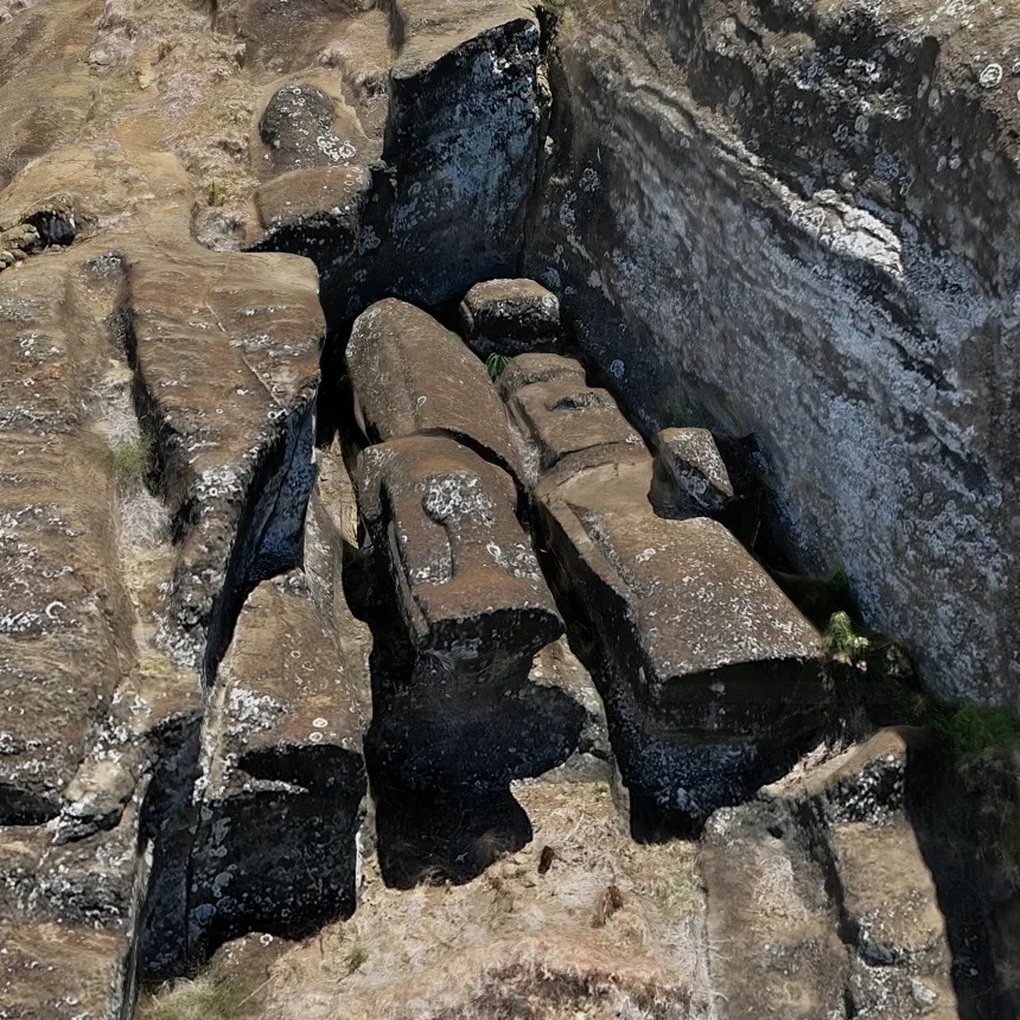
The Moai statues average 4 meters high and weigh up to 12.5 tons (Photo: Binghamton University).
“The presence of Moai on the island is evidence of a hierarchical society: the statues symbolize the presence of chiefs,” said study co-author Professor of Anthropology Carl Lipo (Binghamton University).
Researchers have built the first high-resolution 3D model of the Rano Raraku quarry—the site where the Moai are believed to have been made—from 11,000 overlapping drone photos using photogrammetry.
The team created a 3D model of the Rano Raraku quarry using a drone, a technical process known as photogrammetry or surveying ( Video : Binghamton University).
Through 30 separate mining sites identified, researchers found evidence of the giant statues being transported out of the mine in various directions, before being erected and scattered across the island.
According to the researchers, this approach suggests that the Moai production process was not under centralized control, with indigenous groups working in different areas of the island.
“This means that the entire process of making the statue, from cutting the material from the original stone block to finishing the details, took place in separate areas, rather than everything being done in the same quarry like an ‘industrial’ process,” said Professor Lipo.
These findings add to evidence that Easter Island consisted of many small, independent clans rather than a politically unified society.

A 3D model of the quarry shows 426 Moai in various stages of completion (Photo: Binghamton University).
The 3D model shows 426 Moai statues in various stages of completion, hundreds of cuts in the stone blocks being prepared for carving, and five stone pillars that act as anchors to lower the statues down the slope. Most of the statues were carved in a supine position, with the faces first detailed, followed by the heads and torsos.
Professor Lipo said the unfinished statues include the largest Moai if completed. It is called Te Tokanga, which is about 21 meters tall and could weigh up to 270 tons if completed.
“Some of the statues were beyond the transport capacity of ancient people,” he said, “and we hypothesize that there may have been competition among clans to carve ever larger Moai statues.”
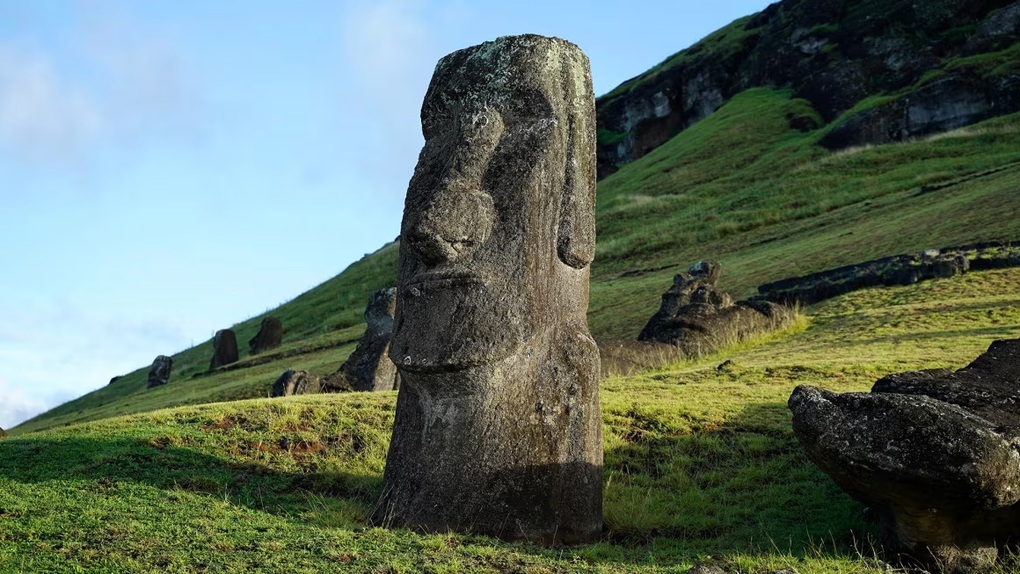
Easter Island is located at the southernmost point of the Polynesian Triangle in the South Pacific Ocean. It is one of the most remote inhabited areas in the world (Photo: Getty).
According to Professor of Archaeology Helene Martinsson-Wallin (Uppsala University, Sweden), the new study is the first time photometric techniques have been applied here, but the results do not really bring anything "breakthrough" about Rapa Nui society.
“The Rapa Nui society was later described as an open society, meaning there was no supreme leader who ruled over the whole. Many studies have shown that this type of social structure could still create monumental structures like Moai,” Professor Martinsson-Wallin added.
Meanwhile, Professor of Archaeology Christopher Stevenson (Virginia Commonwealth University) said that this study has an innovative approach. The hypothesis that the Moai manufacturing process was decentralized, carried out by different clans, needs further verification.
Source: https://dantri.com.vn/khoa-hoc/manh-moi-ve-hinh-thai-xa-hoi-che-tac-tuong-khong-lo-tren-dao-phuc-sinh-20251203163217304.htm


![[Photo] Cat Ba - Green island paradise](/_next/image?url=https%3A%2F%2Fvphoto.vietnam.vn%2Fthumb%2F1200x675%2Fvietnam%2Fresource%2FIMAGE%2F2025%2F12%2F04%2F1764821844074_ndo_br_1-dcbthienduongxanh638-jpg.webp&w=3840&q=75)






























![[VIMC 40 days of lightning speed] Da Nang Port: Unity - Lightning speed - Breakthrough to the finish line](https://vphoto.vietnam.vn/thumb/402x226/vietnam/resource/IMAGE/2025/12/04/1764833540882_cdn_4-12-25.jpeg)



































Comment (0)