With his simple yet distinctive brushstrokes, he transformed painting into a sharp propaganda weapon, encouraging patriotism, denouncing the crimes of colonial invaders, and exposing the reactionary nature of the feudalist lackeys.
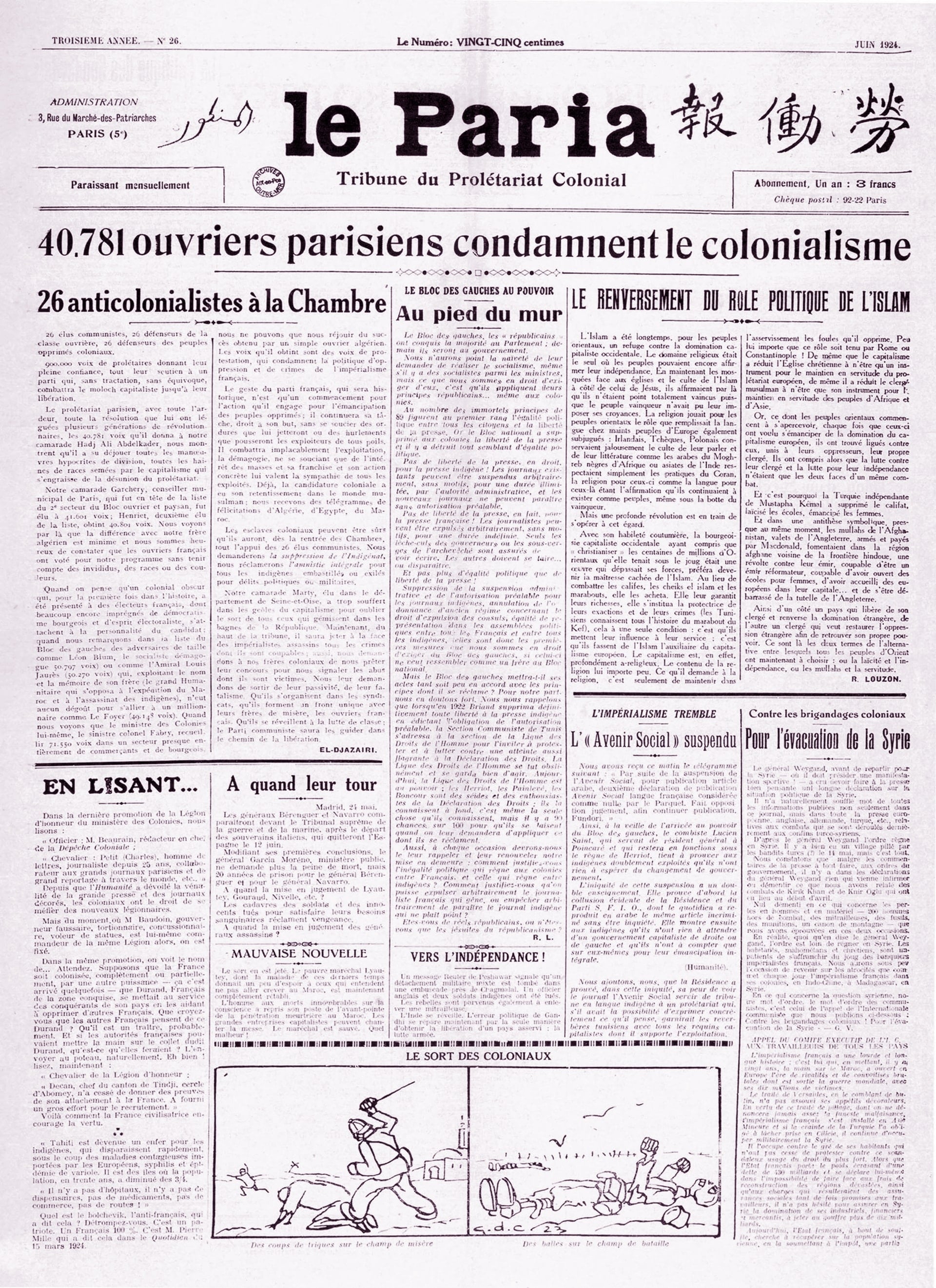
Illustrations by President Ho Chi Minh in the newspaper Le Paria.
From the sketches in the newspaper Le Paria
In January 1922, revolutionary Nguyen Ai Quoc and the Standing Committee of the Colonial Union decided to establish the Association for the Cooperative of the Pariah and publish the newspaper Le Paria (The Pariah) as the Association's mouthpiece.
On April 1, 1922, the newspaper Le Paria published its first issue with a masthead presented in three languages: French, Arabic, and Chinese. The French text "Le Paria" was prominently displayed in the center; to the left was a small, neat line of Arabic text; and to the right were three Chinese characters meaning "Labor Newspaper." From issue 1 to issue 20, the newspaper bore the subheading: "Forum of Colonial Peoples" (Tribune des Populations des colonies). From issue 21 to issue 35, the subheading was changed to: "Forum of the Colonial Proletariat" (Tribune des Prolétariats coloni-aux). Issues 36 and 37 used the subheading: "Organ of the Oppressed Peoples of the Colonies" (Organe des Peuples Opprimés des colonies). By issue number 38, the title had changed again to: "Organ of the Colonial Union" (Organe de l'Union Intercoloniale).
Issue 5 of Le Paria, dated August 1, 1922, published several articles by Nguyen Ai Quoc, including "Civillisation assassine" (A Civilization of Murder); "Gouts spéciaux" (Special Tastes); and "La Femme Annamite et la domination Francaise" (The Annamite Woman and French Domination). Additionally, this issue included sketches by Nguyen Ai Quoc depicting the exploitation of the Vietnamese working class by the French colonialists.
The painting depicts a rickshaw puller with a gaunt, emaciated face, ragged clothes, and bare feet struggling to drag a large, obese French official lying on his back on the cart, holding a walking stick and crossing his legs. Not only that, the official is constantly spewing obscenities and shouting insults, urging the driver to go faster. Below the wheels are sarcastic subtitles: "civilization," "progress," "enlightenment." The painting is attributed to the artist Nguyen AQ.
The brutal exploitation of the oppressed classes by the French colonialists, along with the ferocity of war, continues to be hauntingly depicted in two sketches published on the front page of Le Paria, issue 6, June 1924.
On the front page of this issue, there are two sketches. One depicts a colonial soldier relentlessly whipping a ragged man lying on the ground. Perhaps the force of the blows was too much for the man to get up, forcing him to grit his teeth and endure. In the distance, another person is running. The scene is bleak and gloomy, reflecting the plight of those imprisoned amidst bunkers and barren land... Below the sketch is a French caption: Des coups de triques sur le champ de misère (roughly translated: Drawings of the competition on the field of misery).
The second painting depicts a scene of death on the battlefield with scattered corpses. At the center is a severely wounded French soldier lying on the ground, his uniform tattered, his helmet askew, his leg bandaged, his face contorted with pain, and his hands clenched and raised as if in desperate plea for help. In the distance, flocks of crows swoop down, waiting to feed on the corpses. Below the painting is the caption: Des balles sur le champ de bataille (literally: Bullets on the battlefield). Through this, the reader can understand the implied meaning: the inevitable defeat and tragic fate of the colonial soldiers.
The article and accompanying sketch, "The Farces, or Varen and Phan Boi Chau," published in Le Paria, issues 36-37, September and October 1925, describes the event of Phan Boi Chau's abduction on June 18, 1925, in China, his transfer to Hoa Lo Prison in Hanoi , and his impending trial. In the sketch, the patriot Phan Boi Chau, with a yoke around his neck, is being led to prison, followed by a large crowd of Vietnamese people protesting against the colonial government and demanding his release. However, the colonialists brutally suppressed and beat the protesters.
With vivid and simple brushstrokes, the painting clearly captures the character's demeanor and behavior, conveying the message in a simple and easily understandable way. Even those who don't know French can grasp the content and issues addressed when looking at Nguyen Ai Quoc's sketches. Through this form of illustration, he not only denounced the despicable arrests by the French colonialists but also skillfully encouraged the Vietnamese people's struggle for the release of the patriotic scholar Phan Boi Chau.
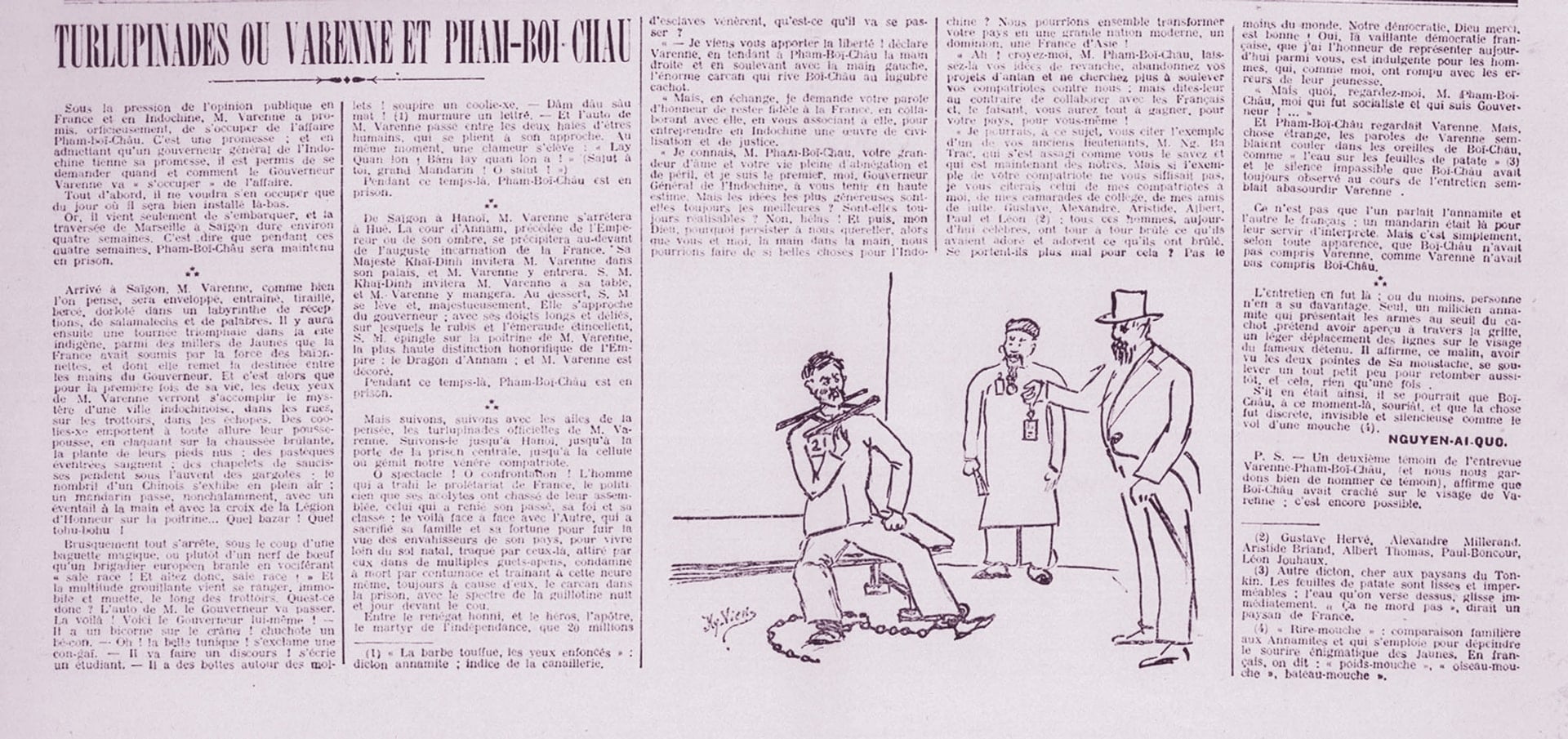
An illustration of President Ho Chi Minh in a French newspaper.
From sketches and propaganda posters in Thanh Nien and Vietnam Independence newspapers.
In issue 68 of Thanh Nien Newspaper, the official publication of the Vietnam Revolutionary Youth Association, also founded by Leader Nguyen Ai Quoc in Guangzhou, China, dated November 7, 1926, a special issue commemorating the 9th anniversary of the Russian October Revolution, prominently featured a portrait by Leader Nguyen Ai Quoc, resembling a propaganda poster promoting Marxism-Leninism. The highlight of this issue was a sketch of Lenin, the leader of the Russian proletarian revolutionary movement and of the world proletariat, standing proudly on a globe pointing towards a five-pointed star. In the center of the star was a hammer and sickle (representing the worker-peasant alliance). Below the star were two couplets written in Chinese characters, each consisting of ten characters, praising the proletarian revolution.
After many years of traveling across continents and oceans in search of a way to save the country, on January 28, 1941, Uncle Ho returned to Vietnam and established a base in Pac Bo to directly lead the Vietnamese revolution. Here, he published the newspaper Vietnam Independence, the propaganda organ of the Viet Minh in Cao Bang.
Issue 103, published in August 1941, featured a very vivid, gentle, and elegant sketch by President Ho Chi Minh, yet full of propaganda and motivational message. It depicted a person playing a trumpet, but the special feature was the way the drawing formed the phrase "Vietnam Independence" (a very imaginative, harmonious, and balanced presentation of the combined letters), with the trumpet subtly formed from the letter D (Independence). The trumpet player was striding forward with great enthusiasm, holding a red flag with a yellow star. Below the drawing was an illustrative poem: "Vietnam Independence," the trumpet plays / Calling on our people, young and old / To unite as firmly as iron / To save our country, Vietnam."
Through articles and sketches published in the Vietnam Independent newspaper, readers can clearly perceive the vision of leader Nguyen Ai Quoc during the period when the revolution was still operating secretly. These works not only called upon the people to follow the path of the proletarian revolution under the light of Marxism-Leninism and the Viet Minh Front, but also demonstrated a profound connection between the Vietnamese revolutionary movement and the national liberation movement worldwide.
The examples mentioned above are just a few typical examples of Ho Chi Minh's sketches in newspapers. His painting style and illustrative art remain an area requiring deeper and more comprehensive research in specialized works. However, this is enough to vividly reflect President Ho Chi Minh's unwavering patriotism, sharp intellect, far-sighted vision, and profound ideology. At the same time, it demonstrates the consistency in Ho Chi Minh's journalistic style: direct, simple, easy to understand, yet profoundly insightful, always emphasizing the essence of events and possessing immense power to inspire the masses.
Source: https://hanoimoi.vn/bac-ho-ve-tranh-tren-bao-706295.html



![[Photo] General Secretary and President To Lam and his wife begin their official visit to Thailand.](https://vphoto.vietnam.vn/thumb/1200x675/vietnam/resource/IMAGE/2026/05/27/1779881249412_anh-man-hinh-2026-05-27-luc-18-10-51.png)
![[Photo] The courage of new recruits of Brigade 144 on the training ground.](https://vphoto.vietnam.vn/thumb/1200x675/vietnam/resource/IMAGE/2026/05/27/1779881651341_anh-man-hinh-2026-05-27-luc-18-32-52.png)































![[Photo] The courage of new recruits of Brigade 144 on the training ground.](https://vphoto.vietnam.vn/thumb/402x226/vietnam/resource/IMAGE/2026/05/27/1779881651341_anh-man-hinh-2026-05-27-luc-18-32-52.png)
















Comment (0)