

Risk of pollution and flow obstruction.
Recently, the illegal dumping of construction waste has been on the rise, appearing in many areas along rivers, vacant lots, residential areas, and urban areas under construction. Some locations that have been frequently reported include D-Green Park apartment complex (Hap Linh ward), Lac Phu residential area (Yen Dung ward), Ninh Khanh urban area (Nenh ward), the southern urban area and Thanh Xuong Giang residential area (Bac Giang ward), the right bank of the Cau River dike, the section passing through Tam Da commune…
Spontaneous waste dumps not only detract from the aesthetics of the area but also spread dust and mud into the environment; they narrow waterways, cause drainage blockages, and increase the risk of flooding during the rainy season.
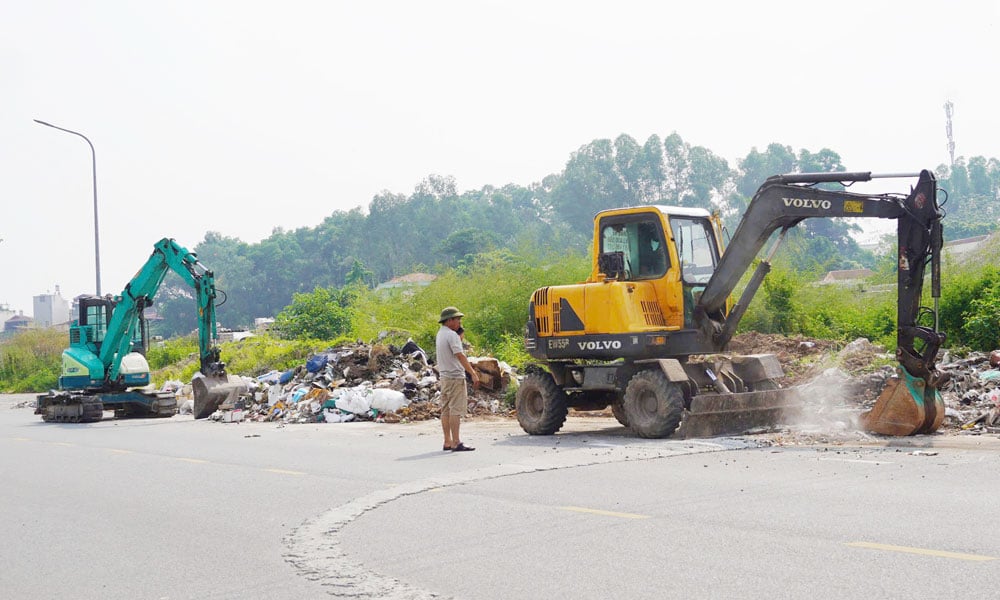 |
Authorities in Bac Giang ward launched an operation to clean up illegally dumped construction waste in the Thanh Xuong Giang residential area. |
In order to utilize construction waste, many project owners have used concrete, broken bricks, soil, and rocks dismantled from construction sites to level the ground and reinforce embankment slopes.
| The province currently has 24 centralized solid waste treatment areas with a total area of 223.3 hectares... The province is planning to add 9 more construction waste treatment sites in the areas south and north of the Duong River with a total area of 36.6 hectares. |
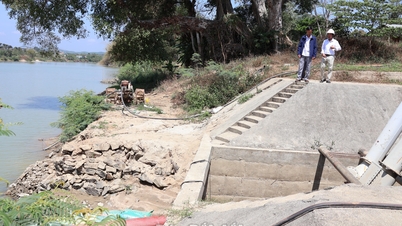
For example, the investor used this waste to reinforce the embankment of the right bank of the Cau River in the Tho Duc irrigation pumping station area (Tam Da commune). However, according to the Department of Agriculture and Environment, this waste poses a potential risk if not properly sorted and processed.
Meanwhile, inspection and handling of violations at the local level still face difficulties. Mr. Trieu Tien Dat, Head of the Economic , Infrastructure and Urban Planning Department of Bac Giang Ward, said: "Since the implementation of the two-tiered local government system, Bac Giang Ward has not been able to handle any cases of discharging solid household and construction waste into the environment. The reason is that we have not been able to catch the violators red-handed."
This reality shows that simply raising awareness or conducting administrative inspections is not enough. Without fundamental and comprehensive solutions, illegal dumping will continue because the act often happens quickly, secretly, at night, or when there are few people around.
Rapidly deploy the planned treatment plant sites.
Bac Ninh is entering a phase of rapid infrastructure development aimed at becoming a centrally-governed city, with a series of key projects being implemented simultaneously. These projects generate a large volume of construction solid waste. Meanwhile, the province's centralized solid waste treatment system, although planned, mainly serves to process household and mixed waste.
According to the review, the province has 24 centralized solid waste treatment areas with a total area of 223.3 hectares, but only a few are operating relatively effectively, such as Phu Lang, Luong Tai, Yen Dung, and Da Mai... However, these areas are not evenly distributed and are far from many construction sites, especially in the area south of the Duong River - where key projects related to Gia Binh airport and strategic transportation routes are concentrated. The high cost of transporting waste to treatment sites leads some transport units to intentionally dump waste illegally, causing environmental pollution.
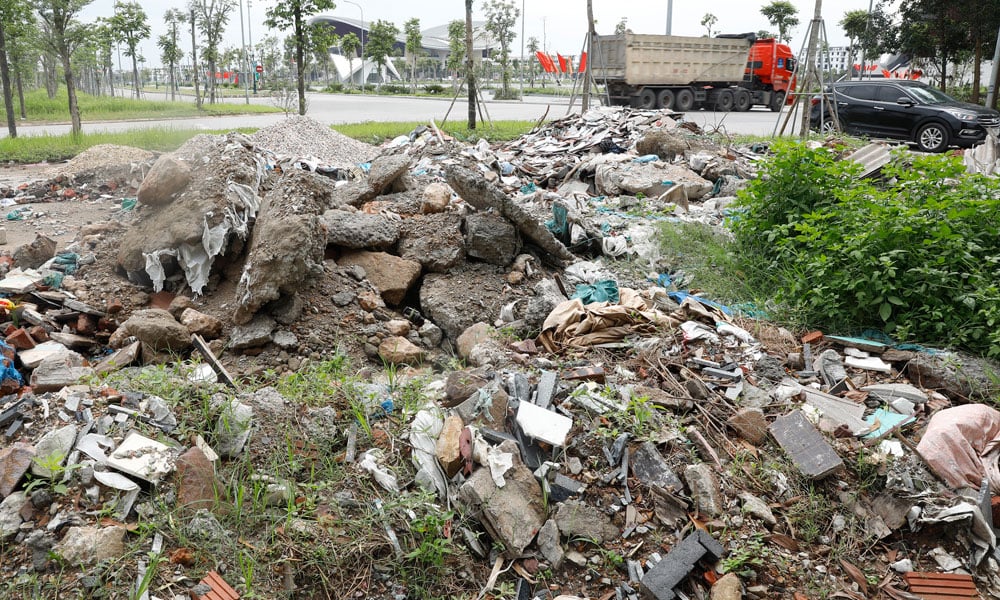 |
Construction waste has long been accumulating in front of the Provincial Cultural and Exhibition Center. |
Along with tightening management and penalizing illegal dumping of construction solid waste, the Department of Construction has reported to the Provincial People's Committee on reviewing the planning of construction solid waste treatment areas/dumping sites in the province. During the process of preparing and approving the urban sub-area plans south of the Duong River, the province has planned 5 locations for construction waste treatment (technical infrastructure land), with a total area of approximately 13.1 hectares.
At the same time, the area north of the Duong River is also planned to have a construction waste treatment area in Dao Vien commune, with a scale of about 15 hectares, which can support the Gia Binh International Airport project and related projects. In the area south of the Duong River, the province has also identified 3 waste disposal sites to serve the construction of the Ring Road 4 in Thuan Thanh and Gia Binh (formerly), with a total area of about 8.5 hectares.
In addition, the consulting unit for the route connecting Gia Binh Airport with Hanoi has worked with local authorities to identify 7 waste disposal sites, totaling approximately 38.6 hectares. The consulting unit for the high-speed railway project has also identified 2 sites in Trung Kenh commune with a total area of approximately 1 hectare and is continuing to work with local authorities along the route to add suitable sites.
To expedite the commissioning of planned waste disposal sites, a representative from the Department of Construction stated that the Department has proposed that the Provincial People's Committee direct the People's Committees of relevant communes and wards to closely coordinate with investors and project consultants to identify public land, uncultivated land, and unused clean land as waste disposal sites. For waste disposal site projects that conform to the planning, the province has assigned the Department of Finance and the People's Committees of the communes to propose a list of projects to attract investment, serving as the basis for selecting investors to implement the projects in accordance with the laws and regulations on investment and construction.
Source: https://baobacninhtv.vn/bac-ninh-cap-bach-thanh-lap-khu-thu-gom-xu-ly-chat-thai-ran-xay-dung-postid444902.bbg
















































































Comment (0)