

A place of thoroughness, a place of relaxation.
Following the directives of the Chairman of the Provincial People's Committee, many localities have focused their efforts on strictly handling violations, but some areas still lack decisiveness, allowing violations to persist and even become more complicated. A survey along the right bank of the Cau River, specifically the section passing through Tam Da commune, spanning over 5 km, shows that the area along the dike is densely populated, posing a high risk of encroachment on the dike's right-of-way.
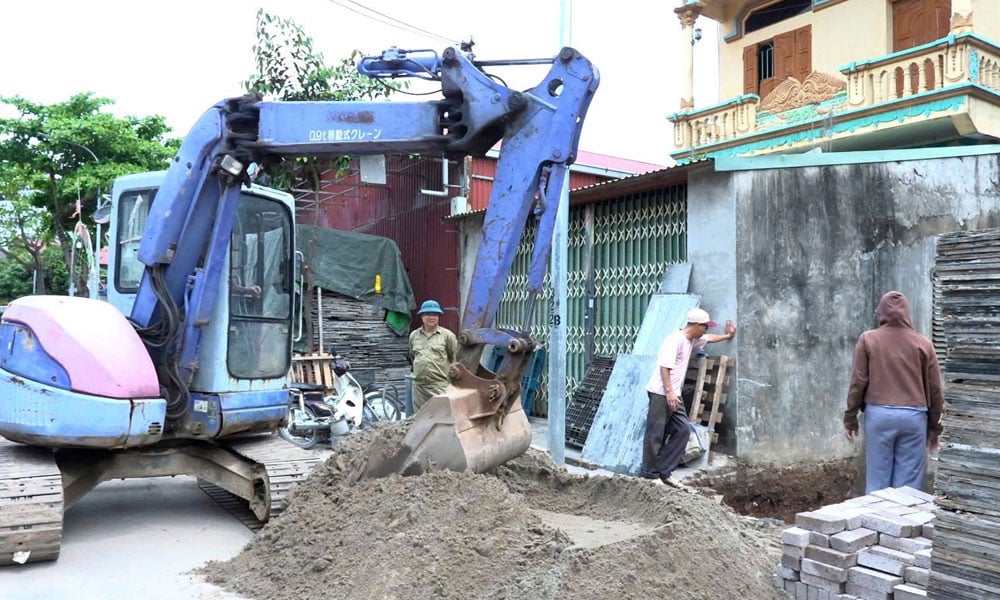 |
Tam Da commune mobilized manpower and resources to handle violations of dike regulations. |
According to Mr. Nguyen Huu Quan, Chairman of the People's Committee of Tam Da commune, the locality has identified the management and protection of dikes as a key task. The commune has established a task force to regularly patrol and inspect the condition of the dike system; violations are dealt with decisively wherever they are detected.
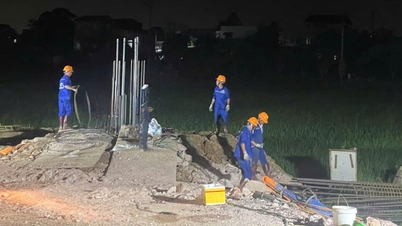
For example, on March 22nd, local authorities conducted a surprise inspection and discovered that Mr. Hoang Dac Chi, from Phan Dong village, was constructing a solid structure on the Cau River side, approximately 14 meters from the concrete edge of the dike. The large-scale structure, measuring about 12x16 meters, had its foundation completed and was in the process of erecting a steel frame in preparation for pouring the concrete floor. Immediately after the discovery, the commune mobilized forces to handle the situation and ordered the complete demolition of the illegal structure.
In addition to addressing existing violations, Tam Da commune has implemented many new management solutions. The local authorities have deployed unmanned aerial vehicles (drones) to patrol and record the entire dike system both during and outside of working hours, with the principle: "Detect from the air, handle immediately on the ground." As a result, since the beginning of the year, several violations have been detected early, prevented, and dealt with promptly.
| According to statistics from the Irrigation Department, in 2026, localities plan to handle 153 cases of dike violations. Notably, while old violations remain unresolved, new violations have emerged in some areas since the beginning of the year. Common violations include: filling in and encroaching on riverbanks and riverbeds; constructing houses, factories, wharves, and concrete mixing plants; and illegally stockpiling materials in flood drainage corridors… |
However, not all localities are taking such decisive action. On the afternoon of May 21st, along the right bank of the Cau River, in the section passing through Yen Trung commune, construction activities encroaching on the dike's right-of-way were still openly taking place.
Many construction projects, despite being discovered and documented by the No. 1 Dike Management District, with requests to stop construction and remove materials and equipment, are still brazenly continuing. At location K42+960, Mr. Nghiem Van Quang's household in Luong Cam village is building a solid house on the river side, 7 meters from the base of the dike. Several neighboring households are also mobilizing workers and machinery to continue construction, disregarding regulations.
According to statistics from Yen Trung commune, since the beginning of the year, there have been 7 cases of dike violations in the area. The cause stems from historical land management issues from the past, as the locality previously had instances of land buying, selling, and allocation that did not comply with regulations.
Notably, despite being informed and reminded, many households, knowing that construction violates the law, still deliberately proceed with the work, taking advantage of working outside of business hours, especially in the late afternoon and at night. According to local leaders, this is one of the reasons why handling violations of dike regulations in the area is difficult.
In reality, the bigger reason remains the reluctance and lack of decisive action from local authorities. When reporters were present at the scene, violations were occurring in broad daylight, but there were no local authorities present to stop them. If minor violations are not dealt with promptly and decisively, they will accumulate and develop into major violations. At that point, handling them will become more difficult and complicated.
Prevent early, deal thoroughly.
Bac Ninh has six major rivers with over 590 km of dikes, protecting industrial zones, urban areas, residential areas, and agricultural production. Protecting and preventing encroachment on the dike corridors will contribute to ensuring the safety of the dikes as well as facilitating rescue operations in emergency situations. Therefore, this is a matter of constant concern for the relevant authorities.
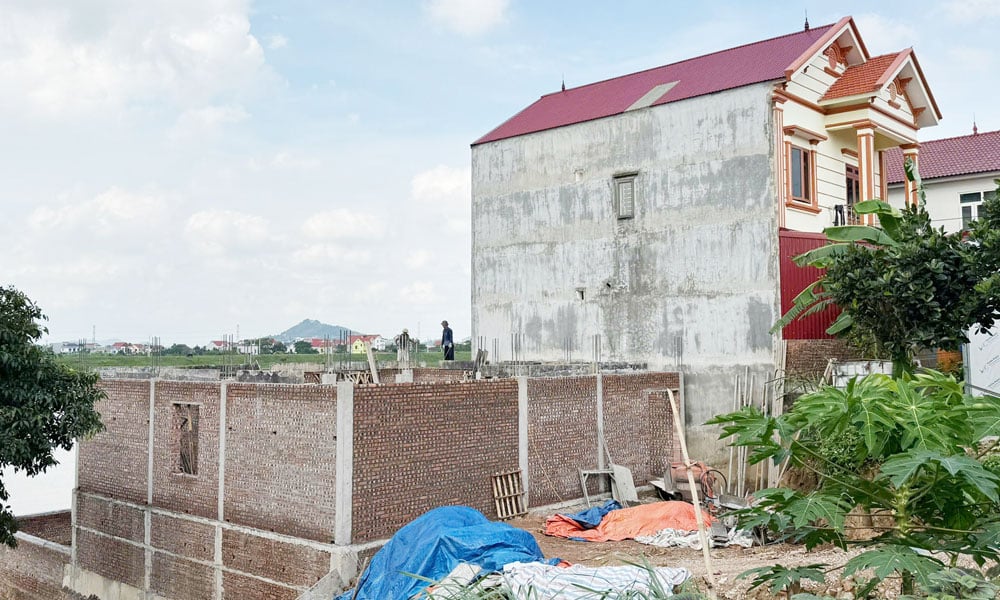 |
Mr. Pham Tien Dat's house (a low-rise house) in Luong Cam village, Yen Trung commune, is under construction and violates the Law on Dikes. |
Bac Ninh has experienced numerous historically unprecedented floods. The dike system has been under immense pressure, resulting in a series of incidents that are still being addressed. To ensure the safety of the dikes and enhance disaster prevention and control capabilities, this year the Provincial People's Committee has identified the handling of dike violations as an urgent task, requiring relevant departments and localities to focus on strict and decisive action, absolutely avoiding complacency or negligence.
Recently, on May 20th, the Chairman of the Provincial People's Committee issued a document requesting the Director of the Department of Agriculture and Environment to urgently direct and advise the province on the issuance of a plan to handle violations of dikes and irrigation works throughout the province; to be directly responsible to the Chairman of the Provincial People's Committee for the results of inspection and handling of violations throughout the province; and to compile the results of implementation and report to the Chairman of the Provincial People's Committee before May 30th, 2026.
For cases of deliberate violations, procrastination, or non-compliance with enforcement requests, the authorities will organize coercive measures as prescribed. The guiding principle is clearly defined as strictly handling violations. The head of the grassroots level will directly supervise and bear full responsibility if new violations occur without timely detection and handling, or if the handling is not thorough.
To ensure effective handling of violations, the most important thing is to enhance the responsibility of local authorities in managing their areas. Where the Party committee and government are decisive, the order of the dike system is maintained. Experience from some localities that have done well shows that, right from the land management stage, when dividing land plots, the government coordinates with the dike management unit to clearly define the boundaries of the dike protection corridor to prevent violations early and from afar.
Authorities at all levels should continue to intensify propaganda efforts to ensure that people understand and strictly comply with regulations. Handling violations should not be done merely as part of campaigns or peak periods; it cannot be a half-hearted effort or a failure to resolve issues completely. Instead, it requires the synchronized, decisive, and continuous involvement of the entire political system.
The province's policy is to relocate factories and concrete mixing plants that violate flood drainage corridors inside the dike; requiring communes and wards to classify and develop plans, clearly stating deadlines for resolving violations. The Department of Agriculture and Environment will regularly inspect and urge localities to expedite the handling of violations, and report periodically to the Chairman of the Provincial People's Committee as prescribed.
Source: https://baobacninhtv.vn/bac-ninh-quyet-liet-xu-ly-vi-pham-de-dieu-postid446551.bbg



![[Photo] The heat at the fireworks display site on the opening night of the Da Nang International Fireworks Festival 2026](https://vphoto.vietnam.vn/thumb/1200x675/vietnam/resource/IMAGE/2026/05/27/1779889741485_ndo_br_z7872039145157-fecaba5112f39e8352544099d7ef4738-5140-jpg.webp)
![[Photo] Life on both banks of the river returns to its bustling pace on the day the Long Bien Bridge opens to traffic.](https://vphoto.vietnam.vn/thumb/1200x675/vietnam/resource/IMAGE/2026/05/28/1779949763708_cau-long-bien-minh-duy-7-3610-jpg.webp)



























































































Comment (0)