


On February 3rd, Vo Quoc Hung, Deputy Director of the Department of Industry and Trade of Quang Ngai province, informed that consumer demand and purchasing power during the Lunar New Year (Tet) holiday in 2026 are projected to increase by approximately 5-10% compared to the same period last year and by about 10-20% compared to normal days. Go! Supermarket alone is expected to see a 20-50% increase. However, according to the assessment of relevant authorities, a shortage of essential food items for the Tet market is unlikely.
Mr. Vo Quoc Hung added that, according to statistics, as of now, 13 businesses are participating in market stabilization; including 6 supermarkets and 2 manufacturing businesses with a total value of over 134 billion VND in reserves, focusing on product groups such as: rice, livestock meat, poultry meat, eggs, vegetables and fruits, instant noodles, cooking oil, fish sauce, sugar, MSG, confectionery, and more than 15,000 other items; and 7 petroleum distribution businesses with a reserve of over 21,300 m3 of gasoline and over 22,700 m3 of diesel fuel.
Furthermore, in communes, wards, and special zones, manufacturing, trading, and distribution businesses have developed plans to stockpile various goods, including food, consumer technology products, electronics, and electrical appliances, with a wide variety of models and types, ensuring sufficient quantity and quality. Goods are priced and sold at the listed prices. In markets, traders have increased the quantity of goods and displayed them attractively to meet the shopping needs of the people.
Overall, the market for goods and services is relatively stable, abundant, diverse, and vibrant. The circulation of goods to rural areas, remote areas, and border regions is convenient and smooth. In particular, the development of modern forms of commerce and the increasing trend of online consumption through e-commerce platforms and social networks have made consumers willing to purchase goods both domestically and internationally.
According to Mr. Hung, the province has also intensified the implementation of the "Campaign for Vietnamese people to prioritize using Vietnamese goods". Three wards in the province (Cam Thanh, Chanh Lo, and Truong Quang Trong) organized the Binh Ngo Spring Flower Fair to serve the people during the Lunar New Year of Binh Ngo 2026.
In An Giang province, a plan is also being implemented to stockpile goods to stabilize the market and meet the shopping needs of the local population.
The An Giang Department of Industry and Trade announced that it has encouraged businesses to proactively stockpile 12 groups of essential goods, increasing their reserves by at least 15-20% compared to a normal month. It has also implemented a network of price-stabilized sales points with at least two points per locality, covering all 102 communes, wards, and special zones. Furthermore, 100% of supermarkets, shopping malls, and convenience stores in the area are participating in promotional and price-stabilized sales programs, preventing shortages and price spikes, and ensuring that all citizens have access to quality essential goods.
Currently, the province has 15 large enterprises registered to participate, with a total value of goods stockpiled exceeding 225 billion VND, focusing on essential food items such as: staple foods (rice, meat, eggs, vegetables, processed foods, alcoholic beverages, etc.) and gasoline, liquefied petroleum gas. In addition to fixed price-stabilized sales points at supermarkets, shopping malls, and convenience stores, the province, together with enterprises, organizes 8 market sessions/sales trips to rural areas and 2 price-stabilized sales trips to island communes and special economic zones; encouraging enterprises to sell price-stabilized goods online through websites and social media to reach modern consumers.
Mr. Nguyen Thong Nhat, Director of the An Giang Department of Industry and Trade, emphasized that the markets and shipments to rural areas and island communes, as well as special economic zones, help people in these disadvantaged areas access quality goods at reasonable prices, preventing shortages or abnormal price increases; at the same time, creating conditions for businesses to promote products, expand markets, and connect directly with consumers. People in disadvantaged areas can buy essential goods at good, preferential prices.
According to the An Giang Department of Industry and Trade, currently, every commune, ward, and special zone in the province has convenience stores and supermarkets, especially in Rach Gia, Long Xuyen, Ha Tien, Phu Quoc, Chau Doc, Tan Chau, etc., with a considerable number supplying goods to the people. During Tet (Lunar New Year), businesses, depending on the actual supply and demand situation in the market, proactively adjust the supply of goods within their systems to ensure that the shopping needs of the people are well met.
In addition, provincial authorities closely monitor market developments and the supply and demand of goods, especially essential items, to proactively implement timely response plans and stabilize the market when necessary, serving the shopping needs of the people. Authorities coordinate with relevant units to strengthen inspections and controls to detect and prevent speculation and hoarding, and resolutely handle violations; at the same time, they strengthen inspections of violations related to pricing, product quality, smuggled goods, counterfeit goods, and food safety. The Provincial Department of Industry and Trade and Market Management publicly announce a 24/7 hotline to receive public feedback on market violations.
In addition, the province requested that communes, wards, and special zones coordinate with relevant agencies and units to implement market stabilization activities in their areas, creating favorable conditions for businesses to organize price-stabilized sales points and mobile sales points, ensuring smooth circulation of goods, and meeting the consumption needs of the people during the upcoming Lunar New Year.
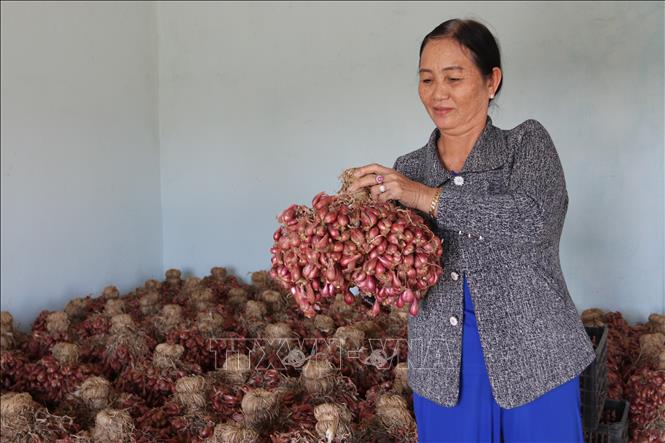
Meanwhile, these days, the atmosphere in the shallot fields in southern Khanh Hoa province is one of bustling activity. Farmers and cooperatives are focusing on harvesting shallot bulbs and shallot flowers (onion stalks) to supply the market, hoping for a successful harvest after overcoming unfavorable weather conditions.
According to observations by VNA reporters, in the concentrated purple onion growing areas of Vinh Hai and Ninh Hai communes, people are mobilizing maximum manpower to harvest onions from early morning to late afternoon. After harvesting, the onions are sorted and dried right in the fields; the onion bulbs are bundled into bunches and transported to markets and supermarket chains inside and outside the province. Currently, the price of purple onion seeds ranges from about 40,000 VND/kg; selected purple onions packed in mesh bags cost from 40,000 - 45,000 VND/kg; and onions sold in bulk at the field reach over 30,000 VND/kg depending on the quality of the bulbs.
The southern area of Khanh Hoa province currently has about 1,000 hectares planted with onions, garlic, and other spices. However, the prolonged heavy rains at the end of November 2025 affected the growth of onions, causing some areas to be late for planting. Thanks to proactive drainage, enhanced care, and the application of production experience, many onion fields quickly recovered, ensuring yield and quality to meet the market demand for Tet (Lunar New Year).
Mr. Tran Van Nhan (Vinh Hai commune) said that his family's 2 sao (approximately 2,000 m2) of onions yielded over 4 tons of bulbs, which were purchased by traders right in the field at an average price of 35,000 VND/kg, bringing in revenue of over 140 million VND. His family still has about 1 sao of onions with wilted leaves, which they expect to harvest at the end of this week. With stable prices, this onion crop has brought a significant income, helping his family cover expenses during the upcoming Lunar New Year (Year of the Horse).
According to Ms. Nguyen Thi Hanh, Director of Thanh Hai Agricultural Service Cooperative (Vinh Hai commune), the investment cost for one sao (approximately 1000 square meters) of onions, including seeds, materials, and fertilizers, ranges from 30 to 35 million VND. With current selling prices, onion growers can earn a considerable profit. The cooperative currently has nearly 20 members cultivating 6 hectares of purple onions and garlic, and also collaborates with local households to purchase their products. Each year, they supply over 100 tons of onions and garlic to the market; among them, the cooperative's purple onions meet OCOP 3-star standards, and the garlic meets OCOP 4-star standards, being sold in markets and supermarkets both within and outside the province.
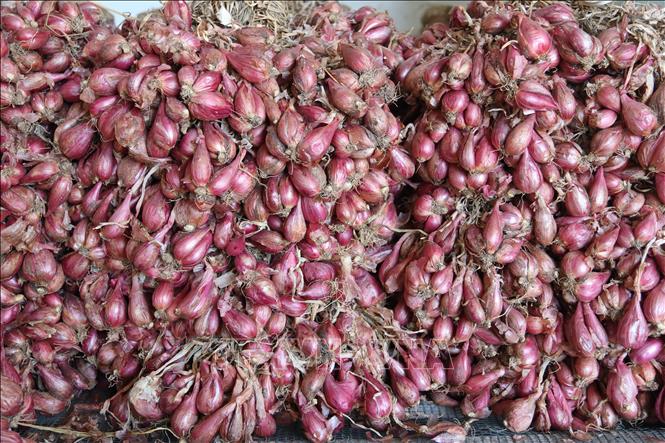
Shallots are a staple crop in many southern localities of Khanh Hoa province, with five harvests per year. The southern harvest (from May to July in the lunar calendar) primarily uses local varieties that are resistant to heat and rain; while the northern harvest (from September to December in the lunar calendar) usually uses Indonesian shallot varieties. During Tet (Lunar New Year), the demand for shallots and other spices increases sharply; shallots grown in sandy coastal areas with plenty of sunshine and wind produce large, firm bulbs with beautiful color and a strong aroma, making them highly sought after in the market.
Besides onion bulbs, farmers also harvest onion flowers (onion stalks) to increase their income. After about 50 days of planting, the onions begin to sprout stalks and flower. This is the time when farmers harvest the stalks to sell on the market and to help the plant concentrate nutrients on the bulbs. On average, each plot of land planted with onions yields about 1 ton of stalks per month, with a selling price of 5,000 - 8,000 VND/kg, depending on the time of year.
To improve production efficiency, the agricultural sector of Khanh Hoa province continues to provide technical guidance and support to farmers in the care, harvesting, and consumption of their products. They also advise onion growers to closely monitor weather conditions and harvest at the right time to ensure quality. The harvest season for purple onions and onion flowers not only meets the increased consumer demand during the Lunar New Year but also provides a significant source of income, allowing farmers to confidently celebrate the holiday and look forward to a prosperous new year.
Source: https://baotintuc.vn/kinh-te/bao-dam-nguon-hang-doi-dao-phuc-vu-thi-truong-tet-20260203171402998.htm

![[Image] Pleasant weather helps students enter the 10th grade entrance exam with confidence.](https://vphoto.vietnam.vn/thumb/1200x675/vietnam/resource/IMAGE/2026/05/29/1780034401612_ngay-1-thi-lop-10-minh-duy-8-5009-jpg.webp)
![[Photo] Ba Lang An Lighthouse - the "eye of the sea" amidst the "rock museum" of Quang Ngai province.](https://vphoto.vietnam.vn/thumb/1200x675/vietnam/resource/IMAGE/2026/05/29/1780038698840_anh-man-hinh-2026-05-29-luc-14-10-42.png)



















































































Comment (0)